Neck pain can be frustrating. Sometimes it comes from sitting at a computer all day, looking down at your phone, sleeping in an awkward position, working out, or simply carrying a lot of tension in your neck and shoulders.
If you’re looking for a CBD cream for neck pain, a topical gives you a way to apply a product directly to the area you’re concerned about. But with so many different CBD creams available, figuring out which strength and formula makes the most sense can get confusing.
At Quiet Monk CBD, we make several different high-potency topicals. Rather than telling you that one product is automatically the “best” for everyone, I’d rather explain the differences and let you decide which one fits what you’re looking for.
Can CBD Cream Help With Neck Pain?
This is where I think it’s important to separate what people experience from what the research has actually proven.
There is research looking at topical CBD and pain, including a small randomized, placebo-controlled study involving people with peripheral neuropathy. That study found reductions in several neuropathy-related symptoms with topical CBD, which is interesting, but peripheral neuropathy isn’t the same thing as everyday neck pain.
There is also a much larger body of research looking at cannabinoids and pain more generally. A 2025 systematic review from the Agency for Healthcare Research and Quality found that evidence for topical CBD specifically was still insufficient to draw firm conclusions.
So I’m not going to tell you that CBD cream is a proven treatment or cure for neck pain.
What I can tell you is that topical CBD is something many people choose to use as part of their personal routine for localized discomfort, and research into topical cannabinoids is continuing.
What Causes Neck Pain?
There are quite a few reasons someone might experience neck discomfort.
Common causes can include:
- Sitting at a desk for long periods
- Looking down at a phone
- Poor posture
- Muscle strain
- Exercise or physical activity
- Sleeping in an awkward position
- Stress and muscle tension
- Previous injuries
Sometimes it’s pretty obvious what caused it. Other times, neck pain seems to show up without much warning.
And sometimes the problem isn’t something a topical product is going to address. If your neck pain is severe, persistent, follows an injury, or is accompanied by weakness, numbness or other concerning symptoms, it’s worth getting it evaluated rather than simply trying to manage the discomfort yourself.
Why Do People Use CBD Cream on Their Neck?
The biggest advantage of a topical is simple: you can apply it directly to the area you want to use it.
You’re not swallowing a capsule or taking an oil by mouth. You apply the cream to the skin and massage it into the area.
That doesn’t mean all of the CBD necessarily stays exactly where you put it, and it doesn’t mean topical CBD works the same way as oral CBD. Skin penetration and absorption can vary considerably depending on the formulation and the ingredients.
If you want to understand more about that, we’ve put together a detailed guide explaining how CBD is absorbed through the skin.
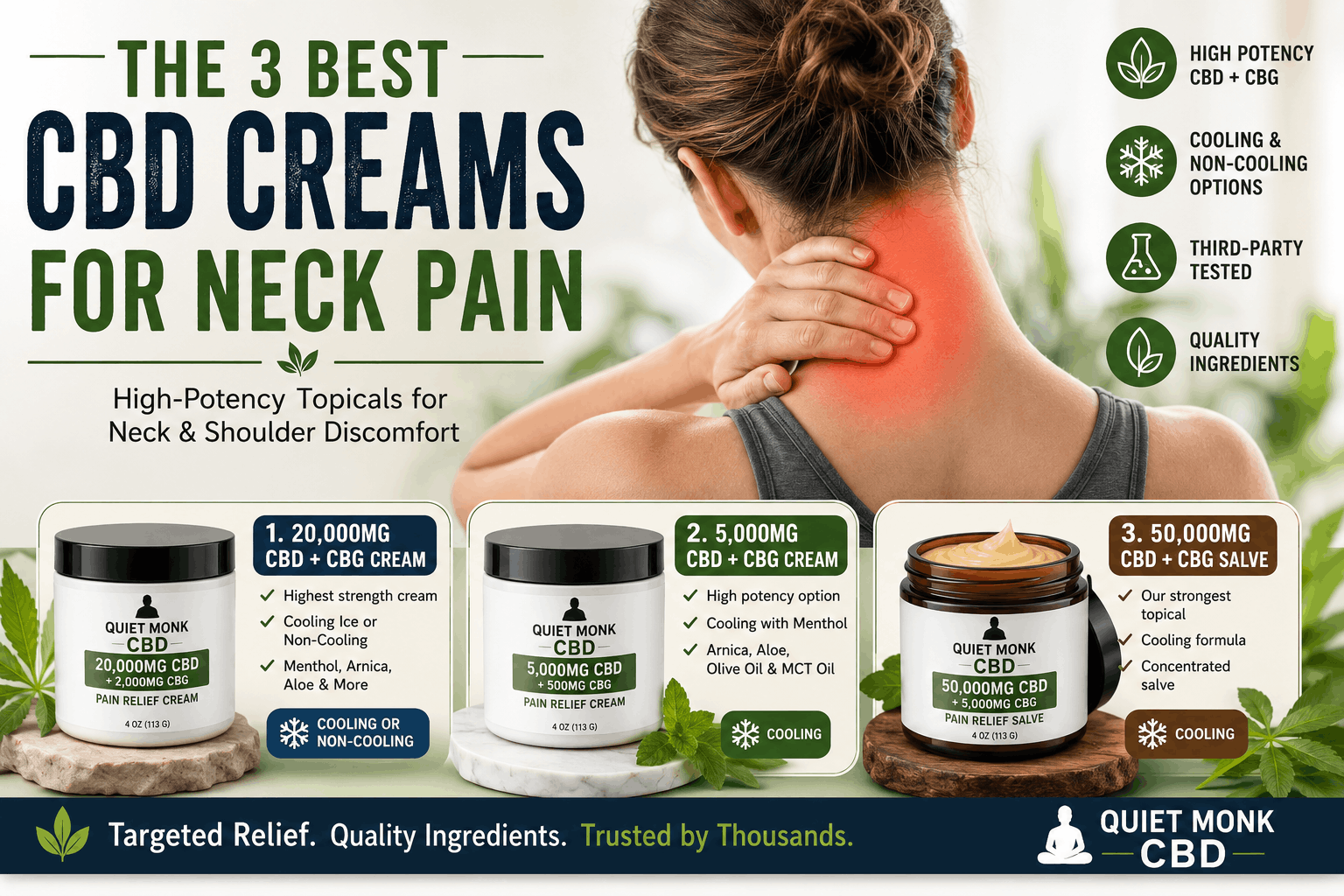
Our 3 Most Popular CBD Topicals for Neck Pain
I don’t think there’s one CBD cream that everybody should use.
Different people want different strengths, textures and sensations. These are three of our high-potency topical options, and I’ll explain where each one fits.
1. 20,000mg CBD + CBG Cream
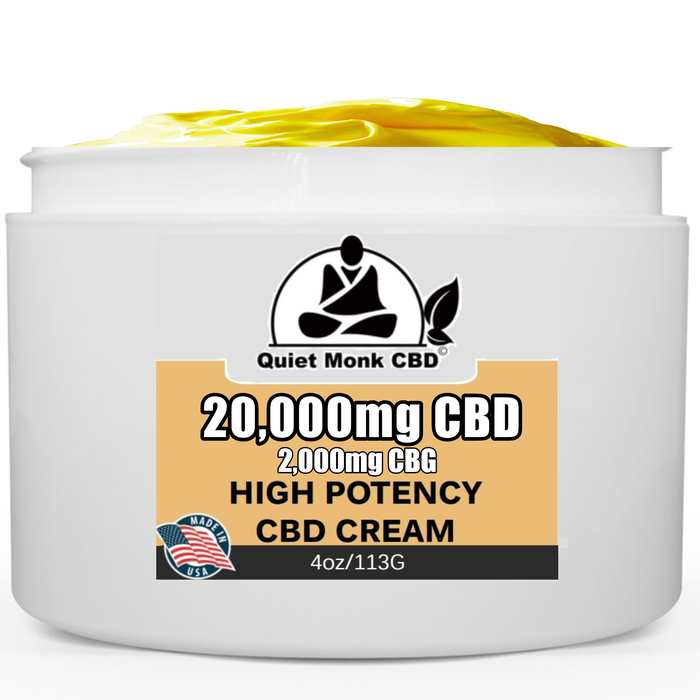
If you’re specifically looking for a very high-potency CBD cream, our 20,000mg CBD + 2,000mg CBG cream is our highest-strength cream.
It’s a 4-ounce formula and is available in both a natural version and a cooling version. The natural version doesn’t contain added menthol, while the Cooling Ice option provides a noticeable cooling sensation.
The cream also contains ingredients including arnica, aloe, olive oil and MCT oil.
If you’re interested in a high-potency cream and want to compare the two versions, see the 20,000mg CBD + CBG cream.
One thing I’d point out, though: I don’t think everyone needs a 20,000mg cream. If you’re new to CBD topicals or only want something for occasional use, there are less expensive options.
2. 5,000mg CBD + 500mg CBG Cream
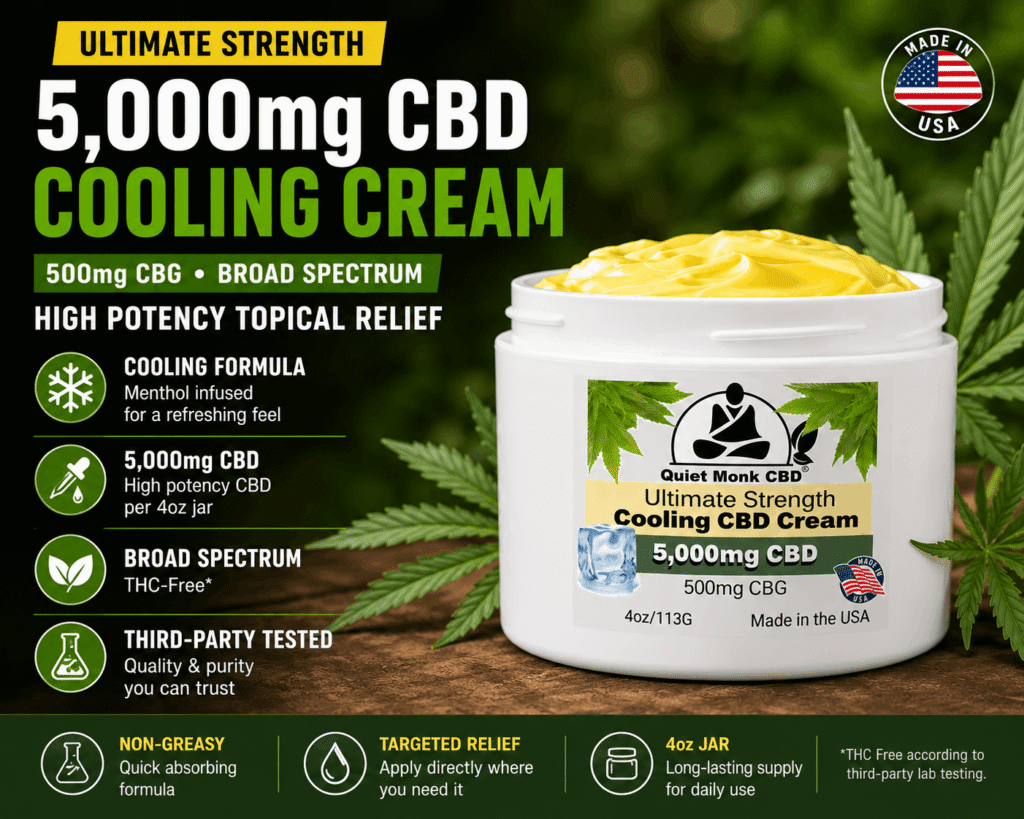
Our 5,000mg CBD cream is a good option for someone who wants a high-potency topical without moving all the way up to our 20,000mg formula.
Each 4-ounce jar contains 5,000mg of CBD and 500mg of CBG. This formula also contains menthol for a cooling sensation, along with ingredients such as arnica, aloe vera, olive oil and MCT oil.
One thing I always recommend when comparing CBD creams is to look at the amount of CBD and the size of the container together.
A big number on the front of a jar doesn’t tell you everything.
You can take a look at our 5,000mg CBD + CBG cream.
3. 50,000mg CBD + 5,000mg CBG Salve
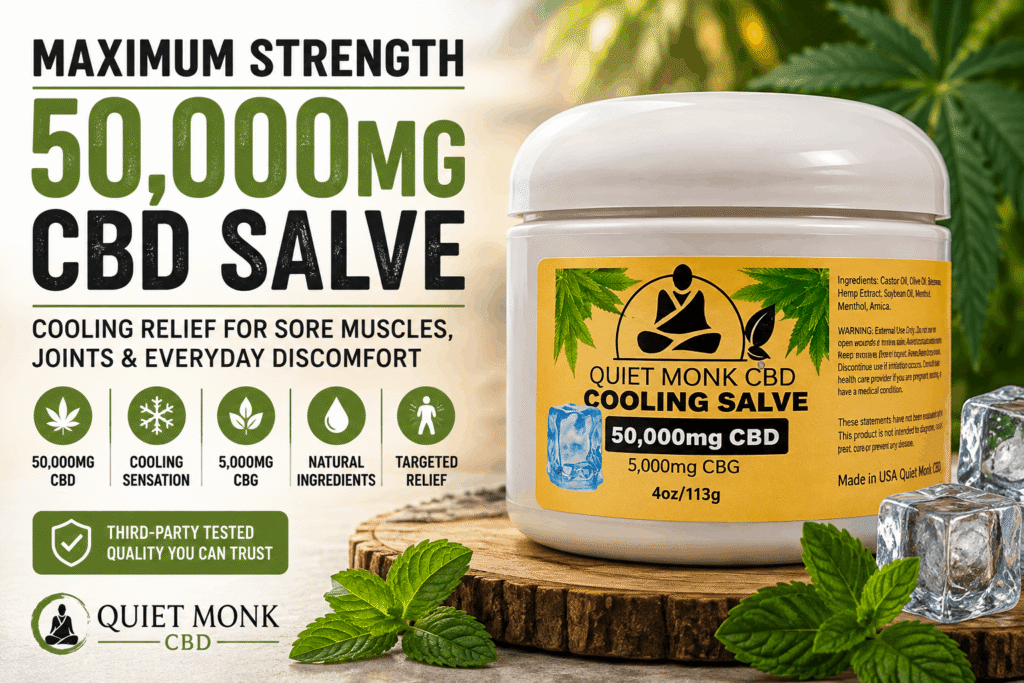
This one is a little different because it’s a salve rather than a cream.
Our 50,000mg CBD + 5,000mg CBG salve is our most concentrated topical. Because of that concentration, it’s intended for targeted, sparing application rather than slathering it over a large area.
It’s also a cooling formula, so you’ll get the noticeable cooling sensation from the menthol.
If you prefer a thicker salve and want our highest-potency topical, see the 50,000mg CBD + 5,000mg CBG salve.
Which CBD Cream Is Best for Neck Pain?
Honestly, I don’t think there’s a single winner.
I’d choose based on what you’re actually looking for.
Want our strongest cream? Take a look at the 20,000mg CBD + 2,000mg CBG cream.
Want a high-potency cream without going that high? The 5,000mg CBD + 500mg CBG cream is a good place to start.
Want our most concentrated topical and prefer a salve? That’s where the 50,000mg CBD + 5,000mg CBG salve comes in.
And if you don’t like menthol, pay attention to the formula you’re buying. The cooling sensation is coming from ingredients such as menthol, not from the CBD itself.
Cooling vs. Non-Cooling CBD Cream
This is something people sometimes overlook when shopping for a topical.
A cooling CBD cream contains ingredients such as menthol that create a cooling sensation on the skin. That sensation can be very noticeable, which some people like and others don’t.
The amount of cooling and the amount of CBD are two completely different things.
A product can contain a lot of menthol and a relatively modest amount of CBD, or a lot of CBD and little or no menthol. Don’t judge CBD potency by how strongly a cream feels on your skin.
If you don’t like the smell or sensation of menthol, look for a non-cooling formula instead.
How Do You Apply CBD Cream to Your Neck?
I’d keep it simple.
Apply a small amount to clean, dry skin around the area where you’re using the topical and gently massage it in. You don’t need to aggressively rub the cream into your skin.
Follow the directions provided with the specific product you’re using, since different formulations can have different recommendations.
If you’re trying a topical for the first time, especially if you have sensitive skin, you may want to test a small amount on another area of skin first.
And remember that the neck can be a sensitive area, so avoid contact with your eyes and other sensitive areas.
How Often Should You Use CBD Cream on Your Neck?
There’s no universally established topical CBD dosage or schedule that applies to everyone.
That’s one reason I don’t like giving people a rigid number such as “you must apply it exactly three times a day.”
Start with the directions for the product you’re using and adjust your routine based on your own preferences and experience.
If you’re using a topical as part of a broader routine for muscle discomfort, you can also read our guide on how often to use CBD muscle balm.
Does a Stronger CBD Cream Work Better?
Not necessarily.
This is probably one of the biggest misconceptions about CBD topicals.
A 20,000mg cream contains more CBD than a 5,000mg cream. That’s a fact. But it doesn’t mean someone will automatically have a better experience with the 20,000mg product.
There are a lot of variables involved, including the formulation, the amount you apply, the area you’re using it on and individual differences.
I look at potency as a product specification, not a promise about what the product will do.
If you’re trying to understand the differences between CBD strengths, our CBD cream strength comparison breaks down the numbers in more detail.
What Should You Look for in a CBD Cream for Neck Pain?
I wouldn’t just look for the biggest number on the label.
Here are some of the things I’d look at.
CBD concentration
Check the total CBD and the size of the container.
For example, 5,000mg of CBD in a 4-ounce container is a different concentration than 5,000mg in a much larger container.
Other cannabinoids
Some products contain cannabinoids such as CBG in addition to CBD.
If they do, look for the amounts to be clearly listed rather than simply combining everything into one giant number.
Ingredients
CBD is only one part of a topical formula.
Look at the entire ingredient list and decide whether the formulation is something you’re comfortable using.
Cooling ingredients
If you like menthol, a cooling cream may be a good fit.
If you don’t like the cooling sensation or smell, choose a non-cooling option.
Third-party testing
I’d also look for independent laboratory testing.
A good COA can give you a better idea of what’s actually in the product than the marketing on the front of the jar.
CBD Cream vs. CBD Oil for Neck Pain
If you’re specifically interested in applying CBD to your neck, a topical cream is obviously different from taking CBD oil.
CBD oil is generally taken orally or sublingually, depending on the product.
A CBD cream is applied to the skin.
Those different delivery methods matter. Research involving oral CBD doesn’t automatically tell us what will happen when CBD is put into a cream and applied to the skin.
That’s one reason I prefer looking at research specifically involving topical CBD when we’re talking about CBD creams.
What Does the Research Say About Topical CBD?
This is worth discussing because there are some interesting studies, but the evidence isn’t nearly as settled as some CBD websites make it sound.
A 2019 randomized, placebo-controlled study included 29 people with symptomatic peripheral neuropathy. The researchers reported statistically significant reductions in several neuropathy-related symptoms in the topical CBD group compared with placebo.
That’s encouraging, but it was a small study and it was looking at peripheral neuropathy—not neck pain.
The larger 2025 AHRQ living systematic review looked across the available evidence on cannabinoids for chronic pain. Its conclusion was that evidence for topical CBD remained insufficient to draw firm conclusions.
That’s how I’d summarize the situation today:
There is enough research to make topical CBD interesting, but not enough to call it a proven treatment for neck pain.
I think that’s a much more honest way to look at it.
What About Neck and Shoulder Tension?
Neck and shoulder discomfort often go together.
If you spend hours at a computer, drive for long periods, look down at your phone or do physical work, you may notice that your neck and shoulders become tight.
A topical can be one part of a personal routine, but I’d also look at the things that may be contributing to the problem.
That could include:
- Taking regular breaks from your computer
- Adjusting your workstation
- Paying attention to posture
- Stretching
- Strengthening exercises
- Getting enough sleep
- Managing stress
- Using heat or cold when appropriate
Sometimes the best thing you can do is figure out why your neck keeps bothering you in the first place.
When Should You See a Doctor About Neck Pain?
CBD cream shouldn’t be used as a substitute for medical evaluation when something more serious may be going on.
I’d get medical advice if your neck pain is severe, persistent, started after a significant injury, or comes with symptoms such as weakness, numbness, problems with balance or a severe headache.
The same goes for pain that keeps getting worse or doesn’t seem to have an obvious explanation.
A topical may be something you choose to use for everyday discomfort, but it shouldn’t stop you from finding out what’s causing persistent neck problems.
Frequently Asked Questions
What is the best CBD cream for neck pain?
There isn’t one CBD cream that’s best for everyone. I’d compare the CBD concentration, ingredients, container size and whether you want a cooling or non-cooling formula.
Can I use CBD cream on my neck?
CBD creams are topical products designed to be applied to the skin. Follow the directions for the individual product and avoid contact with your eyes or irritated or damaged skin.
Is a 20,000mg CBD cream better than a 5,000mg cream?
Not automatically. The 20,000mg cream contains more CBD, but a higher concentration doesn’t guarantee that everyone will have a better experience.
Should I choose cooling or non-cooling CBD cream?
That’s mostly a matter of personal preference. Cooling formulas contain ingredients such as menthol that create a cooling sensation, while non-cooling formulas don’t provide that same sensation.
Does menthol make CBD stronger?
No. Menthol creates a cooling sensation. It doesn’t increase the amount of CBD in the product.
Can CBD cream get into the bloodstream?
Some topical CBD formulations have produced measurable CBD in blood samples, but the amount that gets through the skin can vary considerably depending on the formulation and how it’s used. If you want to learn more, read our CBD skin absorption guide.
Does more CBD mean better results?
Not necessarily. More CBD means a higher amount or concentration of CBD, but individual responses can vary and research hasn’t established that the highest-potency topical is automatically the best choice for everyone.
How often should I use CBD cream for neck pain?
Follow the directions for the specific product you’re using. There isn’t one universally established application schedule for topical CBD.
Can CBD cream cure neck pain?
No. CBD cream shouldn’t be described as a cure for neck pain. Neck pain can have many different causes, and persistent or severe symptoms should be evaluated by an appropriate healthcare professional.
Can I use CBD cream with other treatments?
A topical may be part of a broader personal routine, but if you’re being treated for a medical condition or taking medications, talk with your healthcare professional about whether CBD is appropriate for you.
Final Thoughts
If you’re looking for a CBD cream for neck pain, I wouldn’t get too caught up in finding the product with the biggest number on the label.
Think about what you actually want.
Maybe you want a 5,000mg cream. Maybe you specifically want a 20,000mg cream. Maybe you want a cooling formula because you like the sensation, or maybe you don’t want menthol at all.
Those are all reasonable preferences.
At Quiet Monk, we make different strengths because our customers don’t all want the same thing. And while the research into topical CBD is still developing, I think it’s important to be honest about that rather than making promises that the research can’t support.
If you’d like to compare the products we currently offer, you can browse our CBD pain cream collection.
Research & Sources
If you want to look at the research yourself, these are some of the sources discussed in this article.
Topical CBD and peripheral neuropathy — randomized, placebo-controlled study
29 participants were included in this study of topical CBD for symptomatic peripheral neuropathy.
Read the study on PubMed
2025 AHRQ Living Systematic Review on Cannabis and Chronic Pain
This large evidence review looked at the available research on cannabinoids and chronic pain and concluded that evidence for topical CBD remains insufficient to draw firm conclusions.
Read the AHRQ systematic review
AHRQ evidence table for topical CBD
This provides the specific evidence grading for topical CBD included in the review.
View the evidence table
About Steve Gregoire

I’m Steve, founder of Quiet Monk CBD. I started Quiet Monk because I wanted to make CBD products that were straightforward and didn’t rely on the hype and exaggerated claims you see in this industry.
Over the years, I’ve spent a lot of time researching CBD, talking directly with customers and working with the products we make. I try to approach CBD from a practical standpoint and give people enough information to make their own decision rather than telling them that one product is right for everyone.
We focus on high-potency CBD products, quality ingredients and third-party testing, and I continue to research and test our formulas as we develop them.
— Steve Gregoire, Founder of Quiet Monk CBD
This article is for general educational purposes only and is not intended to provide medical advice. CBD products are not intended to diagnose, treat, cure or prevent any disease. Individual experiences vary. If you have persistent or severe neck pain, or if you take medications or have a medical condition, consult an appropriate healthcare professional.