If you’ve landed here, you’ve probably already tried a shelf’s worth of moisturizers and you’re wondering whether CBD is worth adding to the list. This page is our attempt at a straight answer — including the parts that aren’t especially flattering to us as a company that sells CBD topicals.
(A note on wording: people search for this as CBD, as hemp cream, and as cannabis topicals. They’re broadly the same thing here — a topical made from hemp extract. We’ll use CBD and hemp interchangeably below.)
Short version: the research on CBD for eczema is early and thin. There are promising laboratory findings and a handful of small human studies, but nothing that would let anyone honestly call CBD a treatment for eczema. What we can say is that a well-made CBD moisturiser is, at minimum, a moisturiser — and consistent moisturising is one of the genuinely evidence-backed things you can do for an impaired skin barrier.
Important: CBD products are not approved by the FDA to diagnose, treat, cure, or prevent any disease, including eczema. Nothing here is medical advice. If your eczema is severe, infected, or getting worse, see a doctor or dermatologist.
What eczema actually is
Eczema — most commonly atopic dermatitis — is a long-term inflammatory skin condition. The skin’s outer barrier doesn’t hold moisture the way it should, so water escapes (dermatologists measure this as transepidermal water loss) and irritants get in more easily. The result is the familiar cycle: dry, itchy, red or discoloured patches, scratching, more damage, more itching.
It affects roughly 31 million people in the United States, according to the National Eczema Association. It’s not contagious. It tends to run in families, and it’s usually driven by a mix of genetics, immune response, and environmental triggers — cold dry air, harsh detergents, fragrance, stress, certain fabrics.
There’s no cure. Management is the realistic goal: protect the barrier, reduce inflammation, avoid your triggers.
Common types:
- Atopic dermatitis — the most common form, often starting in childhood
- Contact dermatitis — a reaction to a specific irritant or allergen
- Dyshidrotic eczema — small blisters, usually on hands and feet
- Nummular eczema — coin-shaped patches
How CBD works on skin — the honest version
Your skin has cannabinoid receptors. That’s not marketing; it’s well-established. They’re part of the endocannabinoid system, which helps regulate inflammation, oil production, and how skin cells grow and shed. In laboratory and animal research, cannabinoids interacting with this system have shown anti-inflammatory and anti-itch effects.
That’s the mechanism people point to, and it’s a reasonable basis for interest. Here’s the caveat that most CBD sites skip: a plausible mechanism is not a proven result. The step from “CBD affects inflammatory pathways in a petri dish” to “topical cannabidiol will clear your eczema” has not been made by the evidence.
What exists in humans so far is small: pilot studies, case series, and a couple of small randomised trials — including work on a cannabidiol combination treatment that reported improvement in atopic dermatitis severity scores. A 2025 review in the Journal of Cannabis Research assessing cannabinoids for atopic dermatitis reached the conclusion you’d expect from the field: promising, mechanistically sensible, and badly in need of larger controlled trials.
So: interesting, not settled.
CBD vs hydrocortisone for eczema
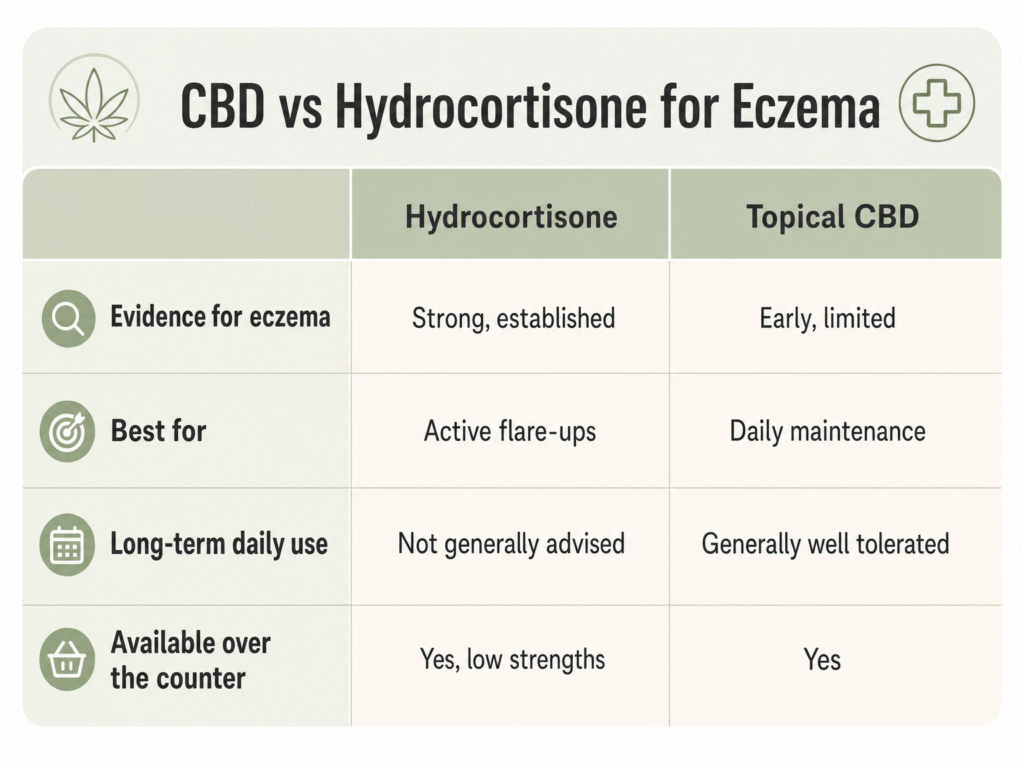
This is the comparison people actually want, so here it is plainly.
Hydrocortisone is a topical corticosteroid. It is a proven anti-inflammatory, available over the counter at low strengths, and it works — it’s a first-line eczema treatment for good reason. Its limitation is long-term use: prolonged application of topical steroids, especially on the face or on thin skin, is associated with skin thinning, which is why the usual guidance is short courses rather than indefinite daily use.
Topical CBD has no comparable evidence base for reducing inflammation. What it does have is a much gentler profile for daily use, and a well-formulated one carries moisturising ingredients that support the barrier.
They aren’t really competitors, which is why our Hydro Extra Strength formula contains both — hydrocortisone for the flare, CBD and moisturizing botanicals in the same base. Our Manuka honey hemp cream is the steroid-free option for people who’d rather not use hydrocortisone daily, or who are already using a prescription steroid and want something separate for maintenance.
If you’re currently using a prescribed steroid, don’t drop it in favour of CBD on your own — talk to whoever prescribed it.
| Hydrocortisone | Topical CBD | |
|---|---|---|
| Evidence for eczema | Strong, established | Early, limited |
| Best for | Active flare-ups | Daily maintenance, barrier support |
| Long-term daily use | Not generally advised | Generally well tolerated |
| Available OTC | Yes, at low strengths | Yes |
How to apply topical CBD for eczema
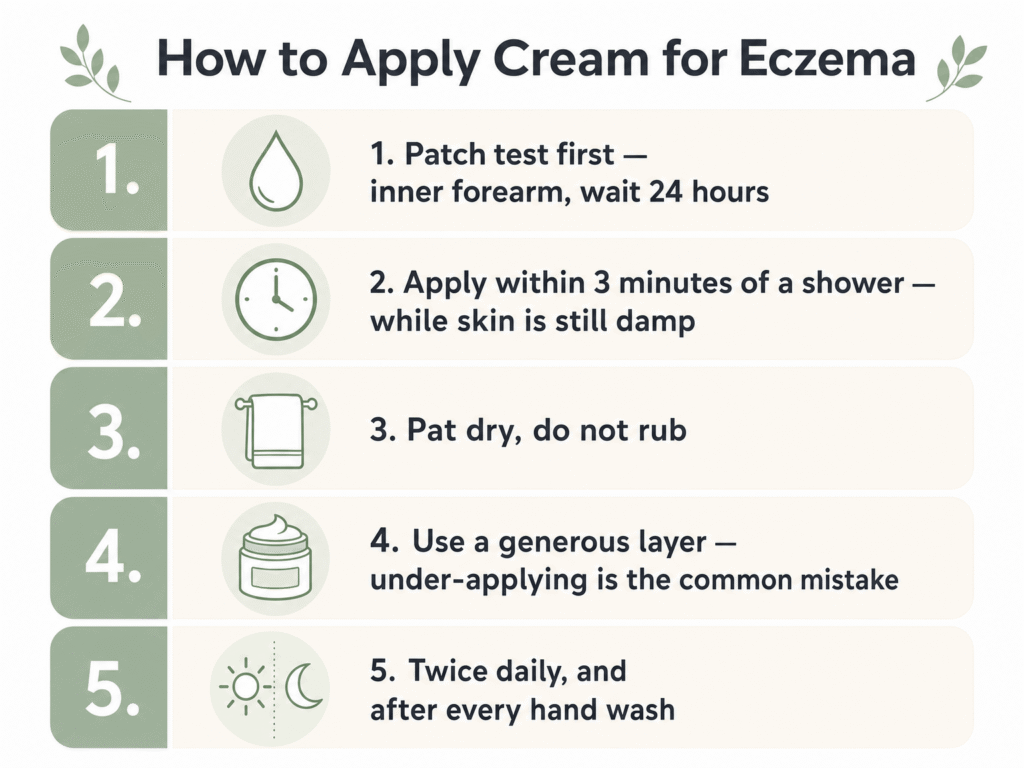
The application detail that matters most has nothing to do with CBD: apply to damp skin. Within three minutes of a bath or shower, while skin still holds water, is when a moisturiser does the most good.
- Patch test first. Inner forearm, small amount, wait 24 hours. Eczema-prone skin reacts to things — including botanicals and essential oils.
- Start with clean, damp skin. Pat dry, don’t rub.
- Use a generous amount. Under-applying is the most common mistake. You want a visible layer, not a rubbed-in trace.
- Twice daily, morning and night, is the usual rhythm — plus after any hand washing if hands are the problem area.
- Be consistent. Barrier repair is cumulative. Sporadic use gets sporadic results.
If a product stings, burns, or worsens the patch, stop using it. That’s not “it’s working.”
How long does topical CBD take to work on eczema?
Two different timescales, and conflating them is where disappointment comes from.
Immediate (minutes): the moisturising effect. Skin feels less tight and less itchy almost straight away. That’s the emollient base doing its job — any decent moisturiser does this.
Gradual (2–6 weeks): if you’re going to see a change in the skin itself — fewer rough patches, better tolerance, less frequent flares — that comes from consistent daily use over weeks, not days.
Anyone promising overnight clearance is selling you something. Give it a month of genuine daily use before deciding whether it’s earning its place in your routine.
Eczema on hands and face — what changes
Hands are the hardest case, and the most-asked about, because you keep washing them and every wash strips the barrier again. The practical answer is frequency: reapply after every hand wash, keep a jar where you actually wash your hands, and wear gloves for washing up and cold weather. Dyshidrotic eczema on the fingers is common and worth getting properly diagnosed.
Face requires more caution. Facial skin is thinner and absorbs more. This is exactly where long-term topical steroid use becomes a concern, and it’s a reasonable place to prefer a steroid-free option. Patch test on the jawline first, use less than you think, and keep it away from the eyes.
Manuka honey for eczema — and why we pair it with hemp
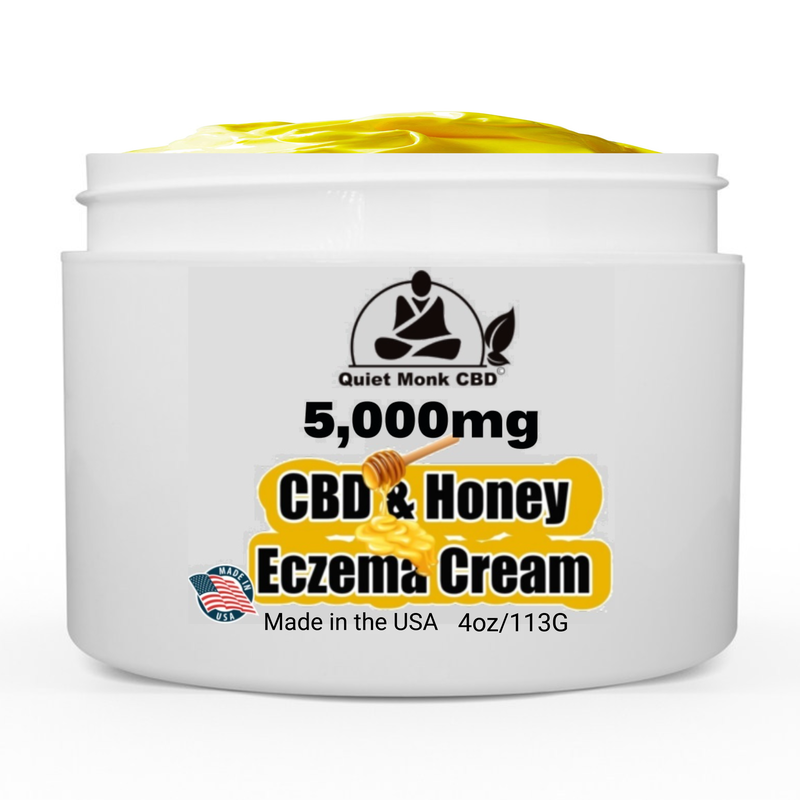
Manuka honey has a longer track record in wound and skin care than CBD does. It’s a humectant (it draws moisture into skin), and it has documented antibacterial properties. That second part matters for eczema specifically: broken, scratched skin is vulnerable to infection, and Staphylococcus aureus colonisation is a well-known complicating factor in atopic dermatitis.
People search for manuka honey for eczema, honey eczema cream and honey eczema balm — usually looking for something soothing that isn’t a steroid. That instinct is sound: a honey-based balm is a reasonable daily moisturiser for irritated skin, and unlike hydrocortisone there’s no limit on how long you can use it.
Pairing Manuka with hemp extract in a moisturising base is the logic behind our Manuka honey eczema cream — moisture retention from the honey, barrier support from the base, and a cannabinoid content that’s meaningfully high rather than token.
What to look for in a CBD topical (whoever you buy from)
- Third-party lab tested, with the certificate available to read. Independent testing has repeatedly found CBD products that don’t contain what the label claims.
- Actual CBD content stated in milligrams, not a vague “infused with hemp.” A hemp cream and a CBD cream are the same category — the milligram figure is what separates a real product from a token one.
- Broad spectrum if you want the wider range of hemp compounds without THC.
- Fragrance-free. Fragrance is a common eczema trigger and has no business in a product for inflamed skin.
- A short, readable ingredient list — you’re going to put this on damaged skin twice a day.
Risks and side effects
Topical CBD is generally well tolerated. Reported issues are usually reactions to other ingredients in the formula rather than to CBD itself — botanical extracts, preservatives, and essential oils are the usual suspects on sensitive skin.
Talk to a doctor before starting if you: are pregnant or breastfeeding, are treating a child’s eczema, take prescription medication (CBD can interact with how some drugs are metabolised), or have skin that’s broken, weeping, or possibly infected.
See a doctor if: the patch is hot, swollen, oozing or crusting (possible infection), your eczema is spreading quickly, or it’s disrupting your sleep. Eczema that interferes with sleep is under-treated eczema, and there are prescription options well beyond what any cream on a shop shelf can do.
FAQ
Does CBD help eczema? The evidence is early. CBD has anti-inflammatory activity in laboratory research and human studies so far are small but not discouraging. A good CBD topical also functions as a moisturiser, and moisturising consistently is one of the better-supported things you can do for eczema. It is not a treatment or a cure.
Is CBD better than hydrocortisone for eczema? No — hydrocortisone has far stronger evidence for reducing inflammation during a flare. Topical CBD is better suited to gentle daily maintenance, where long-term steroid use isn’t advised.
Will topical CBD make me high? No. Topical CBD doesn’t reach the bloodstream in any meaningful amount, and broad spectrum products contain no detectable THC.
Can I use topical CBD on my face? Generally yes, with a patch test first and a light hand. Avoid the eye area.
Can I use it on a child’s eczema? Ask a paediatrician first. We don’t recommend CBD products for children without medical guidance.
How often should I apply it? Twice daily as a baseline, plus after hand washing if hands are affected.
Will it cure my eczema? No. Nothing currently available cures eczema. The goal is managing symptoms and extending the gaps between flares.
Is hemp cream the same as CBD cream for eczema? In practice, usually yes — both are topicals made from hemp extract. The thing worth checking isn’t the word on the label but the stated cannabinoid content in milligrams. “Hemp seed oil” is a different ingredient again: a decent moisturiser, but it contains little to no CBD.
Can CBD be used for eczema and psoriasis both? They’re different conditions, but both involve inflammation and a compromised skin barrier, and the same moisturising approach applies to daily care in both. Neither is cured by CBD.
Does weed help eczema? Smoking cannabis has no established benefit for eczema and smoke is an irritant. The research interest is in topical cannabinoids applied to skin, which is a different thing entirely.
Is CBD oil good for eczema, or should I use a cream? For a skin condition, a topical you apply to the affected area makes more sense than an oil taken under the tongue. A cream or balm also carries moisturising ingredients that do useful work on their own.