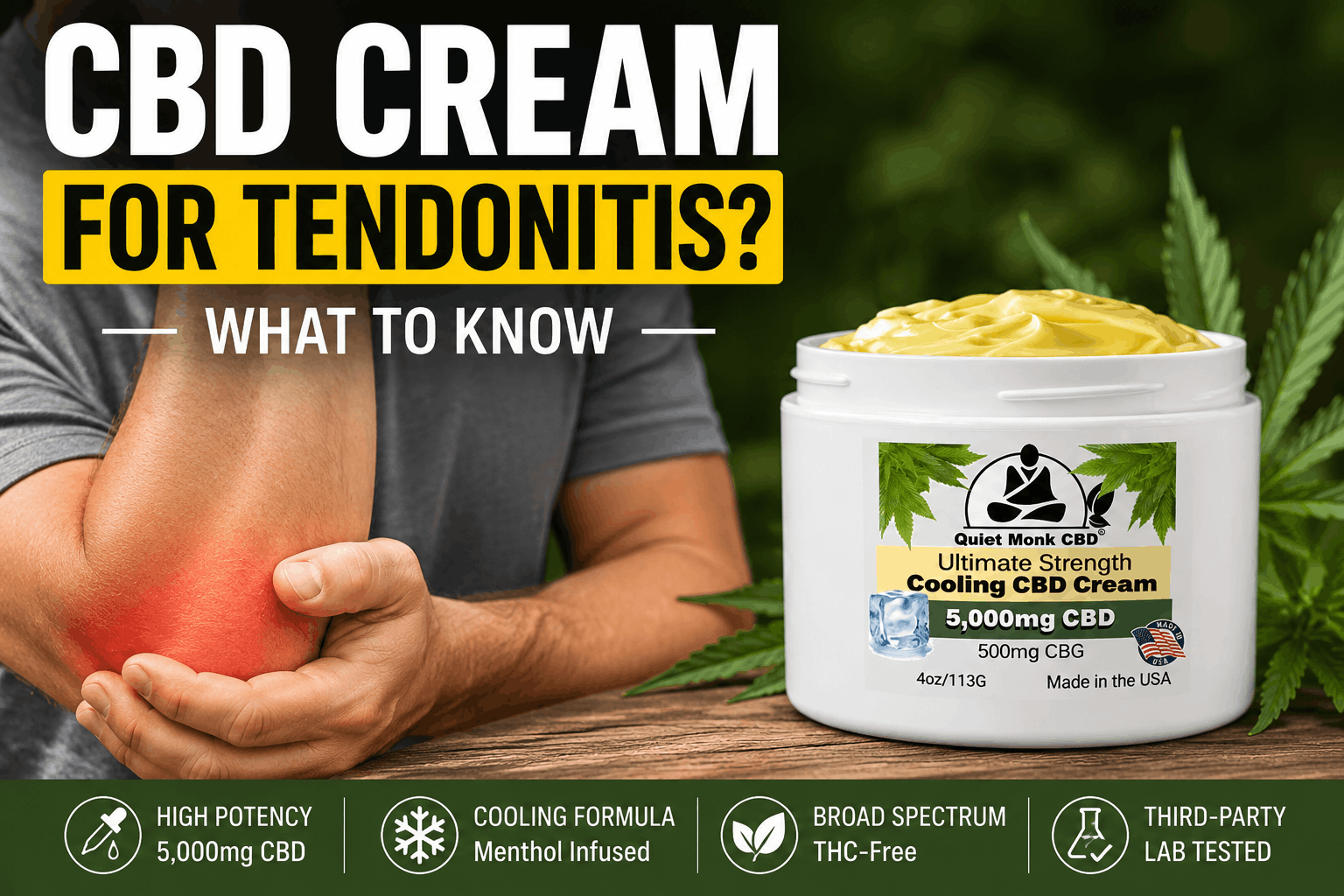
If you’re searching for CBD cream for tendonitis, you’re probably looking for a topical product you can apply directly around a sore or uncomfortable area.
I’ve worked with CBD topicals for years, and one thing I’ve learned is that choosing a product based solely on the words “maximum strength” or the largest milligram number isn’t particularly helpful.
CBD creams can vary considerably in potency, ingredients, consistency, cooling or warming sensation, and third-party testing.
There is also an important distinction to make: CBD cream isn’t a treatment for the underlying cause of tendonitis.
Tendon pain can have different causes and sometimes requires rest, physical therapy, activity modification or medical treatment. If pain is persistent, severe or associated with an injury, it’s worth getting an appropriate diagnosis rather than trying to cover up the symptoms with a topical.
With that understood, here’s what I recommend looking at when comparing CBD topical products.
What Is Tendonitis?
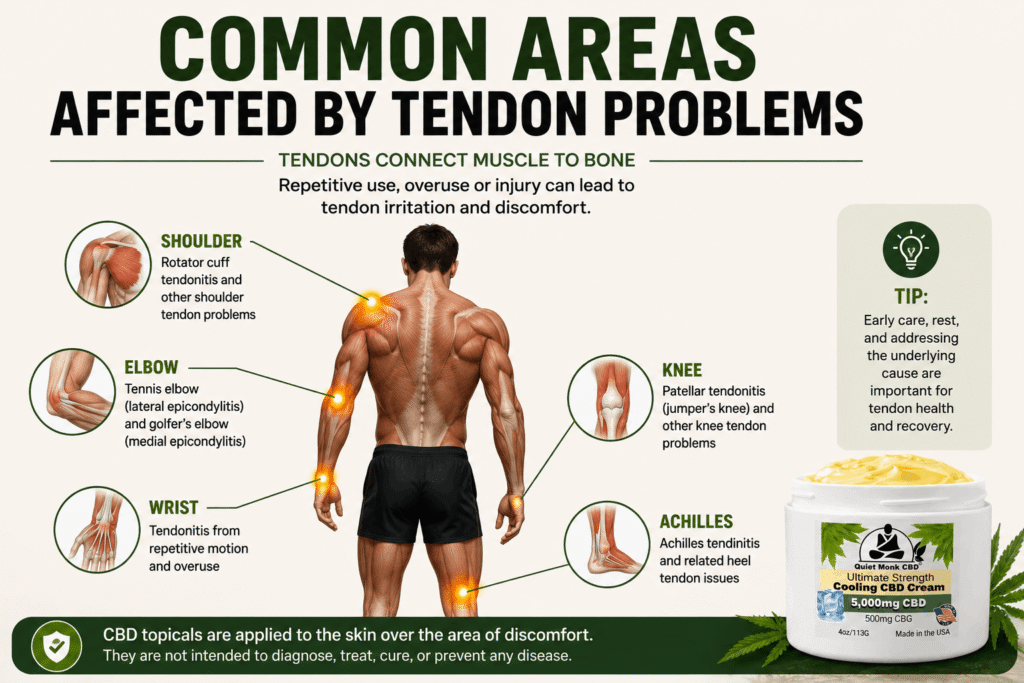
Tendons are strong bands of connective tissue that attach muscles to bones.
Tendonitis generally refers to irritation or inflammation involving a tendon. Tendon problems commonly occur around areas such as the:
- Shoulder
- Elbow
- Wrist
- Knee
- Achilles tendon
You may also hear terms such as tennis elbow, golfer’s elbow, jumper’s knee or Achilles tendinitis used to describe tendon problems in particular locations.
Repetitive movement, sports, work activities and sudden increases in physical activity can all contribute to tendon irritation.
Because persistent tendon pain can have several causes, CBD cream shouldn’t be used as a substitute for determining what’s actually causing the problem.
What Is CBD Cream?
CBD cream is a topical product containing cannabidiol (CBD), a cannabinoid found in hemp.
Unlike CBD oils or gummies, a topical is applied directly to the skin rather than swallowed.
CBD topicals are available as:
- Creams
- Lotions
- Gels
- Roll-ons
- Salves
- Balms
- Sticks
The differences aren’t just cosmetic.
A cream may absorb relatively quickly, while an oil-and-wax-based salve generally has a thicker consistency and stays on the skin longer. Roll-ons and sticks provide direct application without having to scoop product from a jar.
Which format is best largely comes down to personal preference.
What Does the Research Say About Topical CBD?
This is an area where I think CBD companies need to be careful about making promises.
Research into topical CBD and discomfort is still developing. There has been scientific interest in cannabinoids and their interaction with biological pathways associated with pain and inflammation, but that doesn’t mean a CBD cream has been proven to treat tendonitis.
That’s an important distinction.
I wouldn’t choose a product because a company promises it will “heal tendons,” “eliminate inflammation” or “accelerate recovery.”
Those are much stronger claims than the available evidence supports.
Instead, think of a CBD topical as one of the products some consumers choose to incorporate into their personal wellness routine—not as a replacement for appropriate medical treatment.
What Should You Look for in a CBD Cream for Tendonitis?
If I were comparing CBD creams, I’d concentrate on a few practical characteristics.
1. CBD Potency
Look at the actual amount of CBD in the container.
CBD topicals can range from a few hundred milligrams to tens of thousands of milligrams.
But don’t assume the highest number automatically means the best product.
Container size matters too.
For example, 5,000mg of CBD in four ounces represents a different concentration than 5,000mg in eight ounces.
If you’re unsure how to compare those numbers, our CBD cream strength guide explains how milligrams and container size relate to concentration.
2. Other Cannabinoids
Some topical products combine CBD with other cannabinoids such as CBG (cannabigerol).
Read the label carefully.
For example:
5,000mg CBD + 500mg CBG
isn’t the same formulation as:
5,500mg CBD
even though both contain the same total quantity of cannabinoids.
I prefer products that clearly disclose the amount of each cannabinoid rather than combining everything into one large marketing number.
3. Cooling or Warming Ingredients
This is a major consideration with topicals.
Ingredients such as menthol can create a noticeable cooling sensation.
Other formulations may provide a warming sensation.
Some people love these sensations; other people strongly prefer a neutral cream.
Also remember:
How strongly a topical feels on your skin doesn’t tell you how much CBD it contains.
A lower-potency menthol product can feel considerably more intense than a very high-potency CBD cream without menthol.
4. Third-Party Laboratory Testing
This is one of the first things I look for.
A CBD company should make independent laboratory results available so consumers can review cannabinoid testing rather than simply trusting the number printed on the front of the jar.
If avoiding THC is important to you, review that information on the laboratory report as well.
5. Ingredients
CBD is only one ingredient in a topical.
Check the complete ingredient list, particularly if you have sensitive skin or allergies.
Depending on the product, you may find ingredients such as menthol, aloe, carrier oils, botanical extracts and essential oils.
CBD Cream vs. CBD Gel for Tendon Areas
This mostly comes down to application preference.
A CBD cream usually has a richer consistency and can be massaged into the skin.
A CBD gel tends to feel lighter and can work particularly well in a roll-on applicator.
For areas such as elbows, wrists, shoulders, knees or the Achilles region, some people prefer a roll-on because it allows them to apply the topical directly without getting much product on their hands.
Others prefer a cream because they like manually massaging the product over a larger area.
Neither format is automatically superior.
Cooling vs. Non-Cooling CBD Cream
Quiet Monk offers both types because customer preferences differ substantially.
A cooling cream generally contains an ingredient such as menthol to create the cooling sensation.
A non-cooling cream may be preferable if you don’t like that sensation or want something more neutral.
The amount of CBD can be identical even though the products feel completely different when applied.
That’s why I recommend choosing potency and topical sensation separately.
Quiet Monk’s 5,000mg CBD Cream
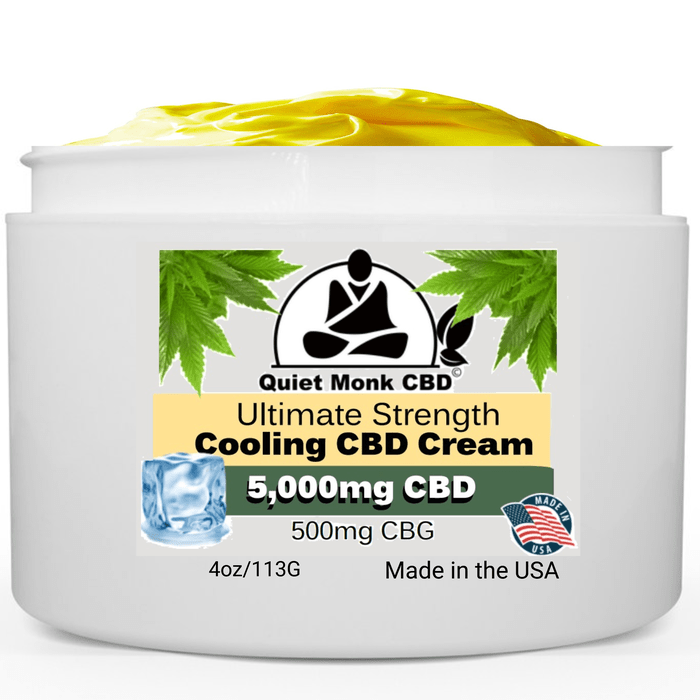
For customers looking for a concentrated topical cream, our 5,000mg CBD cream contains:
5,000mg CBD + 500mg CBG
in a four-ounce container.
It is available in a cooling formulation and is designed for customers who prefer a high-potency topical rather than the lower-strength CBD creams that were more common several years ago.
Higher potency doesn’t automatically make it the right choice for everyone, so compare the concentration, ingredients and formulation with what you’re actually looking for.
Quiet Monk’s 10,000mg CBD Cream
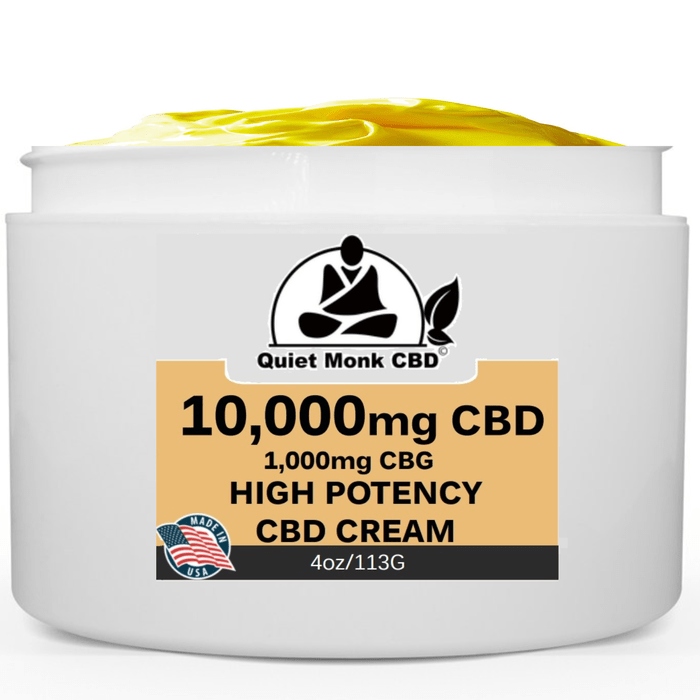
For customers who deliberately seek an even more concentrated topical, our 10,000mg CBD cream contains:
10,000mg CBD + 1,000mg CBG
in a four-ounce jar.
Again, I don’t recommend choosing it simply because the number is larger.
The point of offering different strengths is to give customers options.
What About a CBD Roll-On?
A roll-on is another option if convenience matters to you.
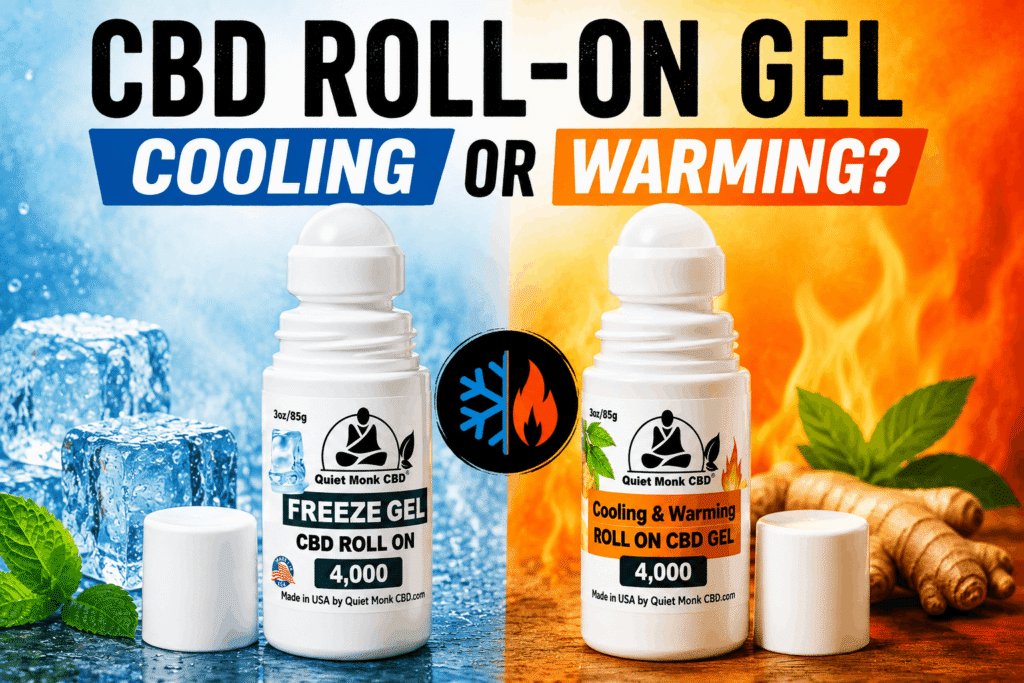
Quiet Monk’s CBD roll-on gels use a roller applicator that lets you apply the topical directly to a specific area.
This can be particularly convenient for places such as the elbow, wrist, shoulder or knee.
We offer both cooling and warming options in our collection of CBD roll-on gels.
Some people prefer a cream that absorbs relatively quickly, while others prefer the thicker consistency of CBD salves and balms or the convenience of a roll-on applicator.
How Do You Apply CBD Cream?
Always follow the directions supplied with the specific product you’re using.
Generally, topical products are applied to clean, dry skin around the desired area.
I recommend starting with a modest amount rather than covering yourself in cream. You can always apply more if needed.
For a new topical, consider patch testing a small area first—particularly if the formula contains menthol, fragrances, essential oils or botanical ingredients.
Avoid contact with your eyes and don’t apply ordinary CBD creams to broken skin unless the product is specifically formulated and labeled for that use.
When Should Tendon Pain Be Evaluated?
This is something an article about tendonitis should address.
Don’t assume every sore elbow, shoulder, knee or Achilles tendon is simply tendonitis.
Consider professional evaluation if you experience:
- Significant or worsening pain
- Sudden pain following an injury
- Significant swelling
- Weakness or loss of function
- Difficulty bearing weight
- Symptoms that persist despite rest
- A popping or snapping sensation associated with an injury
A topical product shouldn’t delay diagnosis of an injury that needs treatment.
What Else Can Help With Tendonitis?
Treatment depends on the location and severity of the tendon problem.
Conventional approaches can include activity modification, rest, physical therapy, appropriate exercise and other treatments recommended by a healthcare professional.
One mistake people sometimes make is returning to the activity that caused the problem as soon as discomfort decreases.
Rehabilitation and gradually restoring load to a tendon may be important, depending on the condition.
CBD cream should not replace those fundamentals.
Frequently Asked Questions
Can CBD cream cure tendonitis?
CBD cream hasn’t been established as a cure for tendonitis. Tendon problems can have different causes and may require rest, rehabilitation, physical therapy or other medical treatment.
What strength CBD cream should I choose?
There isn’t one CBD strength that’s appropriate for everyone. Compare total CBD, container size, concentration, ingredients and whether you prefer a cooling or non-cooling formulation.
Is 5,000mg CBD cream strong?
A 5,000mg CBD cream would generally be considered a high-potency topical compared with many conventional CBD creams. Container size should also be considered when comparing concentrations.
Is 10,000mg CBD cream stronger than 5,000mg?
If both products are the same size, a 10,000mg CBD cream contains twice as much total CBD as a 5,000mg cream.
Is CBD cream or CBD roll-on better?
Neither is universally better. Creams are convenient for massaging over an area, while roll-ons provide direct application with less product on your hands.
Does menthol mean a CBD cream is stronger?
No. Menthol creates a cooling sensation but doesn’t increase CBD concentration. A product can feel intensely cooling while containing substantially less CBD than a non-menthol topical.
Should I talk to a doctor about tendonitis?
Persistent, severe or injury-related tendon pain should be appropriately evaluated. A healthcare professional can help determine the cause and whether treatment or rehabilitation is needed.
Final Thoughts
If you’re comparing CBD cream for tendonitis, don’t choose a product solely because it makes the biggest promises or displays the largest number on the label.
Look at what you can actually verify:
CBD content. Container size. Other cannabinoids. Ingredients. Cooling or warming formulation. Third-party laboratory testing.
And remember that a topical isn’t a substitute for diagnosing or treating the underlying cause of tendon pain.
I’ve been involved with CBD topicals long enough to see a lot of exaggerated claims. I’d rather tell customers exactly what’s in a product and let them decide whether that formulation fits what they’re looking for.
That’s ultimately a much better way to shop for CBD.
About the Author

Steven Gregoire is the founder of Quiet Monk CBD, a U.S. CBD company specializing in high-potency CBD topicals, including CBD + CBG creams, salves, gels and sticks. He writes about CBD from the perspective of someone directly involved in the business, with a focus on helping consumers understand potency, formulations, ingredients and third-party testing.
This article is for general educational purposes only and is not intended as medical advice. CBD products are not intended to diagnose, treat, cure or prevent any disease. Consult an appropriate healthcare professional regarding persistent tendon pain or before making changes to a treatment plan.