
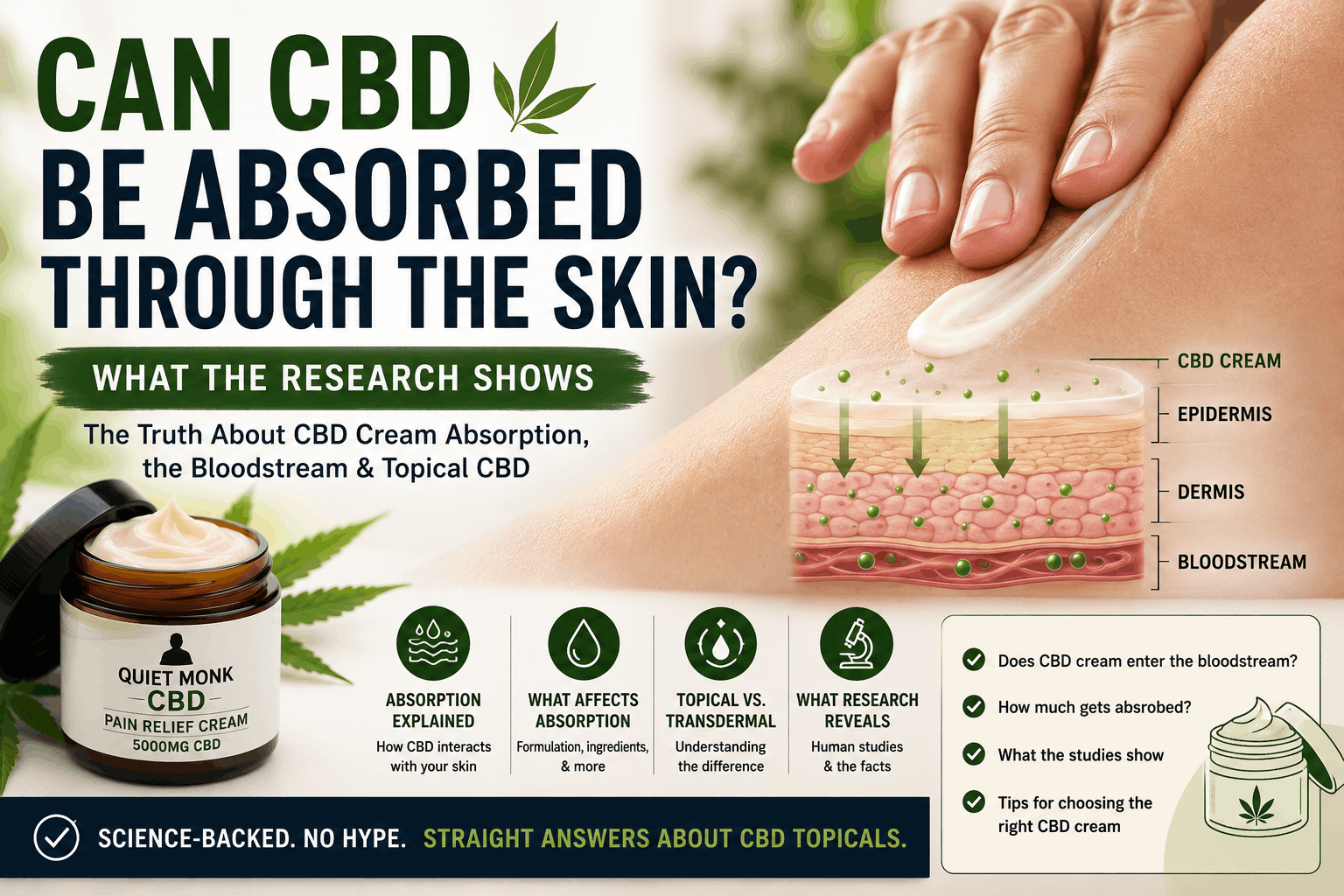
If you’ve ever wondered whether CBD cream actually gets through your skin, you’re not alone.
This is one of the most common questions I hear about CBD topicals.
You’ll find some websites saying that CBD cream is completely absorbed through the skin. You’ll find others saying it can’t enter the bloodstream at all.
The truth is somewhere in between.
CBD can interact with the skin, and research shows that CBD can penetrate into skin tissue. There is also evidence that some topical formulations can result in measurable CBD entering the bloodstream.
But how much gets through—and how far it gets—depends heavily on the formulation.
That’s an important distinction.
Does CBD Absorb Through the Skin?
Yes, CBD can penetrate the skin.
But “absorbed through the skin” doesn’t necessarily mean that all of the CBD you apply ends up circulating throughout your body.
The outermost layer of your skin, called the stratum corneum, acts as a barrier.
CBD is a fat-soluble compound, which makes getting through that barrier complicated. Researchers have found that CBD can accumulate in the skin, while only a portion may move farther through the skin and into circulation.
A 2024 study using human skin found that several specially formulated CBD products delivered CBD into the skin, but cutaneous deposition was much greater than the amount that permeated completely through the skin under the study conditions.
So when you put CBD cream on your skin, don’t think of it as simply disappearing through the skin and going directly into your bloodstream.
It’s more complicated than that.
Does CBD Cream Enter the Bloodstream?
A 2024 human study looked at five commercially available hemp-derived topical CBD products. Researchers detected transdermal absorption from three of the five active products. CBD and metabolites reached their highest average concentrations after several days of repeated use, and the amount absorbed differed between products.
Another human study examined a specific transdermal formulation containing CBD and THC and found measurable CBD in the blood after topical application. That study used a specialized transdermal delivery system, though, so its results shouldn’t automatically be applied to every CBD cream on the market.
Some CBD applied to the skin can reach the bloodstream, but the amount depends on the product and formulation.
Topical vs. Transdermal CBD: What’s the Difference?
You’ll sometimes see the terms topical and transdermal used as if they mean exactly the same thing.
They don’t.
A topical product is generally intended to work at or near the area where you apply it.
A transdermal product is specifically designed to move an active ingredient through the skin and into systemic circulation.
A regular CBD cream isn’t necessarily designed to deliver a specific amount of CBD into your bloodstream.
And you shouldn’t assume that a 5,000mg cream is equivalent to a transdermal CBD product simply because both contain CBD.
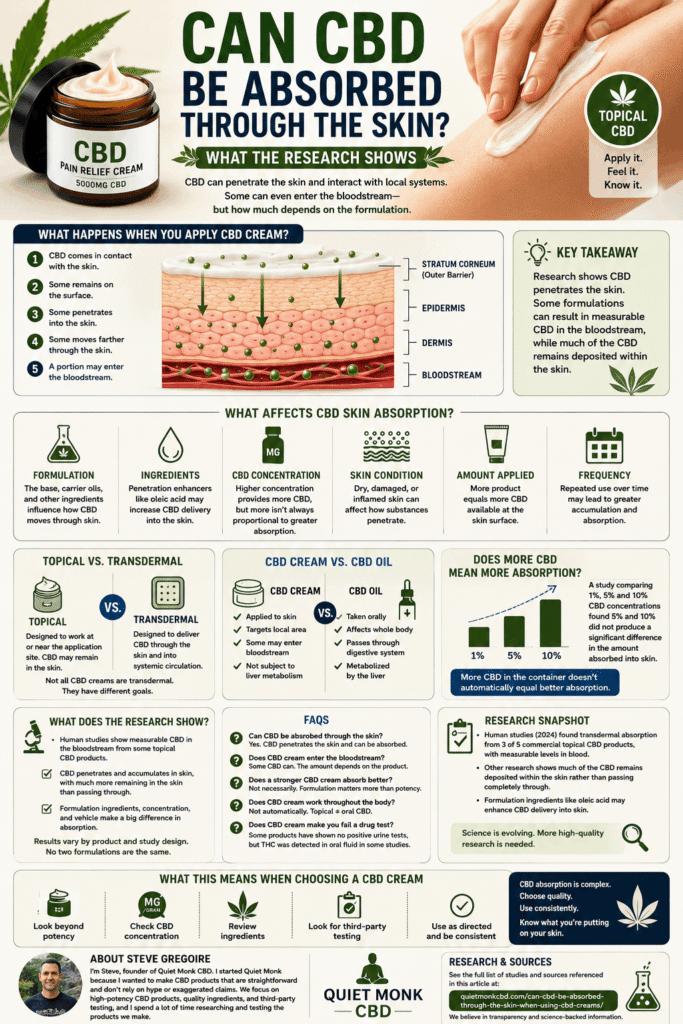
What Happens When You Apply CBD Cream?
Think of your skin as a barrier with several layers.
When you apply a CBD cream, the CBD first comes into contact with the outer layer of the skin.
Some of it can remain on the surface.
Some can penetrate into the skin.
Some may move farther through the skin.
And depending on the formulation, a portion can potentially reach the bloodstream.
Researchers have found that CBD’s movement through skin can be affected by the ingredients used to formulate the product.
That’s why you can’t determine absorption simply by looking at the number of milligrams printed on a jar.
Why Does the CBD Formulation Matter?
This is probably the most important part of the whole discussion.
Two CBD creams could contain the exact same amount of CBD and still behave differently on the skin.
Why?
Because the rest of the formula matters.
Researchers have studied things such as:
- Carrier oils
- Solvents
- Surfactants
- Penetration enhancers
- Gel systems
- Cream bases
- CBD concentration
- pH
A study using human skin found that certain formulation ingredients affected how much CBD moved into and through the skin. Oleic acid, for example, increased CBD delivery into skin under the study conditions.
Another study found that different vehicles affected CBD permeation and skin retention.
So when someone says:
“This cream contains 10,000mg of CBD, therefore it will absorb better.”
I wouldn’t assume that’s true.
The formulation matters just as much as the number on the label.
Does More CBD Mean More Absorption?
Not necessarily.
This is another area where CBD marketing can get confusing.
A product containing 10,000mg of CBD has more CBD in the entire container than a 5,000mg product.
That doesn’t automatically mean twice as much CBD will penetrate your skin.
In one laboratory study using human skin, researchers compared 1%, 5% and 10% CBD solutions. The 5% and 10% preparations did not produce a significant difference in the amount absorbed into the skin under the study conditions.
That’s a good example of why more CBD in the container doesn’t automatically equal proportionally greater skin absorption.
Does CBD Stay in the Skin?
Some of it can.
This is one of the more interesting findings from the research.
A 2024 study examining CBD delivery through human skin found that the amount of CBD deposited in the skin was substantially greater than the amount that passed completely through the skin under realistic application conditions.
That helps explain why the terms “topical” and “transdermal” are important.
A topical product can deliver CBD to the skin without necessarily delivering a large amount of CBD throughout the body.
Can CBD Cream Provide Localized Effects?
This is one of the reasons people are interested in topical CBD.
You can apply the product directly to a particular area.
The skin itself contains components of the endocannabinoid system, and researchers are studying how cannabinoids interact with these systems.
But I’d be careful with the word “localized.”
It doesn’t mean we can guarantee that CBD stays entirely in the exact spot where you put it.
It means that you’re applying the product directly to a particular area rather than taking CBD orally and sending it through the digestive system.
CBD Cream vs. CBD Oil
This is another important difference.
When you take CBD oil orally, the CBD passes through your digestive system and is subject to metabolism in the liver.
A topical cream takes a different route.
You’re applying it to your skin rather than swallowing it.
That means research on oral CBD doesn’t automatically tell us how much CBD you’ll absorb from a topical cream.
The delivery method matters.
That’s why I like seeing research specifically on topical and transdermal CBD rather than simply taking an oral CBD study and applying the results to a cream.
Does CBD Cream Have Systemic Effects?
Some topical CBD products have produced measurable CBD in blood samples in human research. But that doesn’t mean every CBD cream produces the same level of systemic exposure.
One review of topical cannabinoids noted that formulation differences can make it difficult to predict absorption and systemic exposure from the CBD concentration alone.
That’s why I wouldn’t make a blanket statement that topical CBD never enters the bloodstream.
At the same time, I wouldn’t tell you that applying CBD cream is equivalent to taking a CBD oil or capsule.
They’re different delivery methods.
What Can Affect CBD Skin Absorption?
There isn’t one magic number for how much CBD gets through your skin.
Several factors can matter.
The formulation
The cream or gel base can influence how CBD moves through the skin.
The ingredients
Certain ingredients may increase or decrease CBD penetration.
CBD concentration
The amount of CBD available to move into the skin matters, but more isn’t necessarily proportional to greater absorption.
Skin condition
The condition of the skin can affect how substances move through it.
Amount applied
Applying more product can change the total amount of CBD available at the skin surface.
How often you apply it
Repeated application can produce different exposure than a single application. One human study of commercial topical products found measurable CBD/metabolites after repeated use over several days.
Does Massaging CBD Cream Into Your Skin Help?
Massaging a cream into the skin is a normal way to apply a topical product.
It also helps spread the product over the area you’re applying it to.
But I wouldn’t tell you that massaging a CBD cream for a specific number of minutes guarantees better CBD absorption.
We don’t have evidence for a universal massage time that works for every formulation.
For our products, I recommend following the application directions on the individual product.
What About Cooling CBD Cream?
Some CBD creams contain menthol or other ingredients that create a cooling sensation.
That’s separate from CBD absorption.
The cooling feeling comes from the cooling ingredient, not from the CBD itself.
So a cream that feels very cold isn’t necessarily being absorbed more effectively.
If you prefer a cooling topical, that’s a matter of preference and formulation.
If you don’t like cooling ingredients, a non-cooling product may be a better fit.
Does a 5,000mg CBD Cream Absorb Better Than a 1,000mg Cream?
Not automatically.
A 5,000mg product contains more CBD than a 1,000mg product, but absorption depends on more than total CBD.
You also have to consider the size of the container.
For example, if two products both contain 5,000mg CBD but one container is twice as large, they don’t have the same concentration.
That’s why I recommend looking at CBD per gram of product, not just the number on the front of the jar.
You can compare our CBD cream strengths here.
What Does This Mean When Choosing a CBD Cream?
If you’re shopping for a CBD topical, I’d look at more than potency.
I’d check:
- Total CBD
- Container size
- CBD concentration
- Other cannabinoids
- Ingredients
- Whether it contains menthol
- Third-party testing
- How the product is intended to be used
I’d also be skeptical of companies promising that a certain percentage of their CBD will be absorbed through your skin.
Unless they have actually tested that specific formulation, they don’t really know.
That’s one of the biggest things I’ve taken away from looking at the research.
Does CBD Cream Get Into Your System?
It can.
But there’s a big difference between saying “some CBD can reach the bloodstream” and saying “CBD cream is absorbed throughout your body just like oral CBD.”
The research doesn’t support making that leap.
The amount that reaches circulation appears to depend heavily on the formulation and how the product is used. Some topical products have produced measurable systemic CBD, while other research suggests much of the CBD remains deposited within the skin.
Frequently Asked Questions
Can CBD be absorbed through the skin?
Yes. Research shows that CBD can penetrate and accumulate in human skin. How much moves farther through the skin depends on the formulation and other factors.
Does CBD cream enter the bloodstream?
Some CBD topical products have been shown to result in measurable CBD in the bloodstream. However, the amount varies considerably depending on the formulation.
Does all the CBD in a cream get absorbed?
No. A substantial amount may remain on or within the skin rather than passing completely through it.
Does a stronger CBD cream absorb better?
Not necessarily. A higher concentration provides more CBD, but absorption depends on the entire formulation, not simply the total milligrams of CBD.
Is topical CBD the same as transdermal CBD?
No. A topical product is generally intended for application to the skin, while a transdermal system is designed to deliver an ingredient through the skin and into systemic circulation.
Does CBD cream work throughout the whole body?
You shouldn’t assume that it does. Topical and transdermal products behave differently, and systemic exposure varies by formulation.
Does CBD cream make you fail a drug test?
That depends on the product and the test. Some hemp-derived topical products have been studied without producing positive urine cannabis tests under federal workplace criteria, but oral-fluid THC was detected in some participants in one study.
Does massaging CBD cream increase absorption?
Massaging spreads the product over the skin, but there isn’t a universal massage technique or duration proven to maximize CBD absorption for every product.
Final Thoughts
So, can CBD be absorbed through your skin?
Yes—but it’s not as simple as “put it on your skin and it goes straight into your bloodstream.”
Some CBD can penetrate the skin and remain within the skin. Some formulations can move CBD farther through the skin, and human research has shown measurable systemic absorption from certain topical products.
The important word is certain.
CBD creams aren’t all formulated the same way.
That’s why I wouldn’t judge a topical solely by the number of milligrams printed on the jar.
Look at the concentration, the ingredients, the formulation and whether the company provides third-party testing.
And if you’re interested in a topical for localized application, you can browse our CBD pain cream collection or compare our CBD cream strengths.
Resources and Studies
Human studies
Pharmacokinetics and pharmacodynamics of five distinct commercially available hemp-derived topical cannabidiol products
Human study examining CBD absorption from five commercially available topical products.
Read the study on PubMed
Examining the Systemic Bioavailability of Cannabidiol and Tetrahydrocannabinol from a Novel Transdermal Delivery System
Human study examining systemic absorption following application of a specific transdermal CBD/THC formulation.
Read the study on PubMed
Skin absorption research
Cutaneous Delivery and Biodistribution of Cannabidiol in Human Skin After Topical Application of Colloidal Formulations
Study examining how CBD is distributed within and through human skin.
Read the study on PubMed
In Vitro Percutaneous Absorption Studies of Cannabidiol Using Human Skin
Research examining CBD absorption through human skin and the effects of concentration and formulation ingredients.
Read the study on PubMed
Evaluations of Skin Permeability of Cannabidiol and Its Topical Formulations
Research examining CBD permeability and the influence of formulation characteristics.
Read the study on PubMed
About Steve Gregoire

I’m Steve, founder of Quiet Monk CBD. I started Quiet Monk because I wanted to make CBD products that were straightforward and didn’t rely on the hype and exaggerated claims you see in this industry. We focus on high-potency CBD products, quality ingredients and third-party testing, and I spend a lot of time researching and testing the products we make.