If you have looked at the labels on our creams and salves, you have probably noticed that many contain both CBD and CBG.
CBD is the cannabinoid most people recognize. CBG is less familiar, and customers often ask me what it is, what it does and why we add it to products that already contain a large amount of CBD.
The short answer is that CBD and CBG are two different cannabinoids found naturally in hemp. Neither one produces the intoxicating “high” associated with THC. They have some similarities, but they are not interchangeable, and research on CBG is much more limited than research on CBD.
We combine them because we want to offer a broader cannabinoid profile and because many of our customers specifically request products containing both. We also include enough CBG to clearly state the amount—not just a tiny quantity added so we can place “CBG” on the label.
CBD and CBG at a Glance
| CBD | CBG | |
|---|---|---|
| Full name | Cannabidiol | Cannabigerol |
| Naturally found in hemp | Yes | Yes |
| Intoxicating like THC | No | No |
| Typical amount in mature hemp | Usually more abundant | Usually present in smaller amounts |
| Amount of human research | Considerably more | Still very limited |
| Found in Quiet Monk products | Creams, salves, oils, gels and gummies | Selected creams, salves, gels and balm sticks |
| FDA-approved medical use | Purified prescription CBD is approved for certain seizure disorders | No FDA-approved medical use |
That last point is important. CBD and CBG are widely sold in wellness products, but an over-the-counter cream, oil or gummy is not an FDA-approved treatment for pain, anxiety, inflammation, neuropathy or another medical condition.
What Is CBD?
CBD stands for cannabidiol. It is one of the main naturally occurring cannabinoids found in hemp.
CBD does not produce the intoxicating effects associated with THC. That is one reason it has become such a popular ingredient in oils, gummies, creams, salves and other products.
Researchers have studied CBD far more than CBG, but that does not mean every claim made about CBD has been proven. Much of the research involves laboratory studies, animal studies, prescription CBD or amounts and delivery methods that are different from ordinary retail products.
The FDA has approved a purified prescription form of CBD for certain seizure disorders. That approval does not mean the FDA has approved consumer CBD creams, gummies or oils to treat other medical conditions.
CBD may interact with a number of systems and molecular targets in the body. Describing it as simply “binding to CB1 and CB2 receptors” leaves out much of the story. Its activity is more complicated, and researchers are still studying how different amounts and delivery methods affect the body.
What Is CBG?
CBG stands for cannabigerol. It is another naturally occurring cannabinoid found in the cannabis plant.
You may have heard CBG called the “mother cannabinoid.” That description is close, but it is technically CBGA—the acidic form of CBG—that acts as a starting material for several other cannabinoids while the plant is growing.
Enzymes in the plant can convert CBGA into acidic forms that later become cannabinoids such as CBD, THC and CBC. Because much of the available CBGA is converted into other compounds, mature hemp plants generally contain less CBG than CBD.
Producing concentrated CBG has historically required more plant material or specially cultivated hemp varieties. This is one reason CBG products are less common and CBG ingredients usually cost more than CBD.
What Is the Difference Between CBD and CBG?
The most obvious difference is availability. CBD is generally much more abundant in hemp, while CBG is usually considered a minor cannabinoid.
They also interact differently with biological targets in the body. Both are being studied, but we should be careful about turning early laboratory findings into promises about what they will do for an individual person.
The other major difference is the amount of evidence available.
CBD has been studied in considerably more human trials. Research on CBG has largely involved cells, animals or preclinical models. Human CBG research is beginning to appear, but it is still early.
A small 2024 study tested a single 20mg oral serving of CBG against a placebo in 34 healthy adults. Researchers reported reductions in anxiety and stress measurements without evidence of intoxication or impairment.
That is interesting research, but it does not prove that CBG treats an anxiety disorder, works the same way with repeated use or produces the same results when applied to the skin. It was one small study involving an oral CBG tincture and healthy adults.
What Are the Potential Benefits of CBD and CBG?
Both cannabinoids are being investigated for several possible uses. The quality of evidence varies considerably depending on the particular cannabinoid, delivery method and health condition.
Discomfort and inflammation research
CBD and CBG have both shown interesting activity in laboratory and animal research involving inflammatory and pain-related pathways.
However, laboratory activity is not the same as demonstrating that a retail topical treats arthritis, neuropathy or another medical condition in people.
Research involving cannabis or mixed cannabinoid preparations also cannot automatically tell us what isolated CBD, isolated CBG or a THC-free topical will do. Different products may contain different cannabinoids, concentrations and delivery methods.
A CBD and CBG topical can be applied directly to an area where you want it, but it should not be described as curing inflammation or repairing the condition causing the discomfort.
Stress and mood research
CBD has been studied for its possible effects on anxiety and stress, although results depend on the study design, amount and population being tested.
Human research on CBG is much newer. The small 2024 trial mentioned above produced encouraging results, but it needs to be followed by larger and longer studies.
It is too early to say that CBG treats anxiety, improves mood or provides reliable daytime focus. Those claims are common in advertising, but the evidence is not strong enough to present them as established facts.
Sleep research
People frequently shop for CBD products to add to their nighttime routines. Some people may feel that CBD helps them relax, but research has not established CBD or CBG as a dependable treatment for insomnia.
CBG is sometimes advertised as energizing and sometimes advertised for sleep. Those opposite claims are a good reminder that the marketing has moved faster than the research.
Our advice is to look at the complete formula. A nighttime gummy containing CBD and melatonin is different from a plain CBD oil, just as a topical containing CBD, CBG and menthol is different from an ingestible product.
Do CBD and CBG Work Better Together?
You will often see the phrase “entourage effect” used to suggest that cannabinoids work better when combined.
It is a reasonable subject for research, but it is not a guarantee. There is currently not enough high-quality human evidence to say that a particular CBD-to-CBG ratio will always work better than CBD alone.
We do not add CBG because we can promise that it multiplies or “supercharges” the CBD. We add it because CBG is a distinct hemp cannabinoid, customers ask for it, and we prefer a broader formula over relying on CBD alone in certain products.
The honest answer is that CBD and CBG can be formulated together, but researchers have not established one ideal combination for every person or purpose.
Why Quiet Monk Combines CBD and CBG
I started Quiet Monk after seeing what my father went through with rheumatoid arthritis. That experience is also why I have never been interested in making weak products or using trendy ingredients only for the label.
When we say a product contains CBG, we tell you how much is in it.
For example:
- Our 5,000mg CBD Salve contains 5,000mg of CBD and 500mg of CBG.
- Our 10,000mg CBD Cream contains 10,000mg of CBD and 1,000mg of CBG.
- The 20,000mg cream upgrade contains 20,000mg of CBD and 2,000mg of CBG.
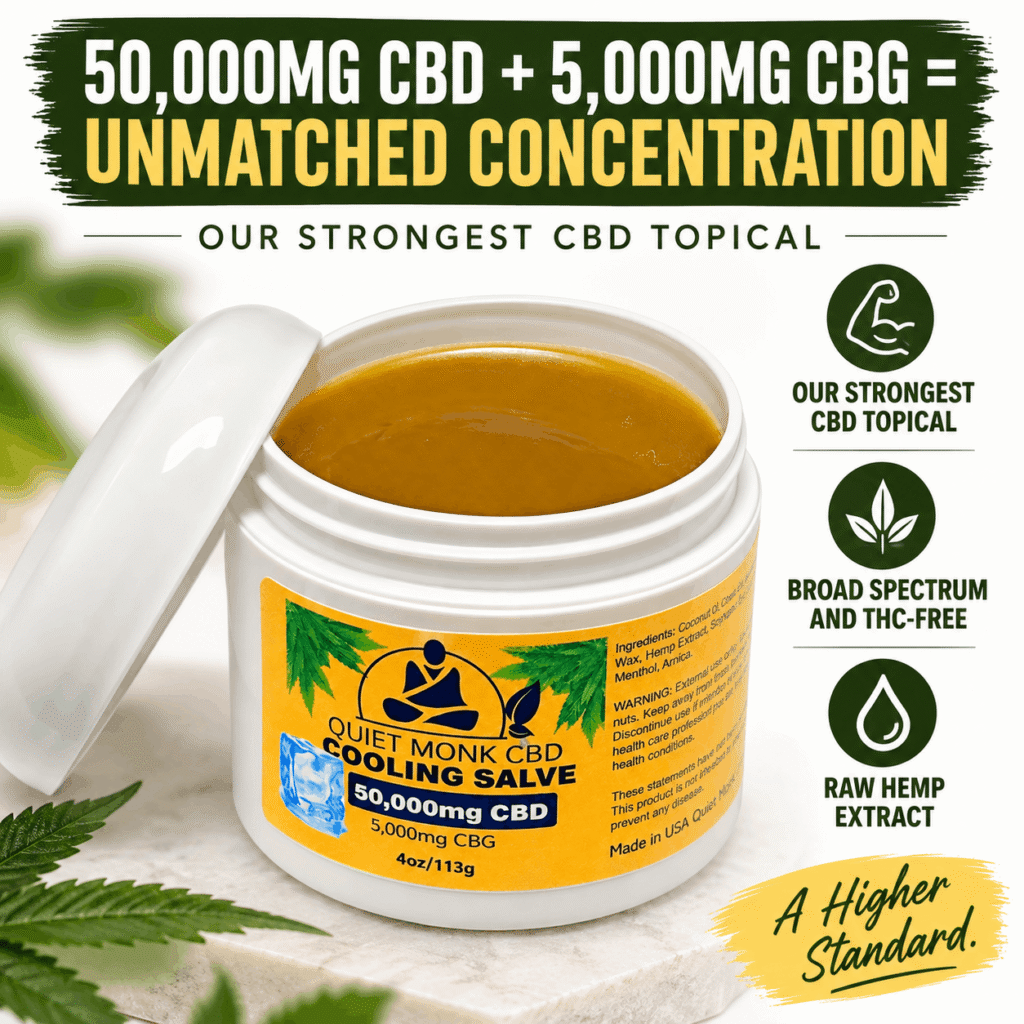
- Our 50,000mg CBD Salve contains 50,000mg of CBD and 5,000mg of CBG.
- Our Neuropathy CBD Cream Gel contains both CBD and CBG in a lighter, fast-absorbing topical.
In each of these formulas, CBG is included at approximately 10% of the stated CBD amount. That gives customers a meaningful and clearly disclosed amount instead of an unspecified dusting of CBG.
This does not mean that everyone needs CBG or that a product with both cannabinoids is guaranteed to work better. It means you know what you are buying and can compare it with other formulas.
CBD and CBG Topicals Versus Oils and Gummies
The way you use a cannabinoid product matters.
Topical CBD and CBG
Creams, gels, salves and balms are applied directly to the skin. People often choose topicals when they want to focus application on their hands, feet, knees, shoulders, neck, back or another particular area.
A cream or gel normally absorbs faster and feels lighter. A traditional salve contains oils and waxes that give it a richer texture and help it remain on the skin longer.
Added ingredients also make a noticeable difference. Menthol creates a cooling sensation. Camphor, capsicum, arnica, aloe and essential oils can affect how a formula feels, smells and spreads.
That immediate cooling or warming feeling does not necessarily come from the cannabinoids themselves. This is why you should evaluate the entire ingredient list rather than looking only at the CBD number.
CBD and CBG oils or gummies
Oils and gummies are swallowed, so they are not used in the same way as a topical product. Oral cannabinoids can also have a greater potential for medication interactions and other whole-body effects.
If you take prescription medication or manage a medical condition, discuss orally consumed CBD or CBG with your doctor or pharmacist. This is particularly important because the FDA warns that CBD can affect how certain medications work.
How Do You Choose the Right CBD and CBG Product?
Start with the type of product you will realistically use.
Choose a cream or gel if you want something that spreads easily and absorbs relatively quickly. Choose a salve if you prefer a thicker texture that gives you more time to massage the product into your skin. A balm stick may be more convenient if you do not want to scoop the product from a jar.
Next, check the numbers carefully.
Do not assume that a product contains a meaningful amount of CBG simply because “CBD + CBG” appears on the front. The company should disclose the amount of each cannabinoid.
You should also consider:
- The size of the container
- Total CBD and CBG content
- Approximate amount per serving or application
- Regular, cooling or warming formula
- Complete ingredient list
- Current third-party laboratory results
- Whether THC is detected in testing
- Return policy and company contact information
You can also use our CBD Cream Strength Comparison to compare topical concentrations in more practical terms.
Does More CBG Automatically Make a Better Product?
No. More milligrams do not automatically make a product better for a particular person.
Concentration is only one part of the formula. Texture, container size, application area, cooling ingredients and skin sensitivity matter too.
Our 50,000mg CBD and 5,000mg CBG salve is the strongest topical we make, but it is not where I would tell most first-time customers to begin. Someone new to high-potency topicals may find the 5,000mg salve or one of our creams more practical.
The strongest product and the right product are not always the same thing.
Are CBD and CBG Safe?
CBD and CBG are often described as natural, but “natural” does not automatically mean risk-free.
CBD may interact with medications and can produce side effects, especially when swallowed. The FDA notes potential concerns involving drug interactions, changes in alertness, gastrointestinal symptoms and liver injury. Much less is known about the long-term safety of concentrated CBG because there have been so few human studies.
For topical products:
- Perform a small patch test first.
- Do not apply them to broken or badly irritated skin.
- Avoid your eyes and other sensitive areas.
- Wash your hands after using strong cooling or warming formulas.
- Stop using the product if irritation develops.
Talk with a healthcare professional before using cannabinoid products if you are pregnant, breastfeeding, taking medication or managing a medical condition.
Will CBD or CBG Cause a Positive Drug Test?
Standard workplace drug tests generally look for THC metabolites rather than CBD or CBG. However, no responsible CBD company should guarantee that you will pass a drug test.
Some hemp products may contain trace amounts of THC, and product labels are not always accurate. Repeated use could increase exposure.
Quiet Monk products are formulated with broad-spectrum hemp extract and are THC-free according to third-party laboratory testing. Customers subject to drug testing should still review the current laboratory report and make their own decision based on their employment or testing requirements.
Frequently Asked Questions
Is CBG stronger than CBD?
CBG is not simply a stronger version of CBD. They are different cannabinoids with different chemical properties. There is no reliable conversion showing that a certain amount of CBG equals a certain amount of CBD.
Does CBG make you feel high?
CBG is not considered intoxicating in the same way as THC. The limited human research available has not shown the familiar intoxicating effect associated with THC.
The complete product still matters. A product combining CBG with meaningful amounts of THC could produce different effects.
What is the best ratio of CBD to CBG?
Research has not established one ideal CBD-to-CBG ratio. Quiet Monk uses approximately a 10-to-1 ratio in several topical formulas, such as 5,000mg CBD with 500mg CBG. That is our formulation choice, not a medically established universal ratio.
Can CBD and CBG be used together?
Yes, CBD and CBG can be included in the same formula. Several Quiet Monk creams, salves and gels contain both. However, evidence has not established that every combination is more effective than CBD alone.
Why is CBG more expensive than CBD?
CBG is generally found in smaller amounts in mature hemp plants. Producing concentrated CBG may require specially cultivated plants and additional processing, which contributes to its higher ingredient cost.
Is CBG the mother cannabinoid?
People commonly call CBG the mother cannabinoid, but CBGA is the more accurate term. CBGA is the acidic precursor the plant uses to form several other cannabinoid acids.
Is CBG better for daytime use?
Some companies promote CBG as a daytime cannabinoid associated with focus or energy. Human evidence supporting those claims is still limited, and people may respond differently. We would not present CBG as a proven stimulant.
Is CBD better researched than CBG?
Yes. CBD has been examined in substantially more laboratory, animal and human studies. Human research on CBG is only beginning, so many popular CBG claims remain unproven.
The Bottom Line
CBD and CBG are separate, non-intoxicating cannabinoids naturally found in hemp. CBD is more abundant and has been studied much more extensively. CBG is present in smaller quantities, costs more to produce and has far less human research behind it.
Early CBG research is interesting, but it does not justify calling CBG a proven treatment for pain, inflammation, anxiety, poor sleep or another medical condition. We should be able to discuss its potential without turning that potential into a promise.
Quiet Monk combines CBD and CBG in selected products because customers want access to both cannabinoids and because we prefer being clear about exactly what is in each formula.
Check the milligrams, container size, ingredients and laboratory results. Then choose a cream, salve, gel or stick based on the texture and application experience you actually prefer.
If you are not sure which product fits what you are looking for, contact us. I would rather answer a few questions than have you order the wrong product.
— Steven Gregoire, Founder of Quiet Monk CBD
Sources
National Center for Complementary and Integrative Health: Cannabis and Cannabinoids
Acute Effects of Cannabigerol on Anxiety, Stress and Mood – PubMed
Acute Effects of Cannabigerol – Full Study, PubMed Central