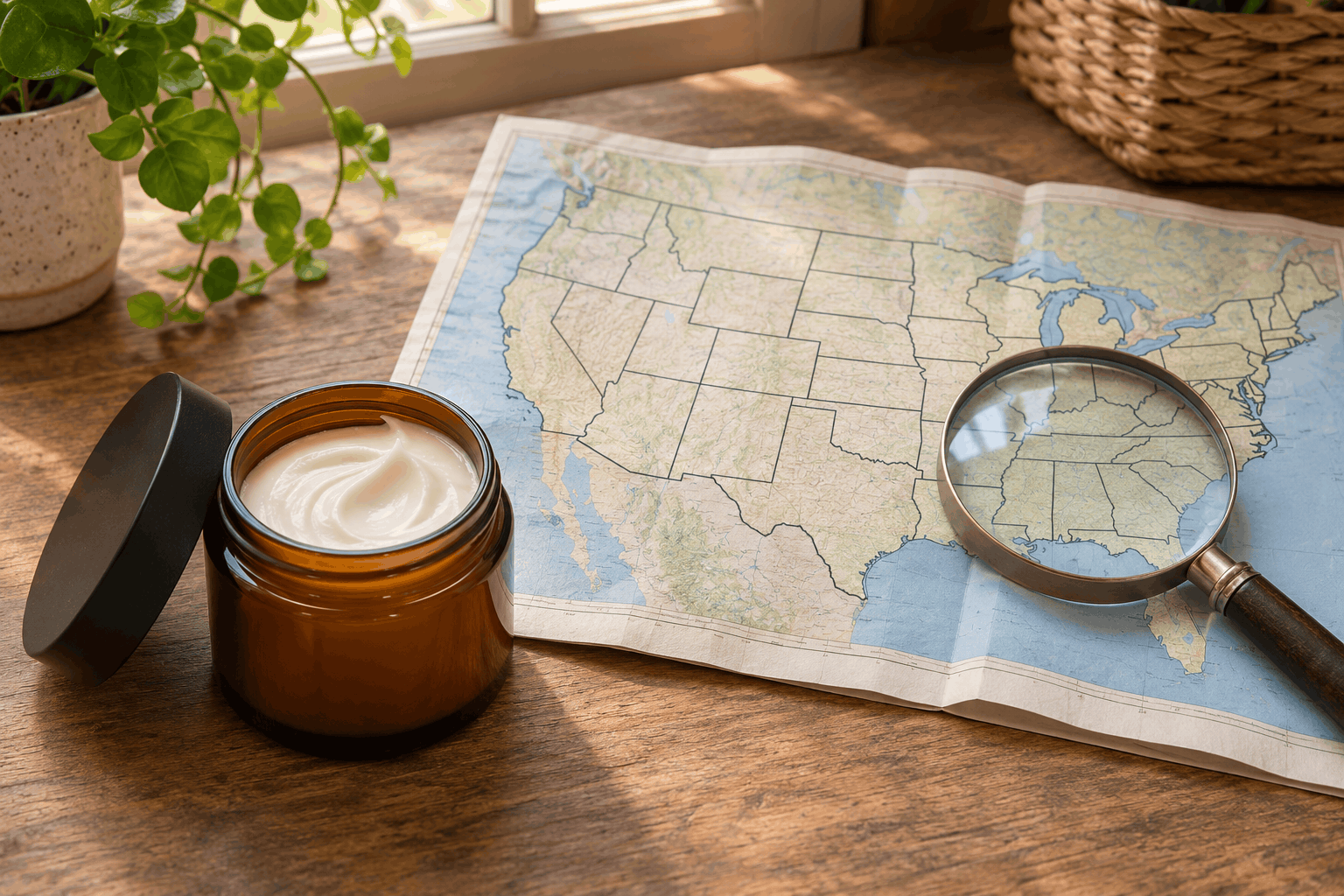
If you’re buying CBD cream online, it’s reasonable to expect a straight answer about whether you can order it. Unfortunately, there isn’t one blanket rule that covers every CBD cream in every state.
The answer depends on the ingredients, THC content, how the product is marketed, and the current rules where it is sold or used. Hemp-derived CBD topicals and marijuana products aren’t always regulated the same way, either.
This guide explains what to check before ordering and where to find information for your state.
What Federal Law Means for CBD Cream
The 2018 Farm Bill removed qualifying hemp from the federal controlled-substance definition. Under that framework, hemp was defined using a limit of no more than 0.3% delta-9 THC by dry weight.
But that change did not give every finished CBD product permission to be sold nationwide. The law preserved the FDA’s authority over products containing cannabis-derived ingredients. State requirements can apply as well.
That’s why “made from hemp” and “contains less than 0.3% THC” aren’t enough, on their own, to establish that a particular cream can legally be marketed, shipped, or sold everywhere. Check the rules in effect when you order rather than relying on an older summary of the Farm Bill.
CBD Cream and Marijuana Laws Aren’t the Same Thing
A state allowing recreational marijuana does not mean every CBD cream can be sold there without restrictions. Likewise, a state restricting marijuana does not automatically prohibit every hemp-derived topical.
States may distinguish between hemp and marijuana, between topical and edible products, and between different cannabinoid ingredients. Requirements can also cover manufacturing, testing, labeling, registration, and retail sales.
For shoppers, the useful question is more specific than “Is cannabis legal here?” Ask whether the state permits the particular type of hemp-derived topical you want to buy.
Does It Matter What the Cream Claims to Do?
Yes. A cream marketed to moisturize skin and a product advertised to treat arthritis or another medical condition can fall under different regulatory requirements.
The FDA considers a product’s intended use, including claims made on its label and in its advertising. Calling something a cosmetic does not automatically make it one if the seller also markets it as a disease treatment.
CBD creams are not FDA-approved treatments for arthritis, plantar fasciitis, neuropathy, or other medical conditions. A laboratory report does not change that approval status.
What to Check Before Buying CBD Cream
You shouldn’t have to become a legal researcher to buy a jar of cream. Still, a few checks can help you avoid relying on an overly broad “legal in all 50 states” statement.
- Check official state guidance. Look for information from the agency responsible for hemp, cannabis, agriculture, or consumer health in your state. Make sure the guidance addresses topicals or cosmetics, rather than only gummies, drinks, or marijuana.
- Read the complete ingredient list. Products sold under the general heading “hemp” can contain different cannabinoids and other ingredients. Don’t assume they are interchangeable.
- Review the laboratory report. Look for a certificate of analysis that identifies the tested product or batch and reports cannabinoid results.
- Confirm shipping eligibility. Ask the seller whether that specific product can be shipped to your address. A checkout accepting your order is not proof that the product meets your state’s requirements.
Does “Non-Detectable THC” Mean Zero THC?
Not necessarily. “ND,” or non-detectable, means the laboratory did not detect the substance above the applicable reporting limit for that test. It does not establish that absolutely none is present.
This distinction matters when a rule requires a particular THC limit. You need to understand the test’s reporting limits and the legal requirement before deciding whether the result answers the question.
You can review our available testing documents on the Quiet Monk CBD lab reports page. These reports provide information about the tested samples; they are not a blanket legal certification for every destination.
Can You Travel With CBD Cream?
Check your destination’s rules before packing it. Being able to purchase a cream at home does not automatically mean you can take it into another state or country.
For air travel, security screening rules, container restrictions, and the law at your destination are separate questions. Permission to carry a container through a checkpoint does not settle whether its contents are permitted wherever you’re going.
International travel needs particular care. Check the destination country’s official customs or embassy guidance rather than relying on a retailer’s shipping policy.
Where to Find Current State Information
Start with your state government’s website and search for “hemp-derived CBD topicals” or “hemp cosmetics.” Check when the guidance was published and whether later rules have replaced it.
If the information is unclear, contact the responsible agency and describe the actual product: a topical cream, its ingredients, and its reported THC content. That gives them a more useful question than simply asking whether CBD is legal.
At Quiet Monk CBD, we encourage customers to check current requirements before ordering or traveling with a product. We would rather help you find the relevant product information than give you an assurance that overlooks the rules where you live.
Official Resources
- FDA: Regulation of Cannabis and Cannabis-Derived Products, Including CBD
- FDA: How Cosmetics Are Regulated
This page provides general information, not legal advice or a determination that a particular product complies with federal or state law. Requirements can change. Confirm current rules with the relevant government agency.
All the States
- Is CBD legal in Arizona
- Is CBD legal in Arkansas
- Is CBD legal in California
- Is CBD legal in Connecticut
- Is CBD legal in Florida
- Is CBD legal in Georgia
- Is CBD legal in Hawaii
- Is CBD legal in Illinois
- Is CBD Legal in Missouri
- Is CBD Legal in New York?
- Is CBD Legal In Texas?
- Is CBD Legal in Wisconsin?
- Is CBD Legal? Role of States in Regulating CBD
- What the New California CBD & THC Law Means in 2026