If you search online for information about CBD cream, you’ll find plenty of confident answers.
Some companies make CBD topicals sound like miracle products. Others dismiss them completely.
After years of making CBD topicals at Quiet Monk CBD and talking directly with customers who use them, I think the more accurate answer is somewhere in the middle.
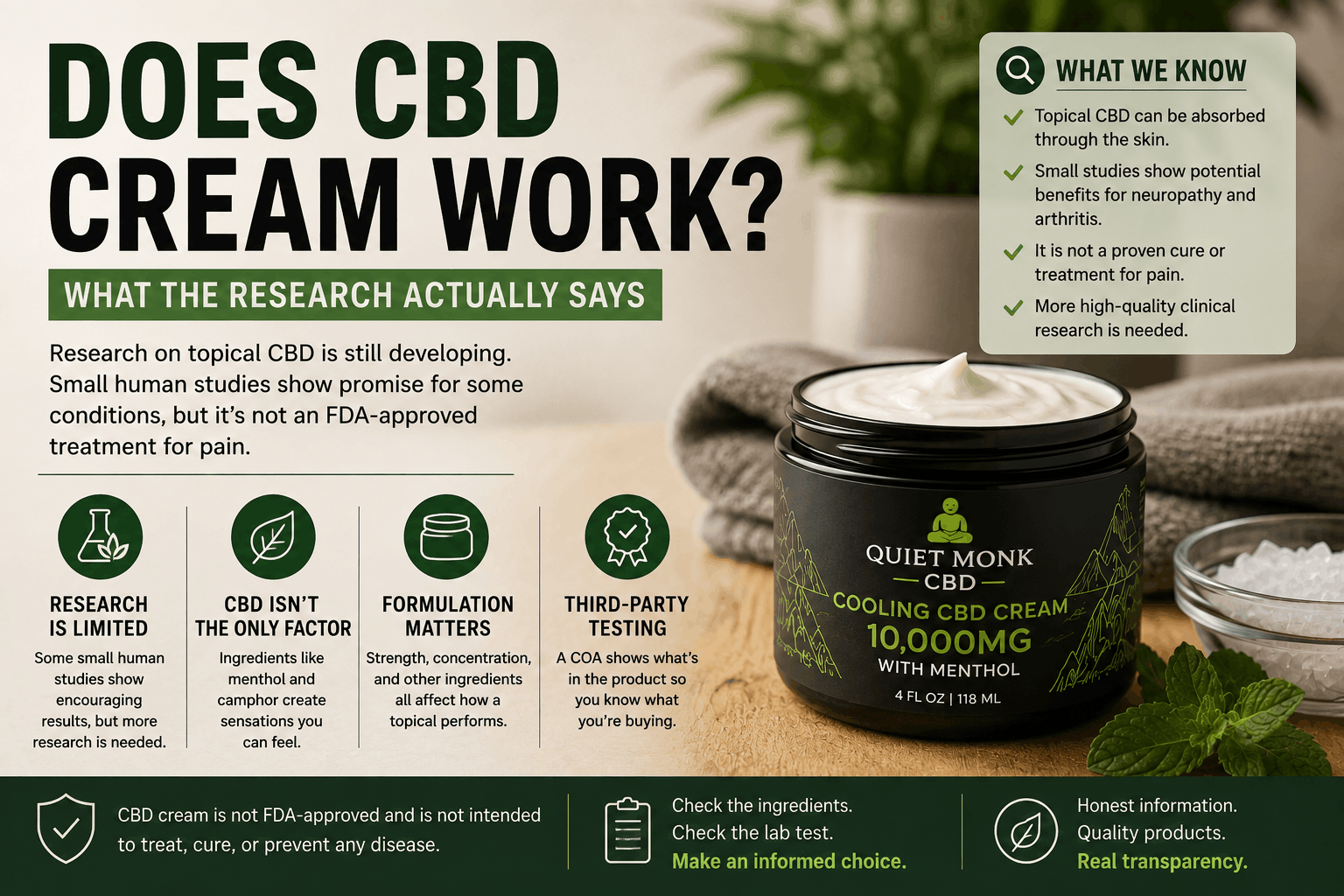
There is some interesting research involving topical CBD, but the evidence is still limited.
CBD cream is not an FDA-approved treatment for pain, arthritis, neuropathy or other medical conditions. At the same time, researchers have conducted human studies involving topical CBD that are worth understanding.
So let’s look at what we actually know.
What Is CBD Cream?
CBD cream is a topical product containing cannabidiol, or CBD.
Unlike CBD oil that’s swallowed, a topical is applied directly to the skin.
CBD topicals come in many different formulations, including:
- Creams
- Lotions
- Salves
- Balms
- Gels
- Roll-ons
The amount of CBD can also vary dramatically.
One product might contain a few hundred milligrams of CBD while another contains several thousand milligrams.
And CBD isn’t necessarily the only ingredient affecting how the product feels.
That’s an important point that often gets overlooked.
Does CBD Cream Actually Work?
There’s no scientifically responsible way to answer this question with a simple yes or no.
It depends on what someone means by “work.”
Researchers have investigated cannabinoids for pain, but much of the broader research involves cannabis products or cannabinoid formulations other than the over-the-counter CBD creams consumers commonly buy.
Research specifically involving topical CBD in humans is much smaller.
There have, however, been some interesting studies.
What Does Research on Topical CBD Show?
Topical CBD and Peripheral Neuropathy
One small randomized, placebo-controlled study involved 29 people with symptomatic peripheral neuropathy.
Participants received either a topical CBD product or placebo for four weeks.
Researchers reported improvements in several symptom measurements among participants using the CBD topical.
That’s interesting.
But 29 people is a very small study, and the particular formulation used in the research isn’t necessarily the same as the CBD cream sitting on a store shelf.
The study gives researchers a reason to continue investigating topical CBD.
It doesn’t prove that every CBD cream treats neuropathy.
Topical CBD and Thumb Arthritis
Another small randomized controlled trial investigated topical CBD in people with symptomatic thumb basal-joint arthritis.
Eighteen participants took part in the treatment portion of the study.
Researchers reported improvements in several patient-reported measurements during the CBD treatment period compared with the control.
Again, that’s encouraging.
But we’re talking about 18 participants using a specific formulation on a specific joint condition.
We can’t take that result and conclude that every CBD topical will work for every type of arthritis or pain.
Why Isn’t the Evidence Stronger?
CBD products became commercially popular much faster than the clinical research developed.
That’s created an unusual situation.
Millions of consumers have access to CBD products, but researchers are still answering fundamental questions about:
- How topical CBD interacts with the skin
- How much CBD penetrates the skin
- Which formulations affect absorption
- What concentrations are appropriate
- Whether other ingredients influence results
- Which conditions should actually be studied
- What happens with long-term use
That’s why I’m skeptical when I see a company confidently claim that its CBD cream is “clinically proven” simply because it contains CBD.
The formulation used in a clinical study matters.
CBD Isn’t Always What You’re Feeling
This is something I think consumers should understand.
Suppose you apply a CBD cream and immediately feel a powerful cooling sensation.
That sensation probably isn’t coming from the CBD.
It may be coming from menthol or another cooling ingredient.
Menthol activates cold-sensitive receptors in the skin, creating the sensation of cooling without actually lowering the temperature of the tissue.
The same principle applies to warming ingredients.
So if someone applies a cooling CBD cream and says:
“Wow, I can really feel the CBD!”
what they’re physically feeling may actually be the other active sensory ingredients in the formulation.
That doesn’t mean the CBD isn’t present.
It simply means we shouldn’t confuse the immediate sensation of a topical with evidence that CBD itself is producing that sensation.
What About Menthol and Camphor?
Menthol and camphor have long been used in topical products because of the sensations they produce on the skin.
Menthol creates a cooling sensation.
Camphor can create cooling and warming sensations depending on concentration and formulation.
These ingredients are different from CBD and shouldn’t be lumped together.
This becomes especially important when comparing CBD creams.
A strongly cooling 5,000mg CBD cream may feel much more noticeable immediately than a non-cooling 10,000mg cream.
That doesn’t mean the 5,000mg product contains more CBD.
It means the formulations are different.
Does Stronger CBD Cream Work Better?
We don’t currently have good clinical evidence establishing a universal topical CBD dose.
That’s why I’m careful about telling people that a certain number of milligrams is automatically “better.”
At Quiet Monk CBD, we manufacture products in different strengths because customers have different preferences.
But when comparing strength, you should consider concentration, not merely the number printed on the label.
For example:
5,000mg in a 4-ounce container
isn’t the same concentration as:
5,000mg in a 1-ounce container.
Our CBD Cream Strength Comparison Guide explains this in more detail.
What About CBG?
You’ll increasingly find CBD topicals containing another cannabinoid called CBG, or cannabigerol.
There’s scientific interest in CBG and other minor cannabinoids, but research is still developing.
I would be cautious about companies claiming that combining CBD and CBG has been clinically proven to produce dramatically better results.
We use CBG in some Quiet Monk formulations, but that doesn’t mean I should turn emerging cannabinoid research into a medical promise.
Consumers deserve to know the difference.
Why Customer Experiences Still Matter — With a Limitation
We’ve talked with many customers over the years who tell us they like using CBD topicals.
Those experiences matter to us.
They help us understand things such as:
- Which textures customers prefer
- Which strengths they choose
- Whether they prefer cooling or non-cooling
- How easily a product spreads
- Which product formats they like
- What questions customers have before purchasing
But customer testimonials aren’t clinical trials.
If ten customers tell me they love a particular cream, I can truthfully tell you that those customers liked the product.
I can’t turn those testimonials into scientific proof that CBD treats a medical condition.
That’s an important distinction.
How Do You Choose a CBD Cream?
If you decide to try a CBD topical, I recommend evaluating the actual product rather than relying on marketing language.
Look at the CBD concentration
Check both the total CBD and container size.
Check the complete ingredients
CBD is only part of the formulation.
Look for ingredients such as menthol, botanical extracts, carrier oils and other cannabinoids.
Decide whether you want cooling or non-cooling
These can feel dramatically different.
Look for third-party testing
A current Certificate of Analysis, or COA, can help verify the cannabinoids detected in the tested product.
Quiet Monk CBD publishes our third-party laboratory results for customers to review.
Be skeptical of miracle claims
Statements such as:
“CBD cures arthritis.”
“CBD repairs nerve damage.”
“CBD heals injuries.”
or
“CBD eliminates chronic pain.”
should make you cautious.
The scientific evidence doesn’t justify those promises.
Is CBD Cream FDA Approved for Pain?
No.
CBD creams sold as general consumer products are not FDA-approved CBD treatments for pain.
The FDA has approved one prescription drug containing purified CBD for specific seizure disorders.
That’s very different from FDA approving over-the-counter CBD creams for pain.
This distinction gets blurred frequently in CBD marketing.
Can CBD Cream Replace Pain Medication?
That’s not something a CBD company should tell you to do.
Don’t stop or replace medication prescribed by a healthcare professional because a CBD website says its product is a “natural alternative.”
If you’re managing a medical condition or taking medications, your healthcare provider or pharmacist is the appropriate person to discuss changes with.
What We’ve Learned From Making CBD Topicals
I’ve been involved with CBD long enough to see the industry go through several phases.
At one point, almost every CBD company seemed to promise everything.
CBD was marketed for sleep, anxiety, arthritis, inflammation, pain, recovery and practically anything else someone could fit onto a product page.
I don’t think that’s where the industry should be headed.
The better approach is:
Tell customers exactly what’s in the product.
Explain the concentration.
Provide third-party testing.
Explain what ingredients such as menthol actually do.
Talk about customer experiences as customer experiences.
Talk about research as research.
And don’t turn either one into something it isn’t.
That’s the standard we’re trying to follow at Quiet Monk CBD.
Frequently Asked Questions
Does CBD cream work immediately?
CBD itself shouldn’t be assumed to produce an immediate noticeable sensation. If a CBD cream feels strongly cooling immediately after application, ingredients such as menthol may be responsible for much of that sensation.
Is CBD cream proven to relieve pain?
There have been some small human studies with encouraging results involving topical CBD, but the evidence remains limited. Over-the-counter CBD creams are not FDA-approved treatments for pain.
Is higher-strength CBD cream better?
Not necessarily. There isn’t an established universal topical CBD dose. Consider CBD concentration, container size, formulation, ingredients and third-party testing.
Does CBD cream work for neuropathy?
A small randomized study of topical CBD involving people with peripheral neuropathy reported encouraging results, but substantially more research is needed. CBD topicals shouldn’t be presented as proven treatments for neuropathy.
Does CBD cream work for arthritis?
A small randomized trial involving thumb basal-joint arthritis reported improvements with a topical CBD formulation. However, the study was small and doesn’t establish that commercial CBD creams generally treat arthritis.
Why does some CBD cream feel cold?
Cooling ingredients such as menthol activate receptors in the skin that produce a cooling sensation. That sensation shouldn’t automatically be attributed to CBD.
How do I know whether CBD cream actually contains CBD?
Look for independent third-party laboratory testing. A Certificate of Analysis can show the cannabinoid concentrations detected in the tested sample.
Final Thoughts: So, Does CBD Cream Work?
The most accurate answer right now is:
There’s interesting early research, but we still need much better evidence.
Small human studies involving topical CBD have produced encouraging results in areas such as peripheral neuropathy and thumb arthritis.
That’s worth paying attention to.
But it doesn’t justify saying that CBD cream has been proven to treat pain generally.
At Quiet Monk CBD, we’re comfortable saying “we don’t know yet” when science hasn’t provided a definitive answer.
We’ve spent years making CBD topicals, experimenting with formulations and listening to customers.
That experience has taught me a lot about CBD products.
It has also taught me that good CBD companies don’t need to promise miracles.
Give people good products, honest information, transparent laboratory testing and enough information to make their own decisions.
That’s what we’re trying to do.