If you’ve shopped for CBD topicals, you’ve probably noticed that they come in just about every form imaginable: creams, lotions, gels, salves, balms, roll-ons, and sticks.
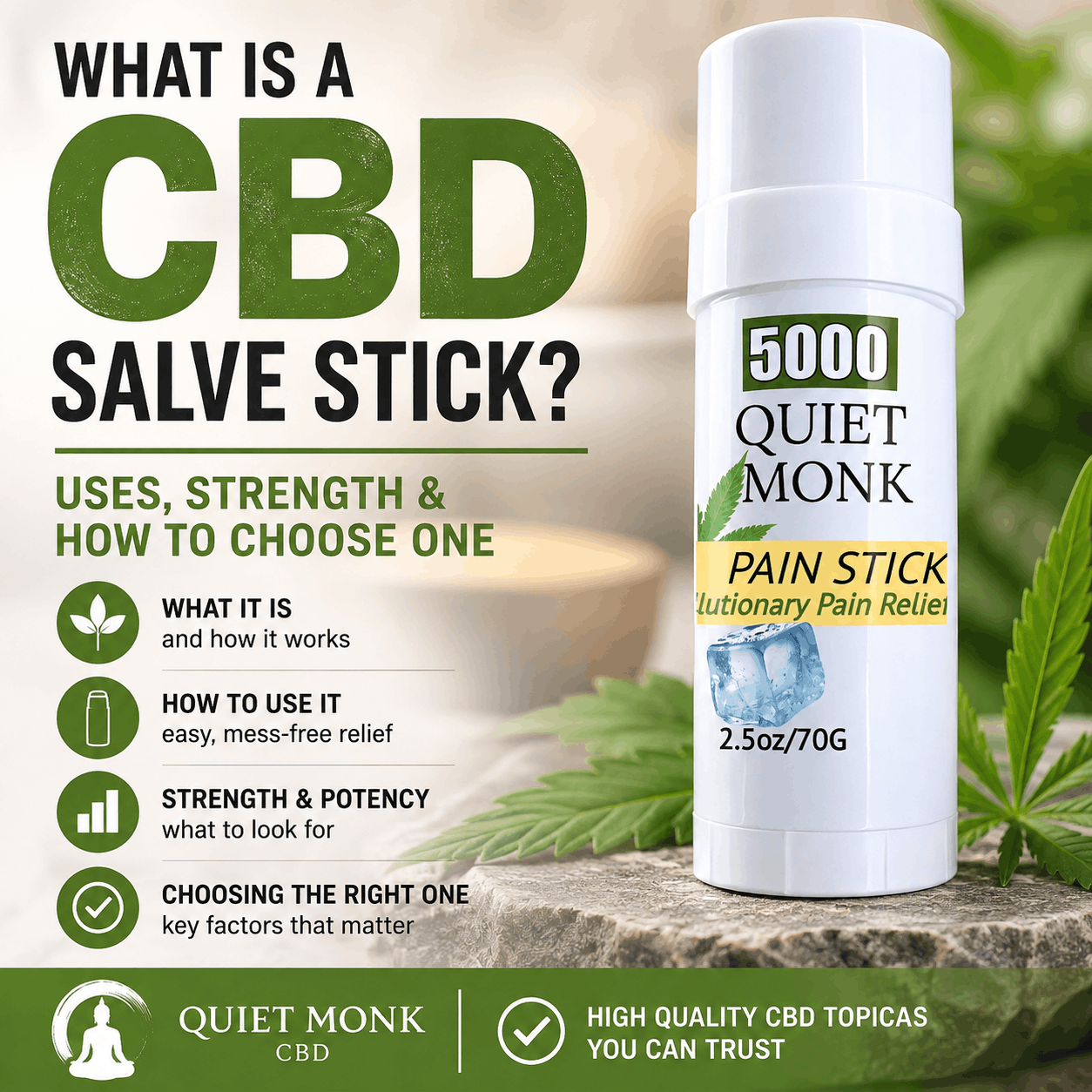
One that customers sometimes ask us about is the CBD salve stick.
The easiest way to explain it is that a CBD salve stick is basically a solid CBD balm packaged in a twist-up container. Instead of scooping a salve out of a jar with your fingers, you apply the stick directly to the area where you want it.
It’s simple, portable, and less messy than using a traditional jar.
But there are some important differences between a CBD salve stick, CBD cream, and CBD balm—and potency can vary tremendously from one product to another.
Here’s what I think consumers should actually look at when comparing them.
What Is a CBD Salve Stick?
A CBD salve stick is a solid topical containing cannabidiol (CBD) that is designed to be applied directly to the skin.
Most use an oil-and-wax base rather than the water-based formulation commonly used to make creams and lotions.
A typical formula might contain ingredients such as:
- CBD
- Carrier oils
- Beeswax or another wax
- Botanical oils or extracts
- Menthol in cooling formulas
- Other cannabinoids such as CBG
The wax helps keep the formula solid enough to stay inside the applicator.
Twist the bottom of the container, expose a small amount of the balm, and glide it directly over the skin.
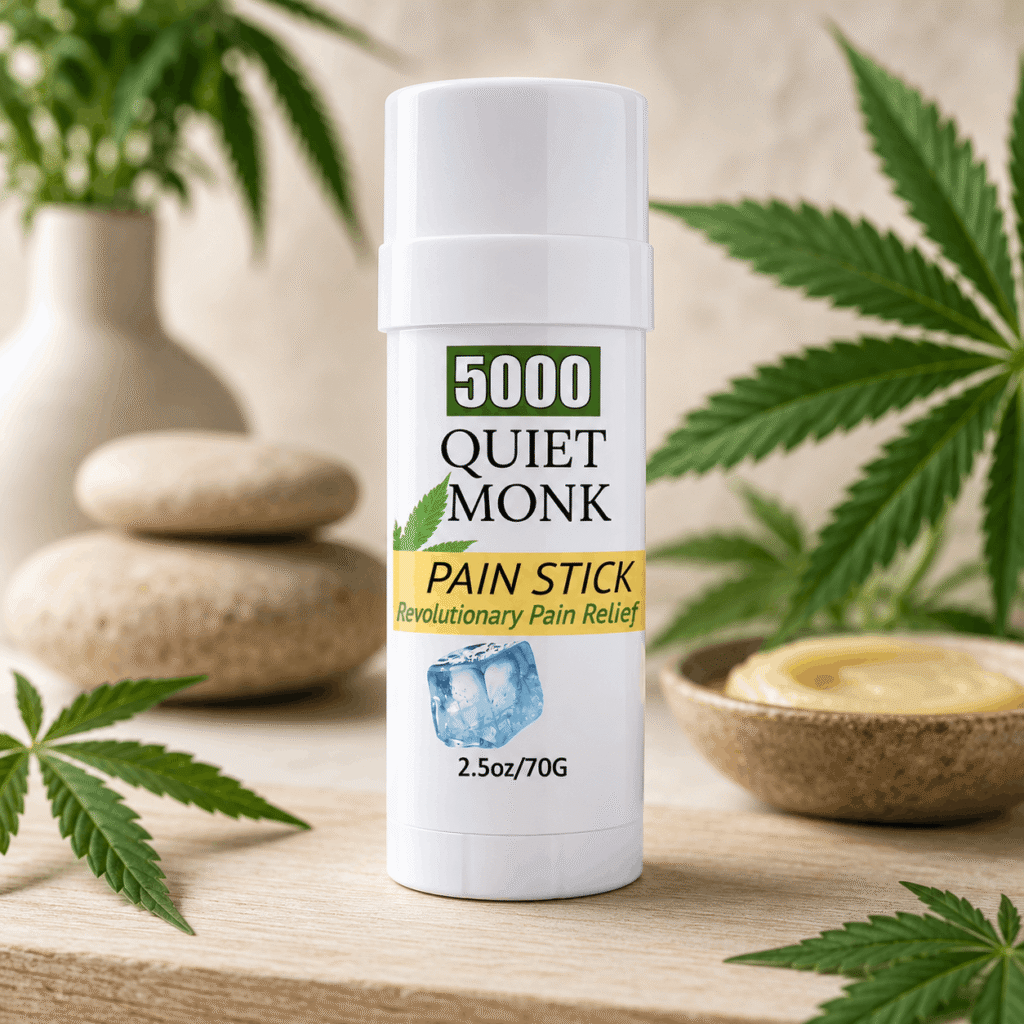
Quiet Monk 5,000mg CBD Pain Stick
5,000mg CBD • 2.5 oz • Easy direct application
View the 5,000mg Pain Stick →
Why Put CBD Salve in a Stick?
Convenience is probably the biggest advantage.
Traditional salves normally come in jars. There’s nothing wrong with that—we sell salves in jars ourselves—but you have to scoop the product out and massage it into your skin.
A stick lets you apply the product without putting your fingers into the container.
That makes CBD sticks particularly convenient for keeping in a gym bag, desk, purse, backpack, or vehicle.
They’re also useful when you want to apply a topical to a specific area without spreading it everywhere.
CBD Salve Stick vs. CBD Balm Stick
There isn’t a strict industry-wide definition separating a CBD salve stick from a CBD balm stick.
You’ll often see the terms used interchangeably.
Both generally describe an oil-and-wax-based CBD topical with a relatively solid consistency.
That’s why I wouldn’t choose one product simply because the manufacturer calls it a “salve” while another company calls theirs a “balm.”
Look at the formulation instead.
Check:
- How much CBD is in it?
- How large is the container?
- Does it contain other cannabinoids?
- Does it contain menthol?
- What oils and waxes are used?
- Is there third-party testing?
Those differences tell you much more than whether the label says balm or salve.
CBD Salve Stick vs. CBD Cream
There is a more meaningful difference between a salve and a cream.
CBD salves and balms
Salves and balms are generally oil-and-wax based. They tend to be thicker and remain on the skin longer.
CBD creams
Creams usually contain water as part of an emulsion. They can feel lighter and often absorb more quickly.
Neither is automatically better.
Some people prefer the richer consistency of a salve. Others don’t like the oily feeling and prefer a fast-absorbing cream.
At Quiet Monk CBD, we’ve found that different customers have very different preferences, which is one reason we offer multiple types of CBD topicals rather than assuming one formulation works for everyone.
If you’re trying to understand the differences between these product types, our selection of CBD salves and balms provides examples of the different strengths and formulations available.
How Do You Use a CBD Salve Stick?
Using one is straightforward.
Twist the container until a small amount of the product extends above the applicator.
Apply it directly to clean, dry skin and gently massage the product into the area.
You don’t need to expose a large amount of the stick. Extending it too far can make a softer balm break off, especially in warm temperatures.
I also recommend starting with a relatively small amount. You can always apply more if necessary.
Follow the directions provided with the individual product because formulations and suggested use can vary.
How Strong Is a CBD Salve Stick?
This is where consumers need to pay attention.
CBD stick potency can vary enormously.
One product might contain a few hundred milligrams of CBD, while another contains 1,000mg or more.
But don’t look only at the total CBD number.
Container size matters.
For example, 1,000mg of CBD in a small stick is not the same concentration as 1,000mg spread throughout a large jar of salve.
When comparing products, consider:
Total CBD ÷ product size = a more useful picture of concentration.
You don’t necessarily need to calculate the exact number every time, but you should at least compare similarly sized products.
This is especially important now that CBD topicals are available in dramatically different strengths.
If you’re comparing different topical concentrations, our CBD cream strength guide explains how potency, container size and total CBD content compare across different strengths.
Does More CBD Mean a Better Salve Stick?
Not necessarily.
Higher potency simply means the product contains a greater concentration or total amount of CBD, depending on the size of the product.
It doesn’t automatically make the product better.
Someone trying CBD for the first time may have completely different preferences from someone who has been buying high-potency topicals for years.
This is why I prefer to look at potency as a product specification, not a promise about what the product will do.
The same applies to our own products.
We manufacture very high-potency CBD topicals, but I don’t believe the largest milligram number is automatically the right choice for every customer.
The difference in potency across CBD topicals can be substantial. For example, our 50,000mg CBD + CBG salve sits at the extreme high-potency end of our topical lineup, while our CBD Pain Stick offers a different format for people who prefer direct, mess-free application. Higher potency isn’t automatically the right choice for everyone, which is why it’s important to compare the product size, cannabinoid content and formulation rather than simply choosing the largest number.
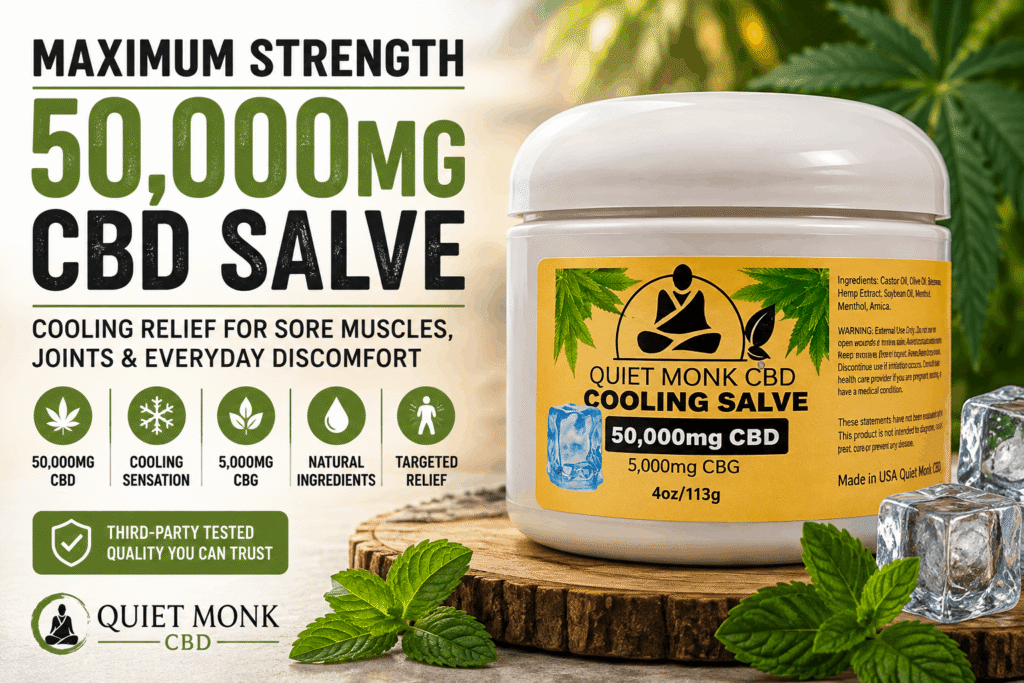
Looking for a higher-potency salve?
Explore Quiet Monk CBD’s 50,000mg CBD + CBG Salve →
What About CBG?
You’ll increasingly see CBD topicals that also contain CBG, or cannabigerol.
CBG is another naturally occurring cannabinoid found in hemp.
Some manufacturers combine CBD and CBG rather than relying entirely on CBD.
When comparing these products, read the cannabinoid amounts carefully.
For example:
is different from:
5,500mg CBD
even though both products contain 5,500mg of total cannabinoids.
I prefer companies to tell consumers exactly how much of each cannabinoid they’re getting rather than combining everything into one large number.
What Does Menthol Do in a CBD Stick?
Menthol is commonly added to topical products because it creates a noticeable cooling sensation on the skin.
Some people love that sensation.
Others absolutely hate it.
That’s why you should check the ingredients rather than assuming every CBD topical feels the same.
Also remember:
Menthol strength and CBD strength are completely different things.
A product can produce an intense cooling sensation while containing relatively little CBD.
Likewise, a high-potency CBD topical doesn’t necessarily produce a strong sensation on the skin if it doesn’t contain menthol or similar ingredients.
Don’t use the cooling sensation as a way of judging CBD potency.
What Should You Look for When Buying a CBD Salve Stick?
If I were comparing CBD sticks, these are the things I would check first.
1. CBD content
Find out how much CBD is actually in the product.
2. Product size
Always consider potency relative to the size of the container.
3. Other cannabinoids
Check whether the formula contains CBG or other cannabinoids in addition to CBD.
4. Ingredients
Look for menthol, fragrances, essential oils, carrier oils, waxes, and anything else that matters to you.
5. Third-party testing
This is a big one.
A reputable CBD company should make independent laboratory testing available so consumers can verify cannabinoid content and review the testing performed on the product.
6. THC information
If avoiding THC matters to you, don’t simply assume that every CBD product is THC-free.
Check the product information and laboratory report.
7. Company transparency
You should be able to figure out who is selling the product, how to contact them, and what their return policy is.
That sounds basic, but it’s worth checking before buying from an unfamiliar CBD website.
Should You Patch Test a CBD Topical?
I recommend it.
Whenever you’re trying a new topical product, apply a small amount to a limited area of skin first.
This is particularly important if the product contains menthol, essential oils, fragrances, or botanical ingredients you’ve never used before.
If your skin reacts badly, stop using it.
And don’t apply ordinary CBD salves or creams to broken skin unless the specific product is formulated and labeled for that use.
Can You Travel With a CBD Salve Stick?
The stick format is convenient for travel because it’s compact and doesn’t have the same potential for leaking as some creams or oils.
However, laws and travel rules involving hemp-derived products can vary by destination.
If you’re flying or traveling internationally, check the current rules for your destination before packing CBD products.
How Should You Store a CBD Salve Stick?
Keep it somewhere cool and dry.
Because salve sticks typically contain oils and waxes, excessive heat can soften the formula.
Leaving one in a hot vehicle, for example, isn’t a great idea.
If the product becomes very warm, let it return to normal room temperature before extending the stick.
Also keep the cap closed when you’re not using it.
Are CBD Salve Sticks Only for Athletes?
No.
The stick format is simply a convenient method of applying a topical.
Athletes may like the portability, but CBD sticks are also used by people who simply prefer a mess-free topical they can keep nearby.
The important thing is choosing a formulation based on its actual specifications rather than who appears in the marketing.
CBD Salve Stick, Cream, or Traditional Balm: Which Should You Choose?
This really comes down to preference.
Choose a CBD salve stick if portability and direct application matter most.
Choose a traditional CBD salve or balm if you prefer a richer oil-and-wax formulation and don’t mind applying it with your fingers.
Choose a CBD cream if you prefer something lighter and generally faster absorbing.
Then compare potency, ingredients, cannabinoid content, testing, and price within whichever category you prefer.
That’s a much better way to shop than assuming one type of CBD topical is universally superior.
Final Thoughts
CBD salve sticks aren’t complicated.
They’re essentially a convenient way to package a solid CBD topical so you can apply it directly to your skin without scooping product from a jar.
What matters much more is what’s inside the stick.
Look at the amount of CBD, product size, additional cannabinoids, ingredients, menthol content, third-party testing, and the company behind the product.
I’ve been around CBD products long enough to see potency numbers become bigger and marketing claims become louder. My advice is to ignore most of the hype and compare what you can actually verify.
A clear label, transparent formulation, and accessible laboratory testing tell you considerably more than a phrase like “maximum strength.”
About the Author

Steven Gregoire is the founder of Quiet Monk CBD, a U.S. CBD company specializing in high-potency CBD topicals, including CBD and CBG creams, salves, balms, gels, and sticks. He writes about CBD from the perspective of someone involved directly in the business, with a focus on helping consumers understand potency, ingredients, formulations, and product testing.
This article is for general educational purposes only and is not intended as medical advice. CBD products are not intended to diagnose, treat, cure, or prevent any disease. If you have a medical condition or take medication, consult an appropriate healthcare professional.