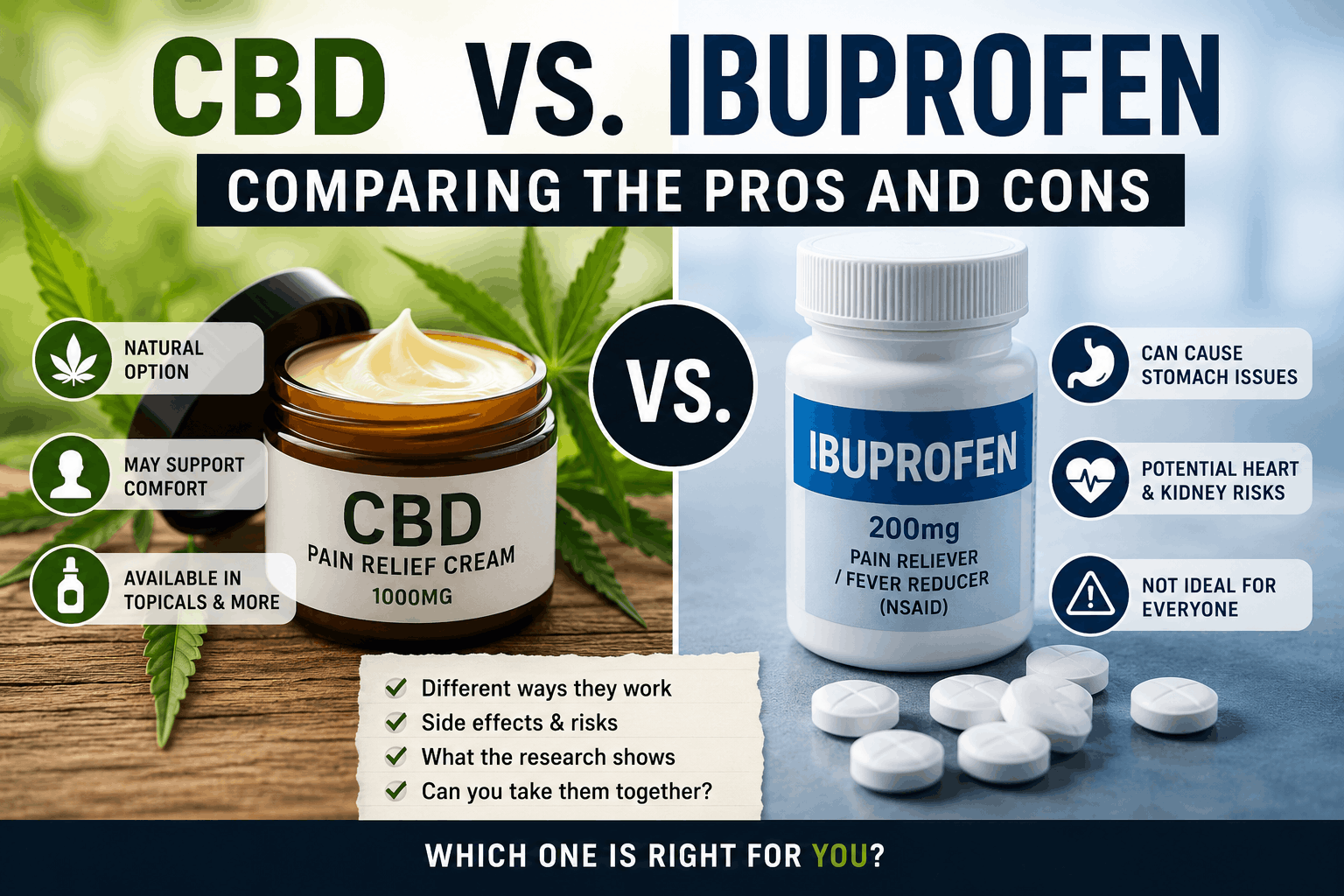
If you’re looking at CBD and ibuprofen for pain, you’re probably trying to figure out a pretty simple question:
Which one should I use?
I don’t think there’s a one-size-fits-all answer. Ibuprofen is a well-established medication that’s been used for decades. CBD is a completely different type of product, and the research surrounding it is still developing.
I’ve been in the CBD business for a long time, and one thing I’ve learned is that it’s easy to make CBD sound better than the research actually supports.
I’d rather give you the straight answer.
Here’s how I would compare the two.
What Is CBD?
CBD stands for cannabidiol. It’s one of the naturally occurring cannabinoids found in hemp and cannabis.
CBD itself isn’t intoxicating like THC.
You can find CBD in all kinds of products, including:
Oils
Gummies
Capsules
Creams
Salves and balms
Gels
Roll-ons
For this comparison, there’s one thing that’s particularly important:
A CBD cream isn’t the same thing as CBD oil.
A cream is applied to the skin, while an oil is generally taken orally or used sublingually.
So if you’re looking at CBD cream specifically, don’t assume that research on oral CBD automatically tells you how a topical CBD product will perform.
What Is Ibuprofen?
Ibuprofen is a nonsteroidal anti-inflammatory drug, commonly called an NSAID.
You’ve probably seen it sold under names such as Advil and Motrin.
It’s commonly used for temporary relief of things like:
Headaches
Toothaches
Muscle aches
Backaches
Menstrual cramps
Minor injuries
Fever
One of the big advantages of ibuprofen is that there’s a large amount of research and clinical experience behind it.
We know what it does, how it’s used and what the major risks are.
That doesn’t mean it’s perfect or that everyone should take it.
It means we have a lot more evidence about it than we currently have about CBD.
How Does Ibuprofen Work?
Ibuprofen works by reducing the production of substances called prostaglandins. Prostaglandins are involved in pain, inflammation and fever. By reducing their production, ibuprofen can help reduce pain and inflammation. This is one of the areas where ibuprofen and CBD are very different. We have a pretty good understanding of how ibuprofen works.
CBD is more complicated.
Researchers are studying how CBD interacts with the endocannabinoid system and other signaling pathways, but we still don’t have a simple explanation that says, “CBD does X, and therefore your pain goes away.”
How Does CBD Compare With Ibuprofen for Pain?
This is where I’d be careful with the claims you see online.
There is research into CBD and cannabinoids for pain.
But the evidence isn’t nearly as strong or consistent as it is for ibuprofen.
The 2025 update of a large living systematic review from the Agency for Healthcare Research and Quality found that evidence for CBD alone did not show a reduction in pain intensity compared with placebo in the oral CBD trials it reviewed.
The same review said evidence for topical CBD was still insufficient to draw conclusions.
That’s important.
It doesn’t mean CBD can’t help anyone.
It means we shouldn’t tell people that CBD has already been proven to work as well as ibuprofen.
The research isn’t there yet.
What About Topical CBD Cream?
This is where things get more interesting for someone looking at Quiet Monk.
There have been human studies specifically looking at topical CBD.
One small randomized, placebo-controlled study involving 29 people with peripheral neuropathy found reductions in several pain-related symptoms with topical CBD compared with placebo.
That’s encouraging.
But it was a small study.
And another randomized, placebo-controlled study involving 40 people with chemotherapy-induced peripheral neuropathy did not find a meaningful improvement with a topical CBD isolate cream compared with placebo.
So we have studies going in different directions.
That’s exactly why I wouldn’t make a blanket statement that CBD cream is proven to work for pain.
There’s something worth researching, but we still need better studies.
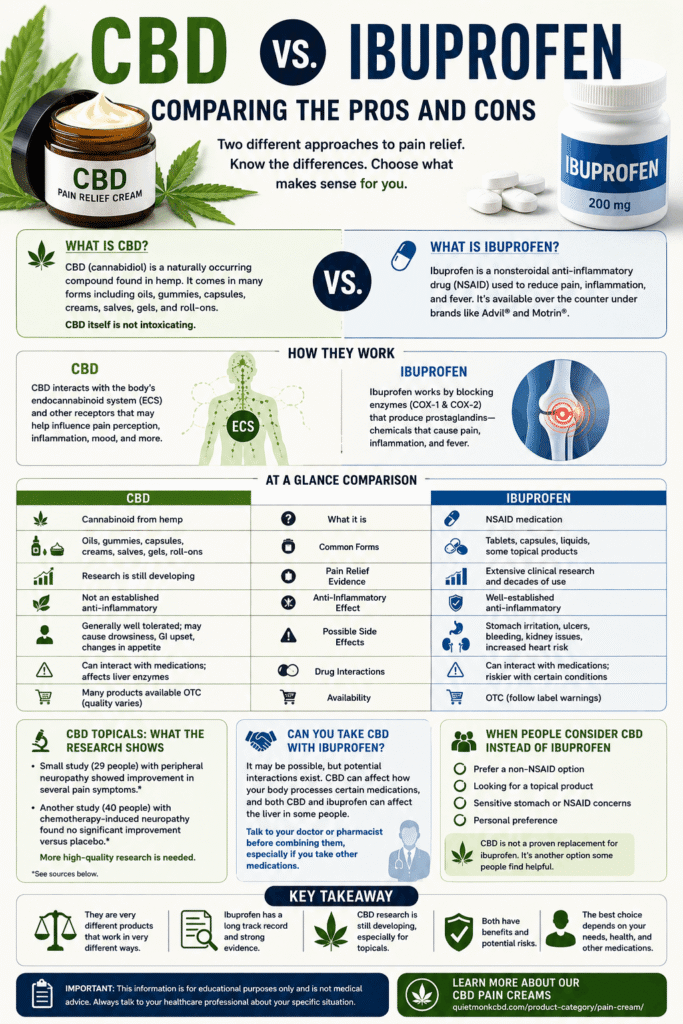
CBD vs. Ibuprofen: The Basic Differences
CBD
Ibuprofen
What is it?
Cannabinoid
NSAID medication
Common forms
Oils, gummies, capsules, creams, salves
Tablets, capsules, liquids and some topical products
Pain evidence
Still developing
Extensive
Anti-inflammatory evidence
Still developing
Well established
Intoxicating?
CBD itself isn’t intoxicating
No
Available OTC?
Many consumer CBD products are
Yes
Drug interactions
Possible
Possible
Long-term safety
Still being studied
Well-established risks
So if you’re looking for the product with the most established evidence for pain and inflammation, that’s ibuprofen.
If you’re interested in CBD, you’re looking at a much newer and less certain area of research.
What Are the Advantages of Ibuprofen?
The biggest advantage is pretty obvious:
It works, and we’ve studied it extensively.
Ibuprofen can be useful for temporary pain, inflammation and fever when used according to the label. It’s also inexpensive and easy to find. But there’s a tradeoff.
Ibuprofen isn’t something I’d recommend treating casually just because you can buy it at almost any drugstore.
NSAIDs can cause stomach bleeding and ulcers and can increase the risk of heart attack or stroke. They can also affect the kidneys. The FDA specifically warns about these risks, particularly with higher doses or longer use. That’s why following the label matters.
What Are the Advantages of CBD?
I think the biggest reason people look at CBD is that they want another option.
Some people don’t like taking NSAIDs.
Some people are interested in trying a topical rather than taking something by mouth.
And some people simply prefer CBD products.
That’s completely understandable.
But I’d separate that from the question of whether CBD has been clinically proven to replace ibuprofen.
It hasn’t.
The research is still developing.
What Are the Downsides of CBD?
CBD isn’t automatically risk-free just because it comes from hemp.
This is another area where I’d ignore some of the marketing you’ll see.
The FDA says CBD can cause liver injury and can affect how other medications work. The FDA also says there are still important unanswered questions about the safety of widely available consumer CBD products.
That’s particularly important if you’re taking medications.
If you’re taking prescription drugs, I’d talk with your doctor or pharmacist before adding oral CBD to your routine.
And when you’re buying CBD, I’d look for:
Third-party laboratory testing
A clear ingredient list
A clearly stated CBD amount
A reputable manufacturer
Clear directions
You shouldn’t have to guess what’s actually in the product.
What Are the Downsides of Ibuprofen?
Ibuprofen’s biggest downside is the risk that comes with NSAID use.
Possible problems include:
Stomach irritation
Ulcers
Gastrointestinal bleeding
Kidney problems
Increased cardiovascular risk
Drug interactions
The risk depends on things like your health, dose, how long you’re taking it and what other medications you’re using.
The FDA’s OTC labeling specifically warns about stomach bleeding as well as increased risk of heart attack and stroke with NSAIDs.
So while ibuprofen is well established, well established doesn’t mean risk-free.
Can You Take CBD With Ibuprofen?
This is a question I would definitely keep in this article because people are searching for it.
The short answer is:
Don’t assume that CBD and ibuprofen are automatically safe to combine just because they’re both widely available.
CBD can interact with drug-metabolizing enzymes and may affect the way other medications are processed.
There are also concerns about CBD and medications that can affect the liver.
There isn’t a simple “wait two hours and you’re fine” rule that I would give someone.
If you’re taking ibuprofen regularly and want to add CBD—especially oral CBD—I’d ask your doctor or pharmacist first.
That’s even more important if you’re taking other medications.
What About CBD Cream and Ibuprofen?
This is a little different.
If you’re comparing a CBD cream with an ibuprofen tablet, you’re comparing two completely different delivery methods.
The CBD cream is applied to the skin.
The ibuprofen tablet is swallowed and enters the systemic circulation.
So don’t assume that a study involving oral CBD tells us exactly what a CBD cream will do. That’s one reason I think topical CBD research deserves to be studied on its own.
Is CBD a Natural Alternative to Ibuprofen?
You’ll see CBD described this way all over the internet. I think the word “alternative” can be misleading. CBD comes from a plant, but that doesn’t automatically make it safer.
And ibuprofen being manufactured as a pharmaceutical doesn’t automatically make it bad.
They’re simply different products.
If you’re interested in CBD because you don’t want to take ibuprofen, that’s one thing. But I wouldn’t make the decision based on the idea that: “Natural = safe and pharmaceutical = dangerous.”
It’s not that simple.
Which Is Better for Inflammation?
If we’re talking about established anti-inflammatory medication, ibuprofen has the clear advantage in terms of clinical evidence.
CBD is being studied for its potential effects on inflammatory pathways, but we don’t have enough human evidence to say that CBD cream works like ibuprofen.
That’s an important distinction.
If you see a CBD company saying its cream is a proven anti-inflammatory medication, I’d want to see the actual clinical evidence behind that claim.
Which Is Better for Muscle Pain?
Again, it depends on what you’re looking for.
Ibuprofen has established uses for temporary muscle aches and pain.
A CBD topical gives you another way to approach a localized area.
This is one area where the topical research is particularly interesting.
As I mentioned earlier, the small randomized study involving peripheral neuropathy found improvements in several symptoms with topical CBD. But the later chemotherapy-induced neuropathy trial didn’t find the same result. So again, interesting research doesn’t equal a proven treatment.
If nerve discomfort is what brought you here, you can also read our information on CBD for neuropathy.
CBD vs. Ibuprofen: Which One Should You Choose?
If you want my honest answer, I wouldn’t choose based on which product has the better marketing.
I’d start with the reason you’re using it.
If you’re looking for an established medication for temporary pain, inflammation or fever, ibuprofen has a long track record.
If you’re interested in trying CBD, understand that the evidence is still developing.
And if you’re specifically interested in topical CBD, pay attention to research involving topical products rather than assuming oral CBD studies tell the whole story.
Then look at the actual product you’re buying.
What’s in it?
How much CBD does it contain?
Has it been third-party tested?
Do you want a cream, gel or salve?
Do you want cooling ingredients such as menthol?
Those questions are much more useful than simply asking which product is “stronger.”
Frequently Asked Questions
Is CBD better than ibuprofen?
There isn’t enough evidence to say that CBD is better than ibuprofen for pain. Ibuprofen has a much larger evidence base, while research on CBD for pain is still developing.
Can CBD replace ibuprofen?
I wouldn’t make that claim. CBD hasn’t been established as a replacement for ibuprofen, and anyone taking medication for an ongoing condition should talk with their healthcare professional before changing their routine.
Can you take CBD and ibuprofen together?
CBD can interact with medications, and there isn’t a simple universal rule for combining it with ibuprofen. If you’re taking ibuprofen regularly, particularly along with other medications, ask your doctor or pharmacist before adding oral CBD.
Is CBD safer than ibuprofen?
It’s not accurate to make that blanket statement. Ibuprofen has well-established risks, while CBD also has potential risks and drug interactions that are still being studied.
Does CBD reduce inflammation like ibuprofen?
Ibuprofen is an established anti-inflammatory medication. Research suggests CBD may influence inflammatory pathways, but there isn’t enough human evidence to say that CBD works like ibuprofen.
Does CBD cream work like ibuprofen?
No. They’re different products and different delivery methods. A CBD cream is applied to the skin, while standard ibuprofen tablets are taken orally.
Is CBD cream an alternative to ibuprofen?
Some people choose topical CBD when they’re looking for another option for localized discomfort, but CBD cream shouldn’t be presented as a clinically proven replacement for ibuprofen.
Which has more research, CBD or ibuprofen?
Ibuprofen has substantially more clinical research and decades of established medical use. CBD research has grown considerably, but important questions remain.
Research & Sources
Want to look at the research yourself? Here are some of the sources I used for this article.
AHRQ 2025 Living Systematic Review — Cannabis and Other Plant-Based Treatments for Chronic Pain Read the 2025 evidence review
I’m Steve, founder of Quiet Monk CBD. I started Quiet Monk because I wanted to make CBD products that were straightforward and didn’t rely on all the hype and exaggerated claims you see in this industry. We focus on high-potency CBD products, quality ingredients and third-party testing, and I spend a lot of time researching and testing the products we make.