
If you’ve been researching CBD for pain, you’ve probably seen the phrase “CBD reduces pain and inflammation” quite a bit.
I’ve used that phrase myself over the years because it’s a simple way to describe why people are interested in CBD.
But there’s a problem with making it sound too simple.
The research on CBD and pain is still developing. Some studies are encouraging, while others haven’t found much of a difference. And when you look closely at the research, you’ll find that some studies use CBD by itself, some use CBD with THC, some use oral products, and some use topical products.
Those aren’t all the same thing.
So let’s look at what we actually know.
What Is CBD?
CBD stands for cannabidiol. It’s a cannabinoid found naturally in hemp and cannabis plants.
Unlike THC, CBD isn’t intoxicating in the same way THC is.
CBD has attracted a lot of interest because cannabinoids interact with biological systems involved in things like pain perception, inflammation, mood and other processes in the body.
But that doesn’t mean CBD has been proven to treat every condition it’s marketed for.
That’s an important distinction.
There’s a lot of interesting research out there, but there’s also a lot of marketing that gets ahead of the research.
How Could CBD Affect Pain?
This is where things get a little complicated.
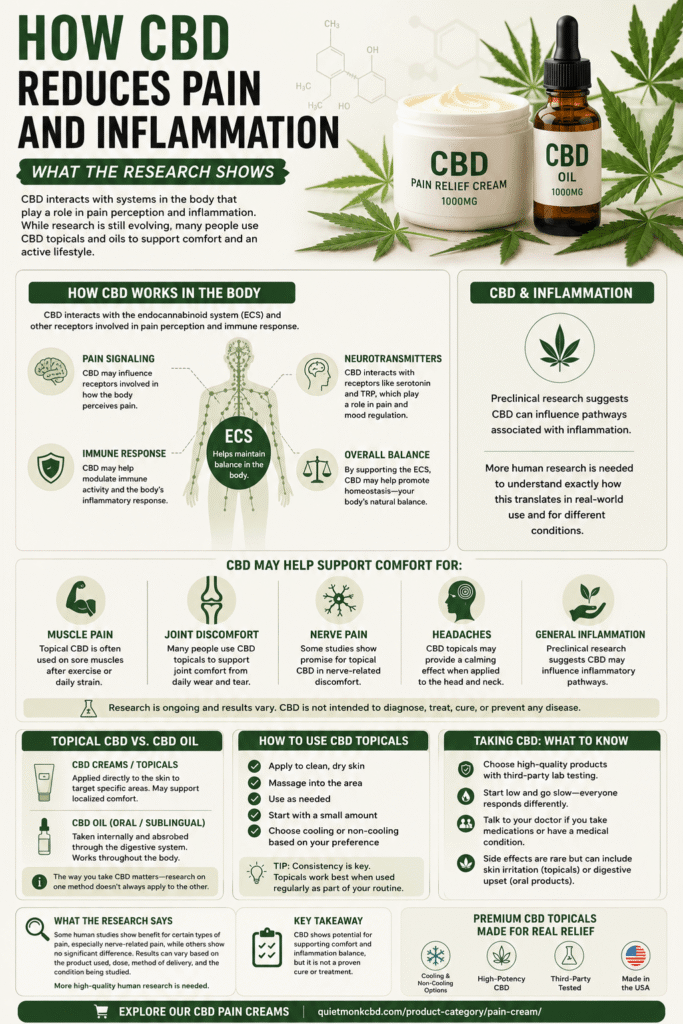
Your body has what’s called the endocannabinoid system (ECS). It plays a role in several physiological processes, including pain signaling and immune function.
CBD doesn’t simply “turn off” pain.
Instead, researchers are studying how CBD may influence several pathways involved in pain perception and inflammation.
CBD also interacts with receptors and signaling systems beyond the classic cannabinoid receptors, including pathways involving serotonin and TRP receptors.
That sounds complicated, but here’s the simple version:
Researchers think CBD may influence some of the systems involved in how the body processes pain and other signals.
That is different from saying we’ve proven exactly how CBD relieves pain in humans.
What Is the Endocannabinoid System?
You may have heard of the endocannabinoid system if you’ve spent much time researching CBD.
It’s a biological signaling system found throughout the body.
It includes:
- Cannabinoid receptors
- Endocannabinoids produced by the body
- Enzymes that make and break down those compounds
The ECS is involved in maintaining balance across several biological processes.
Pain perception is one area researchers are interested in.
But there’s an important point here:
The fact that CBD interacts with systems involved in pain doesn’t automatically mean a CBD product will relieve your pain.
That’s something we need human clinical research to determine.
Does CBD Reduce Inflammation?
This is another area where I think CBD marketing sometimes gets ahead of the science.
There is preclinical research suggesting CBD can influence pathways associated with inflammation.
A lot of that research has been conducted in cells or animals.
That’s useful because it gives researchers clues about how CBD might work.
But a laboratory study isn’t the same thing as a human clinical trial.
So I wouldn’t tell you that CBD cream has been proven to “reduce inflammation” in every person who uses it.
A more accurate statement is:
Research suggests CBD may influence biological pathways involved in inflammation, but more human research is needed to understand what that means in real-world use.
That’s not as flashy as saying “CBD reduces inflammation.”
It’s also more honest.
What Does the Human Research Show?
This is probably the part that matters most.
There are human studies looking at CBD and cannabinoids for pain, and the results are mixed.
The National Center for Complementary and Integrative Health says some evidence suggests cannabis or cannabinoids may provide modest benefits for certain types of chronic pain, particularly neuropathic pain.
But many of those studies involve cannabis products or cannabinoids that contain THC.
That doesn’t necessarily tell us what CBD by itself will do.
That’s why I think it’s important to look at the actual product used in each study.
What About Topical CBD?
This is especially relevant if you’re reading this because you’re interested in CBD cream.
There have been some clinical studies of topical CBD.
One randomized, placebo-controlled study involved 29 people with peripheral neuropathy.
Participants used either a topical CBD preparation or placebo for four weeks. The researchers reported significant reductions in several pain-related symptoms in the CBD group, including intense pain, sharp pain, cold sensations and itching.
That’s interesting.
But it was a relatively small study, and it was studying peripheral neuropathy—not every type of pain.
There was also a 2024 randomized, placebo-controlled pilot study involving 40 people with chemotherapy-induced peripheral neuropathy.
This study used a CBD isolate cream.
The researchers did not find a significant difference between the CBD and placebo groups for their primary outcome.
That’s important, too.
So we have one topical study with encouraging results and another that didn’t find a meaningful difference.
That’s why I wouldn’t tell you that topical CBD has been proven to treat pain.
The research is still developing.
Why Do Different CBD Studies Get Different Results?
There are a lot of variables.
For example:
What type of CBD was used?
CBD isolate is different from a full-spectrum or broad-spectrum product.
How was it taken?
A capsule isn’t the same as a cream.
How much was used?
The dose matters.
What condition was being studied?
Peripheral neuropathy isn’t the same thing as arthritis or muscle soreness.
How long was the study?
A four-week study doesn’t tell us everything about long-term use.
And perhaps most importantly:
Was there a placebo group?
A well-designed placebo-controlled study gives us much stronger evidence than simply asking people whether they felt better after using a product.
CBD Cream vs. CBD Oil
This is an important distinction if you’re shopping for CBD.
CBD oil is generally taken orally or sublingually, depending on the product.
CBD cream is applied to the skin.
You shouldn’t assume that a study involving oral CBD tells you exactly what will happen when you apply CBD cream to your skin.
The route of administration matters.
So if you’re specifically interested in a topical, I’d pay particular attention to research involving topical products rather than assuming all CBD research applies equally to creams.
How Does Topical CBD Work?
When you apply CBD cream to your skin, you’re using a very different delivery method from taking CBD orally.
A topical product is applied directly to the skin over the area you’re interested in.
The skin contains cannabinoid-related receptors and other biological targets that researchers are studying.
But there’s a common misconception I’d clear up:
Applying CBD cream to your skin doesn’t necessarily mean large amounts of CBD enter your bloodstream.
How much of an ingredient penetrates the skin depends on the formulation, the ingredient itself and other factors.
That’s one reason I don’t like making blanket statements about exactly what every CBD cream does once you apply it.
If you want to go deeper into this subject, our guide to CBD absorption through the skin explains the issue in more detail.
What About CBD for Muscle Pain?
Muscle discomfort is one of the reasons people look at topical products.
A cream gives you the ability to apply something directly to the area and massage it into the skin.
But again, I’d separate the experience of using a topical from claims about treating the underlying cause of muscle pain.
If you’re dealing with persistent muscle pain, it’s worth figuring out why it’s happening rather than simply trying to cover up the symptom.
For people looking specifically for a topical product, our CBD pain cream collection is where I’d start.
What About CBD for Joint Pain?
Joint discomfort is another common reason people consider a topical.
You can apply a cream directly around an area such as the knee, shoulder, elbow or hands.
But a topical shouldn’t be considered a treatment for arthritis or another underlying joint condition.
If you have ongoing joint pain or swelling, particularly if it’s severe or getting worse, that’s something to discuss with a healthcare professional.
For more information, you can also read our CBD guide for arthritis pain.
What About CBD for Nerve Pain?
There’s some interesting research here.
As mentioned earlier, the small randomized topical CBD study involving peripheral neuropathy produced encouraging results.
That doesn’t prove CBD cream will work for everyone with nerve pain.
But it does make topical CBD an area worth continuing to study.
If nerve discomfort is the reason you’re researching CBD, we’ve also put together information specifically about CBD for neuropathy.
What About Menthol?
This is something people sometimes confuse with CBD.
Many topical CBD creams contain menthol.
Menthol creates a cooling sensation when you apply it to the skin.
That sensation doesn’t come from the CBD.
So if you apply a CBD cream and it feels cold, that’s generally the result of the cooling ingredients in the formula.
This is one reason two CBD creams containing similar amounts of CBD can feel completely different.
One may contain menthol.
Another may not.
Does a Stronger CBD Cream Work Better?
Not necessarily.
This is one of the biggest misconceptions in CBD.
A 10,000mg CBD cream contains more CBD in the container than a 5,000mg cream.
But that doesn’t mean everyone will automatically get better results from the 10,000mg product.
The formulation, concentration, ingredients and individual response all matter.
If you’re comparing strengths, our CBD cream strength comparison breaks down what the different numbers actually mean.
How Do You Choose a CBD Cream?
If I were shopping for one, I’d look at a few basic things.
Look at the CBD concentration
Don’t just look at the biggest number on the label.
Check the container size, too.
A 5,000mg product in one size container isn’t necessarily the same concentration as a 5,000mg product in another.
Read the ingredient list
CBD is only part of the formula.
Look at the other ingredients and decide whether they’re something you actually want in a topical.
Decide whether you want cooling
If you like menthol, a cooling formula may be a good fit.
If you don’t like the cooling sensation, choose a non-cooling product.
Look for third-party testing
I’d also look for laboratory testing.
It’s one of the better ways to verify what’s actually in a CBD product.
What About CBD Dosage?
This is another area where I’d avoid giving you a fake universal number.
There’s no single topical CBD dosage that has been established for everyone with pain.
The amount of cream you use depends on the product concentration, the size of the area and how much you need to apply.
That’s different from saying something like:
“Use 2 grams three times a day and your pain will improve.”
We don’t have the evidence to make that kind of blanket recommendation.
Instead, follow the manufacturer’s directions and start with a reasonable amount.
Are There Side Effects?
CBD isn’t automatically side-effect-free just because it’s derived from hemp.
People can react to CBD itself or to other ingredients in a product.
With a topical, skin irritation or sensitivity is one thing to watch for.
If you develop significant irritation, stop using the product.
If you’re taking prescription medications, it’s also worth talking with your doctor or pharmacist before adding CBD to your routine.
Does CBD Treat the Cause of Pain?
This is an important distinction.
Pain is a symptom.
Sometimes it’s caused by an injury.
Sometimes it’s related to inflammation.
Sometimes it’s nerve-related.
Sometimes there’s another underlying condition.
A topical CBD cream shouldn’t be presented as a way to diagnose or treat the underlying cause.
If pain is persistent, severe or unexplained, I’d want to know why it’s happening rather than simply trying to make it feel better.
So, Does CBD Reduce Pain and Inflammation?
Here’s my honest answer:
There is enough research to make CBD interesting, but not enough evidence to say that CBD has been proven to reduce pain and inflammation in every situation.
Some studies are encouraging.
Some aren’t.
And some of the strongest evidence involves cannabinoid products that aren’t the same as CBD-only topical creams.
That’s why I think it’s better to look at the actual research rather than make a blanket statement.
And the research on topical CBD is particularly interesting—but it’s still early.
Frequently Asked Questions
How does CBD reduce pain?
Researchers are studying several possible mechanisms, including CBD’s effects on cannabinoid-related signaling and other pathways involved in pain perception. The exact clinical effect in humans isn’t fully established.
Does CBD reduce inflammation?
Preclinical research suggests CBD can influence pathways involved in inflammation, but more human research is needed before we can make broad claims about CBD treating inflammation.
Does CBD cream work differently from CBD oil?
Yes. A topical cream is applied to the skin, while CBD oil is generally taken orally or sublingually. Research involving one delivery method doesn’t automatically establish the same effects for another.
Does topical CBD help nerve pain?
There is some encouraging research. A small randomized placebo-controlled study found reductions in several neuropathy-related symptoms with topical CBD, but other research has produced different results. More research is needed.
Does menthol make CBD stronger?
No. Menthol creates a cooling sensation. It doesn’t increase the amount of CBD in the product.
Does a 10,000mg CBD cream work better than a 5,000mg cream?
There’s no guarantee that a higher-potency cream will produce better results for everyone. The concentration is only one part of the formulation.
How much CBD cream should I use?
There isn’t one universal amount that applies to everyone. Follow the directions for the specific product and consider starting with a reasonable amount.
Is CBD cream a treatment for arthritis?
CBD cream shouldn’t be presented as a treatment or cure for arthritis. People may choose topical CBD as part of their personal routine for localized discomfort, but persistent joint symptoms should be discussed with a healthcare professional.
Is CBD cream a treatment for inflammation?
No CBD cream should be presented as a proven treatment for inflammation. There is interesting research into CBD and inflammatory pathways, but human clinical evidence remains limited.
Final Thoughts
I’ve been around CBD long enough to know that it’s easy to get caught up in the marketing.
You can find a study that sounds incredibly promising and make CBD sound like the answer to almost anything.
You can also find someone who says there’s no research at all.
Neither one is really accurate.
There is real research on CBD and cannabinoids.
Some of it is promising.
Some of it isn’t.
And we’re still learning how things like dosage, formulation and the method of delivery affect the results.
If you’re specifically interested in CBD cream, I’d pay particular attention to research involving topical CBD, rather than assuming that every study involving an oral cannabinoid product applies to a cream.
And when you’re shopping, look beyond the number on the jar.
Check the CBD concentration, ingredients, formulation, testing and whether you actually want a cooling or non-cooling topical.
If you’re looking for a topical CBD product, you can browse our CBD pain creams or compare our different CBD cream strengths.
About Steve Gregoire

I’m Steve, founder of Quiet Monk CBD. I started Quiet Monk because I was looking for a CBD product that actually made sense to me—not a bunch of hype and crazy claims. We focus on high-potency CBD products, quality ingredients and third-party testing, and I spend a lot of time researching and testing the products we make.
Research & Clinical Studies
Interested in reading the research for yourself? Here are several of the human clinical studies discussed in this article. The results aren’t all the same, which is exactly why we think it’s important to look at the actual research rather than simply saying that CBD has been “proven” to work.
CBD vs. placebo in fibromyalgia — 2026
200 participants; randomized, double-blind, placebo-controlled. The study did not find CBD 50mg/day to be an effective analgesic supplement for fibromyalgia.
Read the 2026 fibromyalgia CBD study on PubMed Topical CBD for localized pain in fibromyalgia — 2026
30 women; 12-week pilot study. It found improvements in localized pain, but it was uncontrolled, so the authors say the results are exploratory and cannot establish that CBD caused the improvement.
Read the 2026 topical CBD fibromyalgia study on PubMed Topical CBD for peripheral neuropathy — 2020
29 participants in a randomized, placebo-controlled study. The CBD group had statistically significant reductions in several neuropathy-related symptoms.
Read the topical CBD neuropathy study on PubMed Topical CBD for chemotherapy-induced neuropathy — 2024
40 participants in a randomized, placebo-controlled trial. The researchers found the CBD and placebo groups had similar neuropathy scores and concluded that the studied CBD isolate cream did not improve painful established CIPN.
Read the 2024 topical CBD neuropathy study on PubMed