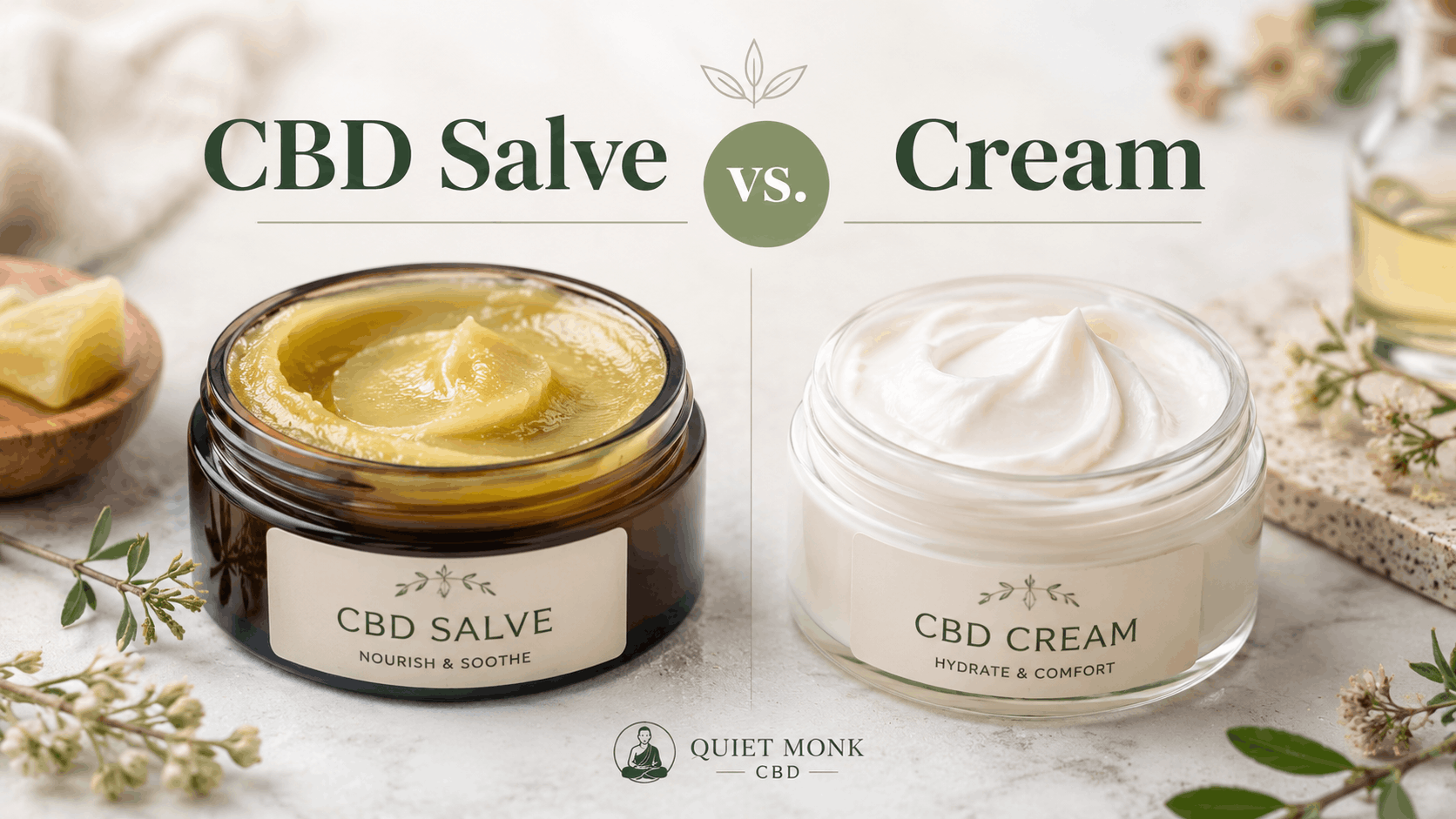
If you’ve been searching for a CBD topical for nerve discomfort, you’ve probably noticed how many different names are used.
CBD salve. CBD balm. CBD cream. CBD lotion. CBD rub. CBD ointment.
It can make things way more confusing than they need to be.
The truth is, a lot of these products are used in a very similar way. The biggest difference is usually the base formula, how thick it is, how fast it absorbs, and whether it gives you a warming or cooling sensation.
So if you’re trying to decide between a CBD salve for nerve pain and a CBD cream, I wouldn’t focus too much on the name alone.
I’d look at what’s actually in the product and how you plan to use it.
CBD topicals are not approved treatments for neuropathy or damaged nerves. If you’re dealing with ongoing numbness, burning, tingling, weakness, or unexplained pain, it’s important to have that checked out by a healthcare professional.
What Is a CBD Salve?
A CBD salve is usually made with oils and waxes.
That means it tends to be thicker than a cream and usually sits on the skin longer.
A typical salve might contain:
- CBD
- Plant oils
- Beeswax or another wax
- Shea butter or cocoa butter
- Botanical ingredients
- Menthol or other warming/cooling ingredients
Balms are usually very similar.
In fact, in the CBD industry, “balm” and “salve” are often used almost interchangeably.
If you like a heavier topical that stays on a smaller area for a while, a salve or balm can make sense.
What Is a CBD Cream?
A cream is different because it usually contains both water and oils.
That gives it a lighter texture.
In my experience, this is one of the biggest practical differences people notice.
A cream usually:
- Spreads easier
- Feels less greasy
- Absorbs faster
- Covers a larger area more easily
That’s also why someone searching for a CBD salve may end up preferring a cream once they actually try both.
The CBD itself may be the same strength. It’s the base that feels different.
CBD Salve vs. Cream for Nerve Pain
There isn’t good evidence showing that a salve works better than a cream for nerve pain.
The main difference is really how the topical is made and how it feels when you use it.
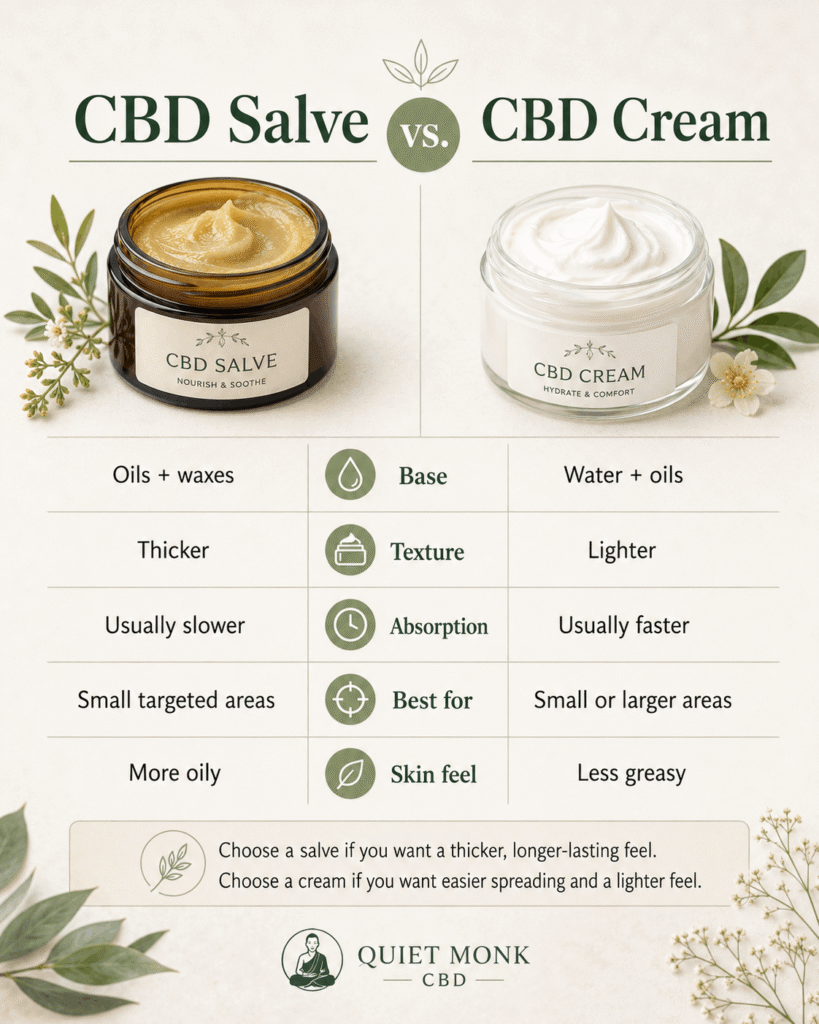
Here’s a simple way to look at it:
| Feature | CBD Salve/Balm | CBD Cream |
|---|---|---|
| Base | Oils and waxes | Water and oils |
| Texture | Thicker | Lighter |
| Absorption | Usually slower | Usually faster |
| Best for | Smaller areas | Small or larger areas |
| Skin feel | More oily | Usually less greasy |
| Warming/cooling options | Available | Very common |
| CBD strength | Varies | Varies |
If you want something thick that stays in one place, a salve may be a good fit.
If you want something easier to spread or less greasy, a cream may make more sense.
Does CBD Salve Help Nerve Pain?
This is one of the questions people ask us most often.
There is some early research on topical CBD and nerve-related discomfort, but I would not oversell it.
One small randomized study looked at topical CBD in people with peripheral neuropathy in the legs and feet. The researchers reported improvement in some symptoms compared with placebo.
That’s encouraging, but it was a small study.
It does not prove that CBD salve or CBD cream treats neuropathy, repairs damaged nerves, or works for everyone.
I think the best way to look at CBD topicals right now is this:
There is enough research to make them interesting, but not enough to make big medical promises.
Salve, Balm, Ointment, Rub — Does the Name Matter?
Not as much as people think.
You’ll see searches for:
- CBD salve for nerve pain
- CBD balm for nerve pain
- CBD ointment for nerve pain
- CBD rub for nerve pain
- CBD cream for nerve pain
- CBD lotion for nerve pain
But these names mostly tell you something about the texture and base.
An ointment is usually heavier and oilier.
A lotion is usually thinner.
A balm or salve is thicker and more wax-based.
A “rub” could be almost anything. That’s more of a marketing term.
So I wouldn’t choose a product just because the word “salve” is on the label.
Look at the formula.
What Strength CBD Topical Should You Use?
This is another area where people can get caught up in the number.
You’ll see products with:
500mg
1,000mg
2,000mg
5,000mg
10,000mg
and even higher.
The problem is that the total milligrams don’t tell you everything.
You also have to look at the size of the container.
For example:
5,000mg in a 4-ounce jar is much more concentrated than 5,000mg in an 8-ounce jar.
That’s why I like comparing:
Total CBD + container size
instead of only looking at the number on the front.
There is no medically established CBD strength for neuropathy, so I’d be cautious of any company claiming that you “need” a certain number of milligrams.
What About CBD Cream for Leg Nerve Pain?
A lot of nerve-related discomfort shows up in the legs and feet.
People often describe things like:
- Tingling
- Burning
- Numbness
- Pins and needles
- Sensitivity
- Odd temperature sensations
But those symptoms can come from a lot of different things.
It could be neuropathy. It could be nerve compression. It could be a back issue, an injury, diabetes, a vitamin deficiency, medication, or something else.
That’s why I don’t like assuming every nerve symptom is the same thing.
A topical may be something someone chooses to use on the area, but it doesn’t tell you why the symptom is happening.
Warming vs. Cooling CBD Topicals
This is something I think people should pay more attention to.
Some customers love cooling products.
Others hate them.
Cooling formulas often use menthol, which creates that cold feeling on the skin.
Warming formulas feel very different.
Neither one is automatically better. It really comes down to what you prefer.
At Quiet Monk CBD, we make a CBD Neuropathy cream for nerve pain in a warming version because some customers simply prefer warmth and we make a cooling neuropathy lotion gel that has a strong menthol cooling effect.
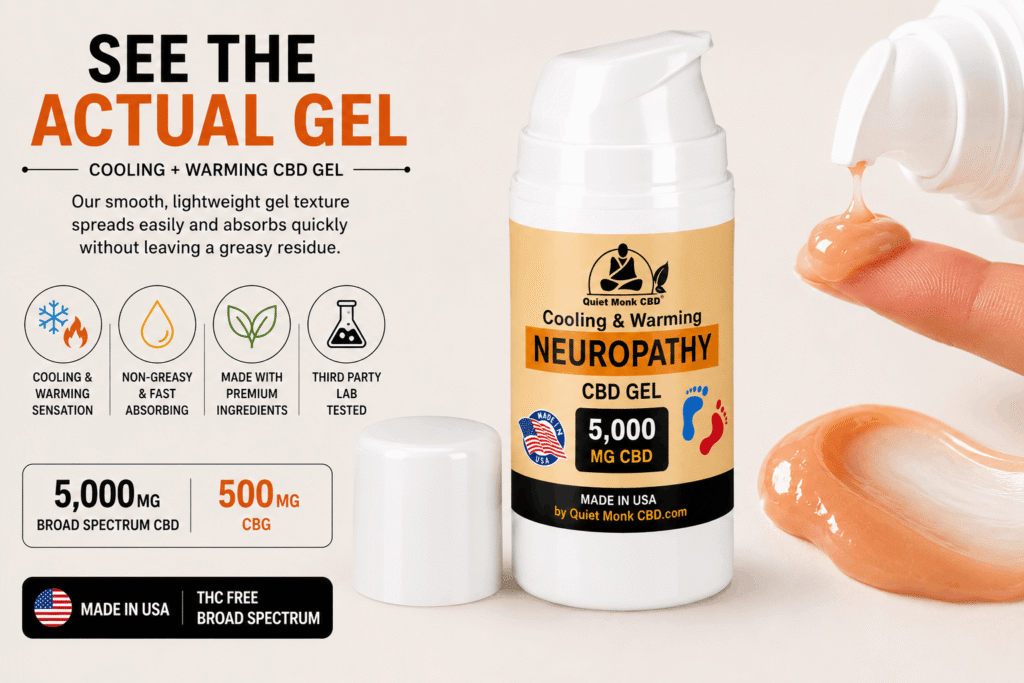
And that brings us back to the salve-versus-cream question.
Someone may search for a salve because that’s the word they know, but they may end up liking a cream better if they want something easier to spread and less oily.
What About CBG, CBC, and CBN?
CBD is no longer the only cannabinoid showing up in topicals.
CBG has become much more common, and we’re also starting to see more products using CBC and CBN.
I think this is interesting, but I would still look at the actual amount.
For example:
5,000mg CBD + 500mg CBG
is very different from:
5,000mg CBD + 25mg CBG
Both can say “CBD + CBG” on the label.
That’s why I like seeing the actual cannabinoid amounts clearly listed.
Research on CBG, CBC, and CBN is still developing, especially for topical use, so I would not assume that adding more cannabinoids automatically means the product will work better.
But if you are paying extra for them, you should at least know how much is actually there.
Look at the Whole Ingredient List
This is something that gets overlooked.
CBD may be the headline ingredient, but most of the product is the topical base.
That base determines:
- How thick it is
- How greasy it feels
- How fast it absorbs
- Whether it smells
- Whether it warms or cools
- Whether you actually enjoy using it
You may see ingredients such as:
- Plant oils
- Aloe
- Shea butter
- Cocoa butter
- Waxes
- Menthol
- Camphor
- Botanical extracts
- Emulsifiers
- Preservatives
If you have sensitive skin or ingredient allergies, this matters a lot more than the marketing on the front label.
Third-Party Testing Is Important
If a company says a topical contains 5,000mg or 10,000mg of CBD, there should be testing behind that claim.
A certificate of analysis, or COA, can help confirm what cannabinoids were detected.
I’d look for:
- CBD potency
- CBG or other cannabinoids
- THC results
- Lab name
- Testing date
- Batch or lot information
The higher the potency claim, the more important I think this becomes.
What Should You Look for in a CBD Topical for Nerve Discomfort?
I wouldn’t overcomplicate it.
Look at a few things:
How strong is it?
Compare total CBD with container size.
What type of base is it?
Do you want a thick salve or a lighter cream?
Does it warm or cool?
Some people have a strong preference.
Are there other cannabinoids?
If so, how much?
Is it tested?
Look for a current COA.
Are the claims realistic?
Be careful with products promising to cure neuropathy or repair nerves.
When Should Nerve Symptoms Be Checked Out?
This is probably the most important part.
If you have ongoing:
- Numbness
- Burning
- Tingling
- Weakness
- Loss of sensation
- Balance problems
- Symptoms that are getting worse
don’t assume a topical is the answer.
There can be a lot of different causes, and figuring out the cause matters.
So, CBD Salve or CBD Cream?
I don’t think one is automatically better.
If you like something thick and oil-based that stays on a small area, a salve or balm may be a good choice.
If you want something lighter, easier to spread, and less greasy, a cream may be better.
The biggest mistake is getting too caught up in the product name.
Look at the strength, ingredients, cannabinoid profile, texture, warming or cooling effect, and lab testing.
That will usually tell you a lot more than whether the label says “salve,” “balm,” or “cream.”
Prefer a Warming Topical?
If you prefer warmth instead of a strong menthol cooling sensation, you can see our Neuropathy CBD Warming Cream and review the strength, ingredients, and lab testing.
If you want to compare more options first, you can also browse our neuropathy gels and topicals.
If you prefer a lighter topical, we also break down whether CBD lotion may help with nerve discomfort, including how lotion compares with cream and what the current research actually shows.

Steven Gregoire is the founder of Quiet Monk CBD and has been involved in developing and selling CBD topicals for years. His work focuses on high-potency creams, salves, gels, and multi-cannabinoid formulations, with an emphasis on clear labeling, third-party testing, and helping customers understand the differences between topical products.
Steven is not a medical professional, and the information in this article is for general educational purposes.