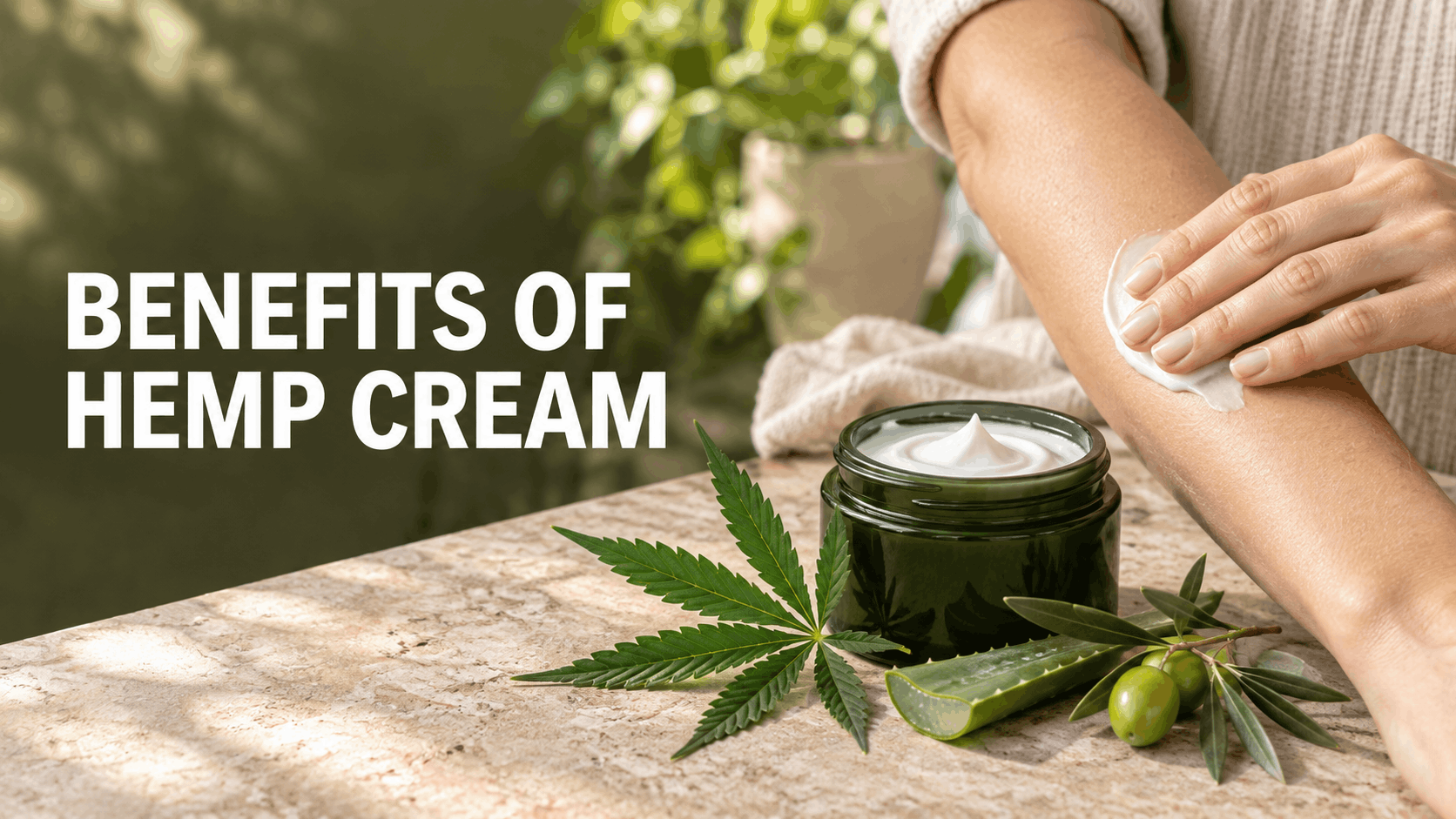
The benefits of hemp cream depend heavily on what is actually inside the container. Some hemp creams are ordinary moisturizers made with hemp seed oil. Others contain measurable amounts of CBD, CBG or other hemp-derived cannabinoids. These products may all be called “hemp cream,” but they are not the same thing.
A good hemp cream can be easy to apply, help condition dry skin and provide a cooling or warming sensation depending on its ingredients. Early research on topical CBD is also encouraging, but the evidence is still limited. Hemp cream has not been proven to cure arthritis, neuropathy, eczema or another medical condition.
Before purchasing one, check the CBD content, container size, complete ingredient list and third-party laboratory results. Those details tell you considerably more than the words “hemp cream” on the front.
What Is Hemp Cream?
Hemp cream is a topical product applied directly to the skin. Unfortunately, there is no standard definition that every company follows.
A product sold as hemp cream might contain:
- Hemp seed oil but no measurable CBD
- CBD isolate
- Broad-spectrum hemp extract
- Full-spectrum hemp extract
- CBD combined with CBG
- Menthol, camphor or capsicum
- Arnica, aloe vera or essential oils
- Ordinary moisturizing oils and emollients
That is why two hemp creams can feel completely different and contain very different amounts of cannabinoids.
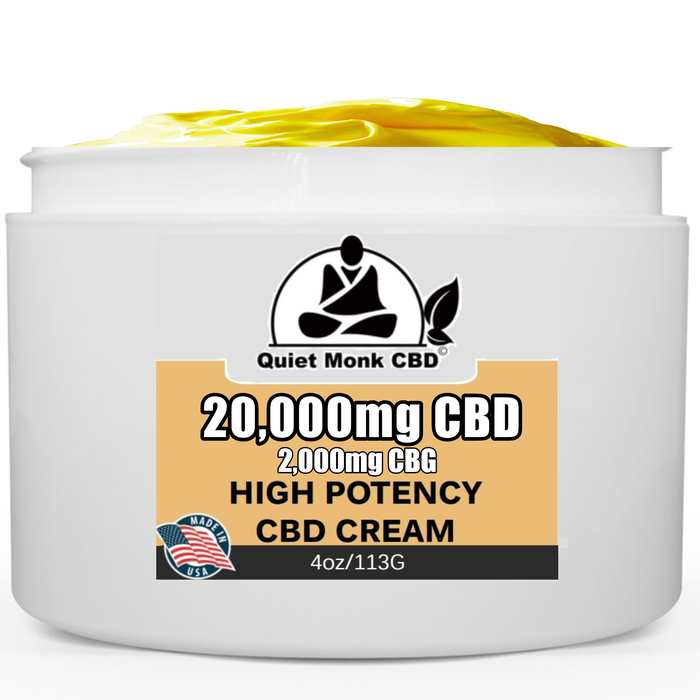
One jar might be intended mainly as a moisturizer. Another might contain thousands of milligrams of CBD and be designed as a high-potency topical.
Hemp Seed Cream and CBD Hemp Cream Are Different
One of the biggest sources of confusion is the difference between hemp seed oil and cannabinoid-rich hemp extract.
Hemp seed oil is pressed from the seeds of the hemp plant. It contains fatty acids and can be used as a skin-conditioning oil, but hemp seeds do not naturally contain meaningful amounts of CBD.
CBD and CBG are obtained from other parts of the hemp plant. If you want a cream containing cannabinoids, the label should state how much CBD or CBG is inside the container.
| Hemp-seed cream | CBD hemp cream | |
|---|---|---|
| Main hemp ingredient | Oil pressed from hemp seeds | CBD or cannabinoid-rich hemp extract |
| Contains meaningful CBD | Usually no | It should, if clearly labeled |
| Primary purpose | Moisturizing and skin conditioning | Targeted application of CBD to the skin |
| Potency listed in milligrams | Usually not | Should clearly list total CBD |
| Laboratory report needed | Not usually for cannabinoids | Yes |
| Can contain menthol or other botanicals | Yes | Yes |
A hemp leaf on the label does not prove that a product contains CBD. Look for an actual milligram amount and confirm it with the available laboratory results.
Three Practical Benefits of Hemp Cream
Many articles make hemp cream sound as though it can solve almost every problem. I would rather focus on the practical reasons people choose it.
1. You Can Apply It to a Specific Area
The most obvious benefit of hemp cream is targeted application.
An oil or gummy is swallowed. A cream can be applied directly to your hands, feet, knees, shoulders, neck, back or another area where you want to use it.
This does not mean the cream travels through the skin and repairs a damaged joint or nerve. It simply means you control where the product is applied.
Creams also tend to spread more easily than thick salves. This can make them convenient when you want to cover a larger area such as the calves, shoulders or lower back.
Many people make application part of a massage routine after exercise, yard work, standing all day or other physically demanding activities.
2. The Cream Base Can Moisturize and Condition the Skin
A well-made cream can help soften and condition dry-feeling skin. This benefit comes from the complete formulation—not necessarily from CBD alone.
Ingredients commonly used for this purpose include:
- Aloe vera
- Olive oil
- MCT oil
- Shea butter
- Glycerin
- Fatty alcohols
- Other plant oils and emollients
These ingredients can help a cream spread smoothly and reduce the dry or waxy feeling associated with some topical products.
Check the label if you have allergies or sensitive skin. A product described as natural can still contain essential oils, fragrances, menthol or other ingredients that cause irritation in some people.
CBD cream should not be presented as a proven treatment for eczema, psoriasis, acne or another diagnosed skin condition. If you have persistent redness, cracking, a rash or broken skin, speak with a dermatologist or another qualified healthcare professional.
3. You Can Choose the Texture and Sensation You Prefer
Hemp creams can be formulated to feel cooling, warming or neutral.
Menthol is usually responsible for the cold sensation in a cooling cream. Camphor can add another noticeable topical sensation, while capsicum is commonly used in warming formulas.
These sensations are separate from CBD potency.
A cream that feels extremely cold does not necessarily contain more CBD. It may simply contain more menthol. Likewise, a non-cooling cream can contain a very high concentration of CBD without creating a cold feeling on the skin.
At Quiet Monk, we offer different formulas because customers do not all want the same experience. Some people love a strong cooling sensation. Others dislike the smell and feeling of menthol and prefer an Original Natural formula.
The benefit is having a choice based on how you want the cream to feel—not pretending that one formula is best for everyone.
What Does Research Say About Topical CBD?
Research on topical CBD is still limited, but a few small human studies have reported encouraging results.
A 2020 study included 29 people with peripheral neuropathy. Participants used either a topical CBD product or a placebo. The CBD group reported improvements in measurements that included intense pain, sharp pain, cold sensations and itching.
A separate randomized controlled trial examined topical CBD in people with thumb basal-joint arthritis. Researchers reported improvements in pain and certain patient-reported measures.
These studies are worth paying attention to, but they do not prove that every hemp cream works for pain.
The studies were small, examined particular products and involved specific groups of people. A different cream with different ingredients, CBD concentrations and application instructions might produce different results.
A 2023 systematic review of topical and transdermal CBD trials concluded that the research remains limited and that better-designed clinical studies are needed.
The honest conclusion is that topical CBD has potential, but marketing claims have moved faster than the evidence.
Does Hemp Cream Help With Pain or Inflammation?
Some people use hemp cream as part of their routine for sore or hardworking areas. Customer experiences vary, and a product’s noticeable effects may come from several parts of the formula.
For example:
- Menthol creates a cooling sensation.
- Camphor can produce a noticeable topical feeling.
- Capsicum can create warmth.
- Massage may temporarily help an area feel looser or more comfortable.
- Moisturizing ingredients help the skin feel softer.
- CBD and CBG provide the cannabinoid content.
It is difficult to separate these components when several are used together.
Hemp cream should not be described as an alternative to necessary medical treatment or prescription medication. Pain and inflammation can have many causes, and the correct treatment depends on what is creating the problem.
New, severe or unexplained pain should be evaluated by a healthcare professional.
What Ingredients Should You Look For?
There is no universal ingredient list that makes one hemp cream best. Look for ingredients that fit the experience you want.
CBD and CBG
The label should state the amount of each cannabinoid separately.
For example, our 5,000mg CBD Cream contains 5,000mg of CBD and 500mg of CBG in a four-ounce jar.
Our 10,000mg CBD Cream contains 10,000mg of CBD and 1,000mg of CBG in the same four-ounce size.
We do not combine the two numbers and call the product “5,500mg CBD” or “11,000mg CBD.” The customer should be able to see exactly how much of each cannabinoid is included.
Menthol
Menthol creates a cooling sensation. It can feel strong, especially when applied over a large area or used immediately after a hot shower.
Cooling intensity does not indicate CBD strength.
Arnica
Arnica has a long history of use in topical formulations. It is commonly included in massage creams and products made for post-activity routines.
Do not apply arnica-containing products to broken skin unless the product directions specifically say that it is safe.
Aloe vera
Aloe is commonly added as a skin-conditioning and moisturizing ingredient. It can also help create a lighter cream texture.
Plant oils
Olive oil, MCT oil and other plant oils can act as emollients. They help soften the skin and affect how smoothly the cream spreads.
How to Compare Hemp Cream Strengths
The large number on the front of the jar does not tell you everything.
You need to consider the total CBD and the size of the container.
For example, 5,000mg in a one-ounce container is more concentrated than 5,000mg in a four-ounce container. Both labels say 5,000mg, but the amount of CBD in each gram of cream is different.
When comparing products, check:
- Total CBD in the container
- Total CBG or other cannabinoids
- Container weight
- CBD per gram, if provided
- Approximate amount used per application
- Cooling, warming or non-cooling formula
- Complete ingredients
- Third-party laboratory testing
Our CBD 1500mg Cream Comparison explains how to compare concentrations without relying only on the largest number printed on the label.
Hemp Cream, Salve or Gel: Which Should You Choose?
The main difference is often the texture.
Hemp cream
Creams contain water and oils. They generally spread easily and absorb faster than a traditional salve. A cream can be a practical option for larger areas.
Hemp salve or balm
A salve is usually made primarily with oils and waxes. It feels thicker, remains on the skin longer and may take more time to massage into the desired area.
Hemp gel
Gels are generally lighter and faster absorbing. They are popular with people who dislike the oily or waxy feeling of salves. None of these formats is automatically stronger. Check the cannabinoid concentration rather than judging by the product type.
You can compare Quiet Monk’s current cream options on our CBD Pain Creams page.
How to Apply Hemp Cream
Always follow the directions provided with the product you purchase.
A basic routine is:
- Apply the cream to clean, dry skin.
- Begin with a small amount.
- Massage it gently over the desired area.
- Allow it to absorb before applying more.
- Wash your hands afterward, particularly when using menthol, camphor or capsicum.
Do not apply hemp cream to open wounds, badly irritated skin, your eyes or other sensitive areas.
Perform a small patch test when trying a new product. Stop using it if you develop redness, itching, burning or another unwanted reaction.
How Often Can You Use Hemp Cream?
There is no single application schedule that applies to every hemp cream. The appropriate frequency depends on the formula, concentration, added ingredients and product directions. A mild non-cooling moisturizer may have different directions than a concentrated cream containing menthol or capsicum. Start with the amount and frequency stated on the label. Using a large amount does not guarantee a better experience and may make cooling or warming ingredients feel uncomfortably intense.
Why Laboratory Testing Matters
Third-party testing helps confirm what is actually in a cannabinoid product.
A laboratory report should allow you to review:
- CBD content
- CBG and other cannabinoids
- Whether THC was detected
- The identity of the product or batch tested
A laboratory report does not prove that a cream will produce a particular result. It verifies important information about the product’s cannabinoid content.
That is still much more useful than a vague label that says “premium hemp” without stating how much CBD it contains.
A Note From the Owner
My interest in CBD started in large part because of my father and what he went through with rheumatoid arthritis. The 5,000mg cooling cream eventually became his favorite Quiet Monk product. I want to be careful about how I say that: his experience was personal, and I am not claiming that CBD cream treats or cures rheumatoid arthritis.
What I learned from him—and from talking with customers over the years—is that people care about more than the number on the label. They care about whether the cream feels greasy, whether the menthol is too strong, whether it spreads easily and whether the company will answer questions when they call. That is why I believe hemp cream should be sold with straightforward information: what is in it, how much CBD and CBG it contains, how large the jar is and where to find the testing.
— Steven Gregoire, Founder of Quiet Monk CBD
Frequently Asked Questions
What are the main benefits of hemp cream?
The practical benefits include targeted application, skin-conditioning ingredients and the ability to choose a cooling, warming or non-cooling formula. CBD-containing hemp creams are also being studied, but evidence for specific medical benefits remains limited.
Is hemp cream the same as CBD cream?
Not always. Some hemp creams contain only hemp seed oil and no measurable CBD. A genuine CBD cream should list the amount of CBD in milligrams and provide supporting laboratory results.
Can hemp cream get you high?
CBD and CBG are not intoxicating in the same way as THC. However, product formulas vary. Check whether a product contains THC and review its laboratory report.
Is hemp cream good for dry skin?
A cream containing appropriate emollients and skin-conditioning ingredients may help soften and moisturize dry-feeling skin. The benefit depends on the entire formula, not simply the presence of CBD.
Can hemp cream be used for arthritis?
Some people apply topical products to uncomfortable joints, and small studies of particular topical CBD products have produced encouraging results. Hemp cream has not been proven to cure arthritis or repair joint damage. Discuss persistent joint pain, swelling or reduced movement with a healthcare professional.
Can hemp cream help nerve pain?
A small study of topical CBD for peripheral neuropathy reported encouraging results, but the research remains limited. Hemp cream has not been proven to repair damaged nerves or treat the underlying cause of neuropathy.
Does stronger cooling mean the cream has more CBD?
No. Cooling normally comes from ingredients such as menthol. CBD strength is determined by the cannabinoid content and the size of the container.
What strength hemp cream should I choose?
There is no strength that is right for everyone. Compare the total CBD, container size, concentration, ingredients and whether you prefer a cooling or non-cooling formula. New customers do not automatically need the highest available potency.
Can I use hemp cream on broken skin?
Unless the product is specifically intended for that purpose, do not apply it to broken, infected or badly irritated skin. Follow the label and ask a healthcare professional about wounds or persistent skin problems.
The Bottom Line
The term “hemp cream” can describe very different products.
A plain hemp-seed moisturizer is not the same as a cream containing thousands of milligrams of CBD and CBG. One may be designed primarily for skin conditioning, while the other provides a measured amount of cannabinoids for targeted topical application.
The most reliable benefits of hemp cream are practical: you can apply it where you want it, select a texture that works for you and choose cooling, warming or non-cooling ingredients.
Research on topical CBD is promising but limited. Avoid products that guarantee pain relief, claim to cure medical conditions or present customer experiences as scientific proof.
Read the ingredients, compare the concentration and check the laboratory report. That is the best way to understand what you are actually buying.