
Hemp laws in the United States are undergoing one of the biggest changes since the 2018 Farm Bill. A new federal rule set to take effect in November 2026 will redefine how THC is measured in hemp products. Instead of using a percentage-based limit, regulators are moving toward a strict per-product THC cap. Below are the most important statistics explaining the new hemp THC limits, state-level bans, and what this means for consumers and businesses. As regulations evolve, many consumers are shifting toward safer, non-intoxicating options like THC-free CBD products
🔢 Key Hemp THC Limit Statistics (2026)
- Hemp was federally legalized in 2018 under the Farm Bill
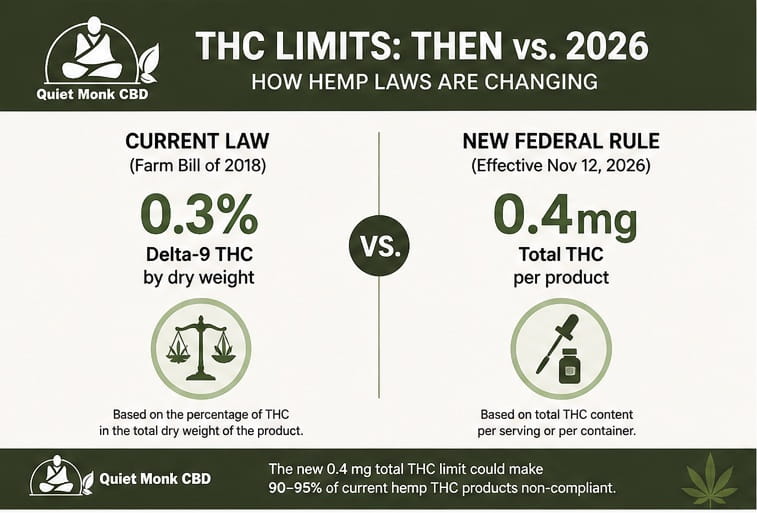
- Current law allows ≤0.3% delta-9 THC by dry weight
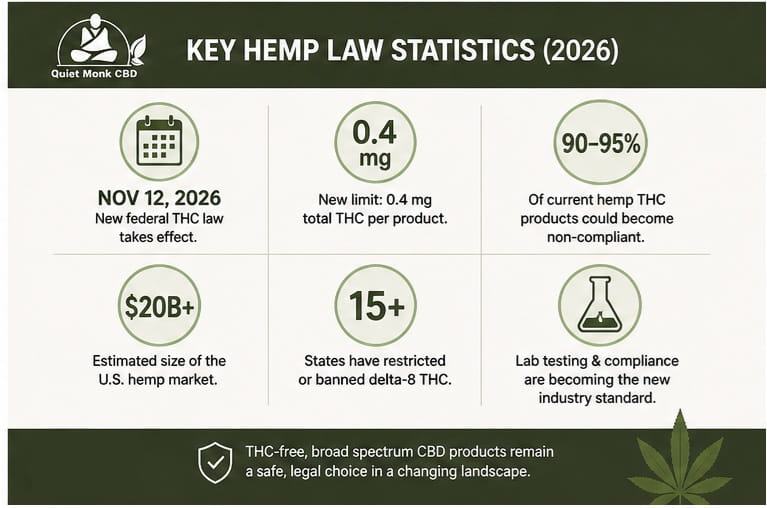
- A new federal rule introduces a 0.4 mg total THC limit per product
- The new law takes effect November 12, 2026
- Up to 90–95% of hemp-derived THC products could become illegal
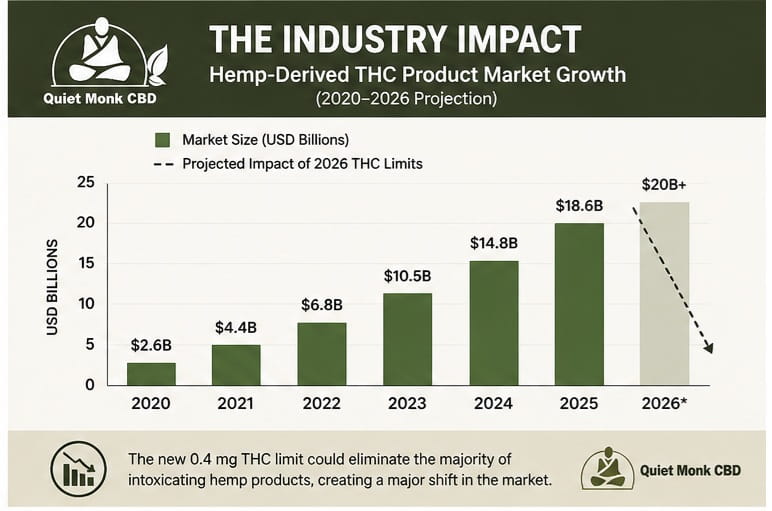
- The U.S. hemp market is valued at $20+ billion annually
- Dozens of states are tightening rules on hemp-derived THC
📊 Federal THC Law Changes Explained
- The 2018 Farm Bill defined hemp using delta-9 THC percentage only
- This created a loophole allowing:
- Delta-8 THC
- THCA flower
- Hemp-derived THC edibles
- The 2026 update changes the definition to:
- Total THC (including THCA and other cannabinoids)
👉 This closes the loophole that fueled the rapid growth of hemp-derived THC products.
📉 Industry Impact Statistics
- Hemp-derived THC products (gummies, drinks, vapes) are among the fastest-growing categories
- The new THC cap could:
- Remove most intoxicating hemp products from shelves
- Force reformulation across the industry
- Thousands of retail stores may be affected by compliance changes
👉 Many current products exceed the new 0.4 mg THC per container limit. As a result, demand is increasing for compliant alternatives such as high-potency CBD lotion for pain relief
🗺️ State-Level Hemp THC Restrictions
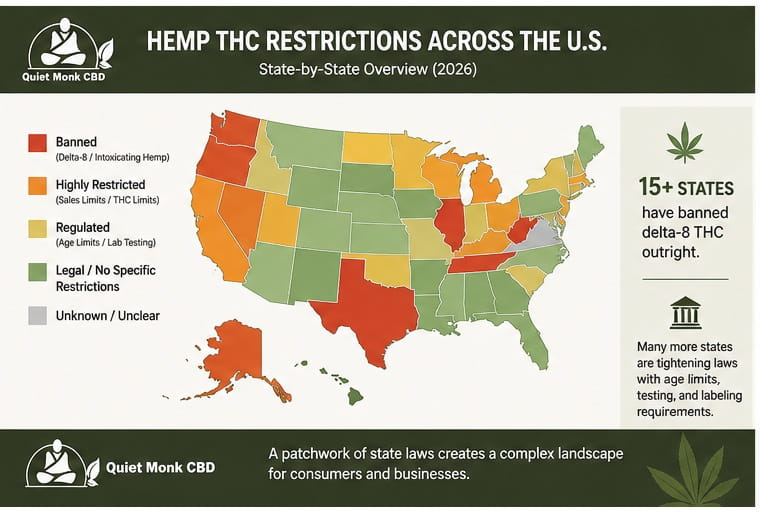
- At least 13 states have banned delta-8 THC outright
- Additional states:
- Restrict sales to licensed dispensaries
- Limit THC per serving
- Require strict testing and labeling
- Some states ban multiple cannabinoids (delta-8, THCA, HHC)
- Others operate in legal gray areas with inconsistent enforcement
👉 Result: a fragmented, state-by-state regulatory system
⚖️ Legal Timeline (Simple Breakdown)
- 2018 – Hemp legalized federally
- 2020–2024 – Rise of delta-8, THCA, hemp THC products
- 2025 – Federal law passed tightening THC definitions
- Nov 12, 2026 – New THC limits take effect
📈 Compliance & Consumer Trends
- Increasing demand for:
- THC-free CBD products
- Broad spectrum formulations
- Verified lab testing (COAs)
- Retailers are shifting toward:
- Lower-risk, compliant products
- Non-intoxicating cannabinoid options
👉 Compliance is becoming a key differentiator in the CBD market. Many brands are now focusing on broad spectrum CBD cream with non-detectable THC to stay aligned with evolving regulations.
❓ FAQ: Hemp THC Limits
What is the current THC limit for hemp?
Hemp products must contain ≤0.3% delta-9 THC by dry weight.
What is the new THC rule for 2026?
A proposed update limits hemp products to 0.4 mg of total THC per container.
What products are affected?
- Delta-8 THC products
- THCA flower
- Hemp-derived THC edibles and drinks
Will CBD products still be legal?
Yes—especially products like CBD cream for joint pain that are THC-free or contain non-detectable levels of THC, which are less impacted by changing regulations.
Why are laws changing?
To close loopholes that allowed intoxicating hemp products to be sold outside regulated cannabis systems.
🔗 What This Means
As laws tighten, the industry is shifting toward:
- THC-free (non-detectable) CBD
- Clearly labeled, lab-tested products
- Safer, compliant formulations
For consumers, this means choosing products that remain consistent across changing regulations. Choosing lab-tested CBD products with verified COAs is becoming increasingly important for consumers navigating these changes.