
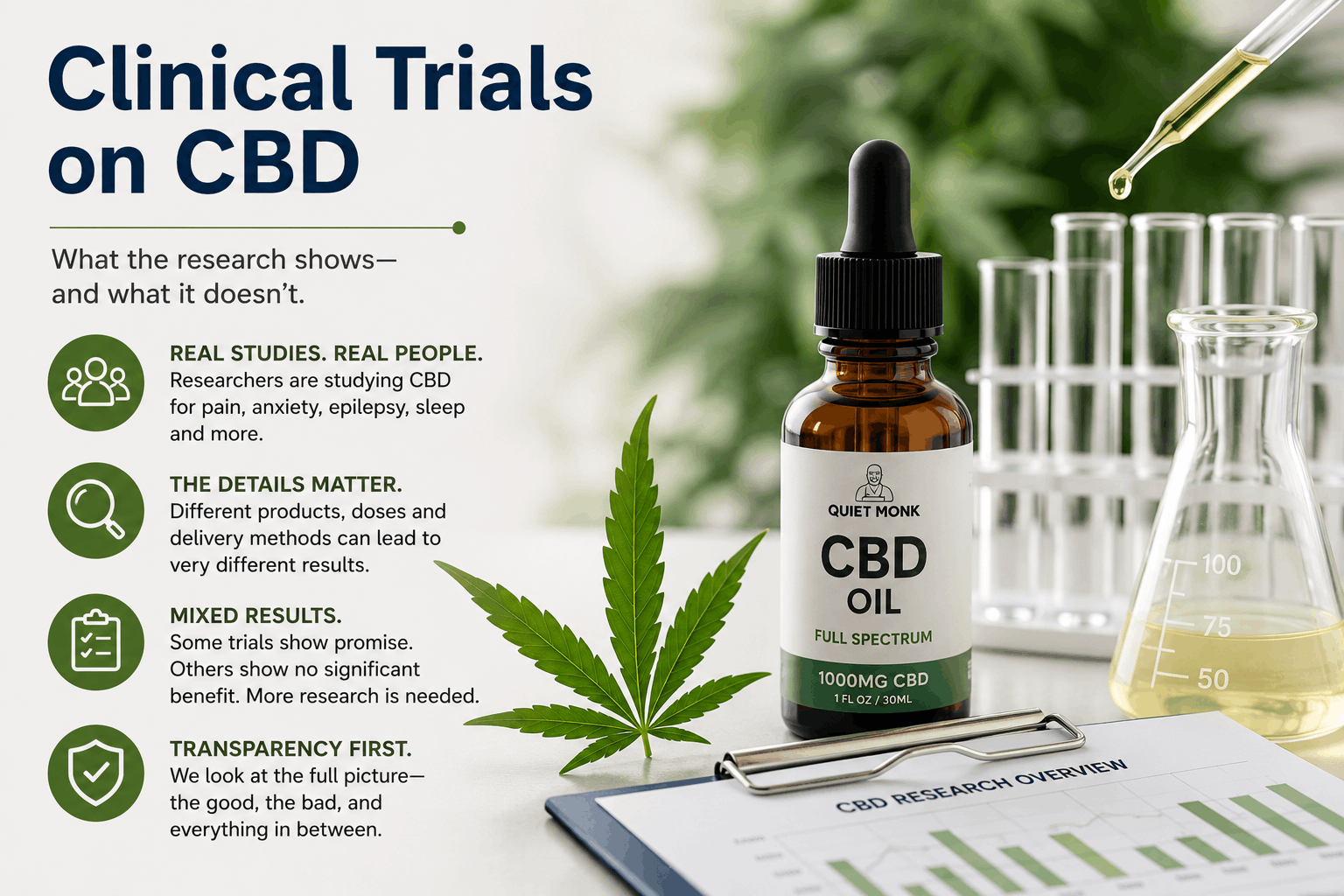
If you’ve spent any time looking into CBD, you’ve probably seen some pretty big claims.
CBD can help with pain. CBD can help with anxiety. CBD can help with inflammation. CBD can help with sleep.
Then you’ll find someone else saying there isn’t enough research to support any of those claims.
So what’s the truth?
There is legitimate clinical research on CBD and other cannabinoids. But the results are mixed, and you have to pay attention to what was actually studied.
That’s something I think gets lost when CBD companies talk about “clinical studies.”
A study involving THC and CBD together isn’t the same as a study using CBD by itself. A study using CBD oil isn’t necessarily evidence that a CBD cream will work the same way.
And an animal study isn’t a human clinical trial.
So let’s look at the actual research.
What Is a Clinical Trial?
A clinical trial is a study involving people that’s designed to answer a specific question about a treatment.
Some of the most useful studies are randomized, placebo-controlled trials.
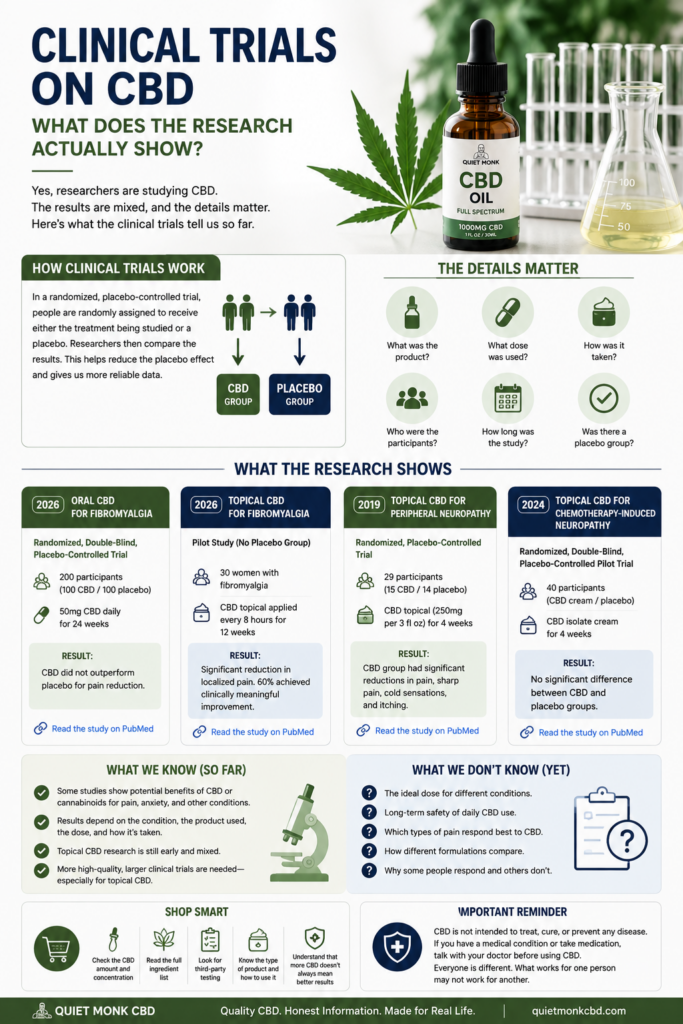
In simple terms, people are randomly assigned to receive either the treatment being studied or a placebo, and researchers compare the results.
That’s important because people can feel better for all sorts of reasons when they believe they’re trying something that might help.
The placebo effect is real.
That’s why controlled trials are so useful.
Is There Clinical Research on CBD for Fibromyalgia?
Yes—and this is where the research has gotten particularly interesting recently.
A 2026 randomized, double-blind, placebo-controlled trial looked specifically at CBD in people with fibromyalgia.
The researchers enrolled 200 people and randomly assigned 100 to receive 50mg of plant-derived CBD daily and 100 to receive a placebo.
After 24 weeks, the CBD group had a smaller improvement in pain than the placebo group.
The researchers concluded that the results did not support 50mg of daily CBD as an analgesic supplement for people with fibromyalgia.
That’s not the result a CBD company would necessarily want to advertise.
But I think it’s important to tell you about it.
If we’re going to talk about the research, we should talk about the research—even when the results aren’t what we’d hoped for.
Read the 2026 fibromyalgia CBD clinical trial on PubMed
What About CBD Cream for Fibromyalgia?
This is where things get even more interesting.
A 2026 pilot study specifically looked at a CBD-containing topical formulation in people with fibromyalgia who had localized pain.
The study included 30 women with fibromyalgia.
Participants applied a commercially available CBD-containing topical formulation to a painful area every eight hours for 12 weeks.
The researchers reported a significant reduction in localized pain, and 60% of participants achieved the study’s threshold for a clinically meaningful improvement.
That’s encouraging.
But there’s a very important catch.
There was no placebo or control group.
That means the study can show that participants improved while using the product, but it can’t tell us with confidence how much of that improvement was caused by the CBD product itself.
The researchers specifically described the findings as exploratory and said larger randomized controlled trials are needed.
I actually like this study because it shows both sides of the story.
There’s a signal worth investigating, but there’s not enough evidence yet to say, “CBD cream has been proven to treat fibromyalgia.”
Read the 2026 topical CBD fibromyalgia study on PubMed
So Which Study Should You Believe?
Honestly, I’d look at both.
The 2026 oral CBD study was randomized and placebo-controlled, which gives it much more ability to answer whether CBD itself made a difference.
The topical study is interesting because it actually involves a topical product and people with fibromyalgia, but it doesn’t have a placebo group.
That’s why I wouldn’t take either study by itself and make a sweeping statement about CBD.
And there’s another issue:
The two studies aren’t testing the same thing.
One used 50mg of CBD taken orally every day.
The other used a CBD-containing topical product applied to localized areas.
You can’t simply take the result from one and assume it applies to the other.
What About Older CBD Research?
There are older studies worth looking at, too.
One particularly interesting study looked at topical CBD for peripheral neuropathy.
The trial included 29 people, with 15 receiving a topical product containing 250mg of CBD per 3 fluid ounces and 14 receiving placebo.
After four weeks, the CBD group had statistically significant reductions in several symptoms, including intense pain, sharp pain, cold sensations and itching. The researchers reported that the product was well tolerated.
That’s interesting because it was a placebo-controlled human study involving a topical CBD product.
But again, it wasn’t a fibromyalgia study.
It was a peripheral neuropathy study.
That’s an important distinction.
Read the topical CBD neuropathy trial on PubMed
But Another Topical Study Had a Different Result
There’s another study that I think is important to mention because it keeps us from cherry-picking the positive research.
In 2024, researchers conducted a double-blind, placebo-controlled pilot trial involving 40 people with established chemotherapy-induced peripheral neuropathy.
Participants received either a topical CBD cream or placebo.
The researchers found that the neuropathy scores were similar between the CBD and placebo groups.
Their conclusion was that the trial did not support the studied CBD isolate cream improving painful established chemotherapy-induced neuropathy.
Again, that’s not evidence that every CBD cream doesn’t work.
It simply means this particular study didn’t demonstrate a benefit over placebo for that particular condition and product.
That’s how clinical research works.
Read the 2024 topical CBD clinical trial on PubMed
What About CBD and Chronic Pain in General?
There is a larger body of research looking at cannabis and cannabinoids for chronic pain.
The National Center for Complementary and Integrative Health (NCCIH) says some evidence suggests modest benefits from cannabis or cannabinoids for chronic pain, particularly certain types of neuropathic pain.
But here’s another important detail:
A lot of that research involves cannabinoid products containing THC, combinations of THC and CBD, or other cannabinoid preparations.
That isn’t the same thing as taking CBD by itself.
One review discussed by NCCIH looked at 47 studies involving 4,743 people and found that 29% of people taking cannabis or cannabinoids achieved at least a 30% reduction in pain compared with 26% taking placebo.
That’s a difference, but it’s a fairly small one.
NCCIH notes that the difference may be too small to be meaningful to patients.
That’s a much more useful way to describe the research than simply saying:
“Clinical studies prove CBD helps pain.”
They don’t.
What About Fibromyalgia Studies Using Cannabis?
There are studies involving cannabis and cannabinoid products in people with fibromyalgia that are worth knowing about.
But again, we have to look at what’s actually being used.
For example, an earlier randomized trial studied a THC-rich cannabis oil in 17 women with fibromyalgia.
The oil contained much more THC than CBD—24.44mg/mL THC compared with only 0.51mg/mL CBD.
The study reported improvements in fibromyalgia impact scores compared with placebo.
That’s a cannabis study.
It’s not a CBD-only study.
This distinction may sound like I’m splitting hairs, but I’m not.
If you’re trying to figure out what CBD itself does, the ingredients in the product being studied matter.
What Does the Research Say About CBD and Anxiety?
CBD has also been studied for anxiety.
NCCIH points to a small human study involving 24 people with social anxiety disorder. Participants who received CBD before a simulated public-speaking test experienced less anxiety than those who received placebo.
That’s interesting, but again, one small study doesn’t establish CBD as a treatment for anxiety disorders.
There is still a lot more research needed.
What About CBD and Sleep?
Sleep is another area where the answer isn’t as simple as some CBD advertising makes it sound.
Some studies involving cannabis or cannabinoids have reported improvements in sleep measures.
But researchers have an obvious question to answer:
Did the cannabinoid directly improve sleep, or did people sleep better because another symptom—such as pain—improved?
NCCIH says it’s still uncertain whether cannabinoids directly improve sleep or whether people sleep better because other symptoms improved.
I think that’s a good example of why it’s worth digging into the actual research rather than just reading a headline.
What Does All This Research Tell Us?
Here’s how I look at it.
CBD is interesting enough that researchers continue studying it.
There are human clinical trials.
There are some promising results.
There are also studies that don’t show a meaningful benefit.
And there are still a lot of unanswered questions.
That’s not unusual for something that is still being researched.
The mistake is going from:
“Researchers found an interesting result.”
to:
“CBD has been clinically proven to treat this condition.”
Those are two very different statements.
Why Does the Type of CBD Product Matter?
This is probably the biggest thing I want you to take away from this article.
Let’s say you find a clinical trial showing that a CBD product produced a positive result.
Before applying that result to a product you’re considering, I’d ask:
What exactly did they use?
Was it:
- CBD isolate?
- Full-spectrum CBD?
- CBD combined with THC?
- A prescription cannabinoid?
- An oral product?
- A topical cream?
- A specific dose?
- A specific formulation?
Those details matter.
A 50mg CBD tablet isn’t the same thing as a 5,000mg CBD cream.
And a topical CBD product containing several ingredients isn’t necessarily equivalent to a pure CBD isolate cream used in a clinical trial.
What About a 5,000mg CBD Cream?
This is where I think people sometimes get confused by the numbers on CBD products.
A 5,000mg CBD cream means there are 5,000mg of CBD in the entire container.
It doesn’t mean you’re applying 5,000mg of CBD every time you use it.
For example, our 5,000mg cream comes in a 4 oz container.
If the container contains approximately 113 grams of cream, that’s roughly:
5,000mg ÷ 113g = about 44mg CBD per gram of cream.
That’s the number I’d look at when comparing concentrations.
If you’re interested in comparing different strengths, we’ve put together a CBD cream strength comparison that breaks down the numbers.
Does More CBD Mean Better Results?
I don’t think we can say that.
And I wouldn’t want to tell you otherwise just because we sell high-potency CBD creams.
More CBD in a container doesn’t automatically mean a person will get better results.
The research doesn’t establish a simple rule where doubling the CBD automatically doubles the benefit.
There are too many variables involved.
That’s why I’d rather explain exactly what’s in a product and let you decide which concentration makes sense for you.
What About Clinical Research on CBD Cream Specifically?
This is probably the most important question if you’re shopping for a topical.
The honest answer is:
There is some clinical research on topical CBD, but there isn’t enough high-quality evidence to say that CBD cream has been proven to treat specific pain conditions across the board.
We’ve now got:
- A small 2019 randomized topical CBD neuropathy trial with 29 participants that reported positive results.
- A 2024 randomized topical CBD trial with 40 participants that did not find a benefit for chemotherapy-induced neuropathy.
- A 2026 pilot study involving 30 women with fibromyalgia that reported improvements in localized pain but had no placebo group.
That’s a pretty good illustration of where the science stands.
Interesting? Yes. Proven? Not yet.
Why I Think That’s Actually Good Information
If you’re considering CBD, I don’t think you need someone telling you that it will definitely work.
I’d rather know what the research actually says.
If a study is positive, let’s talk about it.
If another study doesn’t show a benefit, let’s talk about that too.
And if researchers say they need larger randomized trials, we should say that.
That’s a much better way to make a decision than relying on a company telling you that “clinical studies prove” its product works.
Frequently Asked Questions
Are there clinical trials on CBD?
Yes. Researchers have conducted clinical trials involving CBD for conditions including fibromyalgia, neuropathy, anxiety and other health concerns. The results vary depending on the condition, formulation and route of administration.
Has CBD been clinically proven to treat fibromyalgia?
No. A 2026 randomized controlled trial of 200 people found that 50mg of daily oral CBD did not outperform placebo for pain reduction. A separate 2026 topical pilot study found promising improvements in localized pain but did not include a placebo group.
Is there a clinical trial on topical CBD?
Yes. There are several. A 2019 randomized trial involving 29 people with peripheral neuropathy reported improvements with topical CBD, while a 2024 randomized trial involving 40 people with chemotherapy-induced neuropathy did not find a meaningful benefit over placebo.
Does CBD work better than placebo?
It depends on the study. Some trials have found differences between CBD or cannabinoid products and placebo, while others have not.
Is CBD the same as medical cannabis?
No. Medical cannabis can contain THC, CBD and other cannabinoids. Some clinical trials study combinations of cannabinoids rather than CBD alone.
Does research on CBD oil apply to CBD cream?
Not necessarily. The way a product is administered, its formulation and its dose can all affect the results. A study involving oral CBD shouldn’t automatically be used as proof that a topical CBD cream will produce the same results.
Does more CBD mean better results?
There’s no simple evidence that says more CBD automatically produces better results. Concentration is one factor, but it isn’t the only factor that matters.
Is more research needed?
Absolutely. Especially for topical CBD. The 2026 fibromyalgia topical pilot study itself points toward the need for larger randomized controlled trials.
Final Thoughts
I’ve been around CBD long enough to know that there’s a lot of marketing surrounding it.
Some of it is reasonable.
Some of it gets way ahead of the research.
When I look at the clinical trials, I see something in between the two extremes.
There is legitimate research into CBD and cannabinoids. Some studies are encouraging. Some aren’t. And we still have a lot to learn.
The newest fibromyalgia research is a good example.
A 200-person randomized trial of oral CBD didn’t show CBD beating placebo for pain.
At the same time, a small 2026 study of a CBD-containing topical in people with fibromyalgia found encouraging improvements in localized pain—but because there was no placebo group, we can’t say the CBD caused those improvements.
To me, that’s a much more honest picture of where the research stands.
If you’re considering a CBD product, look at the actual ingredients, the concentration, the type of product and the research behind whatever claim you’re being asked to believe.
And if you’re specifically looking for a topical, you can browse our CBD pain cream collection or compare our different CBD cream strengths.