Lower back pain is incredibly common. It can show up after lifting something heavy, spending too much time sitting, working a physical job, exercising, or simply doing something your back wasn’t ready for.
It’s also one of the reasons people ask us about CBD cream.
At Quiet Monk CBD, we’ve spent years making CBD topicals in different strengths and formulations. We’ve also talked with many customers who use topical products on their backs.
But there’s something important to establish from the beginning:
CBD cream is not an FDA-approved treatment for back pain.
Research into topical CBD is still developing, and lower back pain can have many different causes.
So rather than promising that CBD cream will “fix” your back, let’s look at what topical CBD is, what the research currently tells us, and what you should consider when choosing one.
Why Do People Use CBD Cream on Their Lower Back?
One obvious advantage of a topical product is that you can apply it directly where you want it.
For someone using a topical on the lower back, that might mean massaging cream into the muscles on either side of the spine or another specific area.
The massage itself can also be part of the experience.
CBD topicals come in several forms, including:
- Creams
- Salves
- Balms
- Cooling gels
- Warming gels
- Roll-ons
They can also contain very different concentrations of CBD.
That’s why two products both labeled “CBD cream” can be quite different.
Does CBD Cream Work for Lower Back Pain?
This is where CBD marketing often gets ahead of the science.
Research involving topical CBD has produced some interesting early findings, but we don’t yet have strong clinical evidence showing that over-the-counter CBD cream is a proven treatment for lower back pain.
There have been small human studies involving topical CBD for certain types of discomfort and joint conditions, but those findings shouldn’t automatically be applied to every CBD topical or every type of back pain.
Lower back pain itself isn’t one condition.
It can involve muscles, joints, discs, nerves and other structures.
That makes claims such as “CBD cream treats back pain” much too broad.
Our approach at Quiet Monk is to explain the product rather than promise a medical outcome.
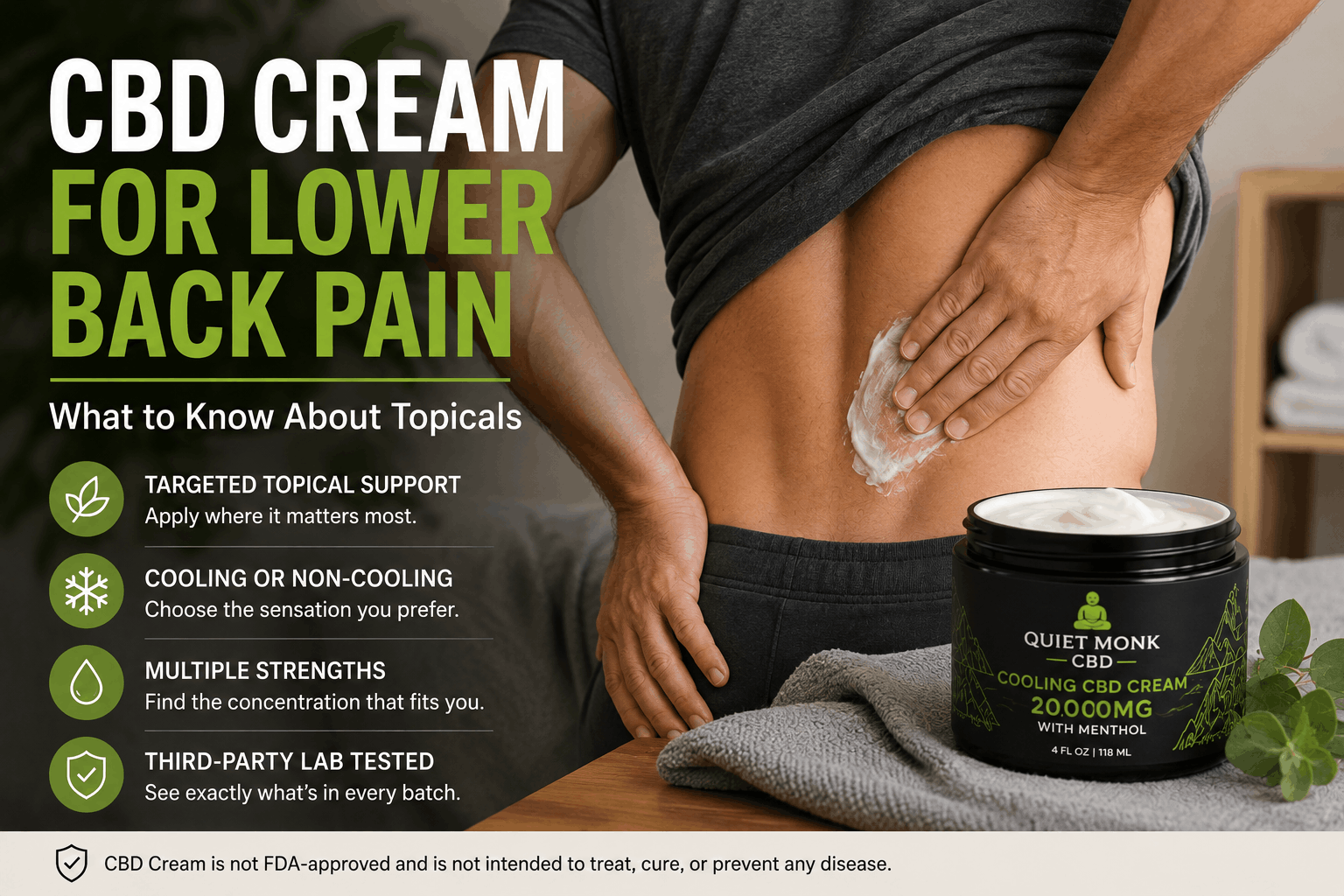
Cooling vs. Non-Cooling CBD Cream for Your Back
This can make a surprisingly big difference.
A cooling CBD cream commonly contains ingredients such as menthol.
Menthol activates cold-sensitive receptors in the skin, creating a cooling sensation. It doesn’t actually make the muscles underneath your skin colder.
Some people really enjoy that sensation on their lower back, particularly after physical activity.
Other people dislike menthol entirely.
That’s why a non-cooling CBD cream can be preferable for someone who wants the topical application without the cooling sensation.
Neither one is automatically better.
It’s primarily about what you prefer.
What CBD Strength Should You Use?
There isn’t an established medical dose of topical CBD for lower back pain.
That’s important because CBD products are available in dramatically different concentrations.
You might see:
1,000mg
5,000mg
10,000mg
20,000mg
or even higher.
But don’t look at the milligram number by itself.
Container size matters.
For example:
10,000mg in a 4-ounce jar
is a different concentration from:
10,000mg in a 1-ounce jar.
That’s why we recommend comparing CBD concentration rather than simply choosing whichever product displays the biggest number.
If you’re trying to understand the differences, our CBD Cream Strength Comparison Guide breaks down CBD strength and concentration in much more detail.
What About CBG and Other Cannabinoids?
Some CBD creams contain CBD alone.
Others contain additional hemp-derived cannabinoids such as CBG or broad-spectrum hemp extracts containing several cannabinoids.
You’ll also encounter products made primarily with CBD isolate.
There’s ongoing research into different cannabinoids, but I wouldn’t choose a topical simply because a manufacturer tells you that adding another cannabinoid makes the product dramatically more effective.
Instead, look at what’s actually in the formulation and whether the product has been independently tested.
Ingredients Matter Too
CBD gets most of the attention, but it’s only one part of a topical.
Depending on the product, you might also find:
- Menthol
- Botanical extracts
- Carrier oils
- Moisturizing ingredients
- Other cannabinoids
- Essential oils
Those ingredients affect the texture, scent and sensation of the product.
For example, someone looking for a strong cooling experience will have very different preferences from someone who doesn’t want menthol.
Always check the complete ingredient list, particularly if you have sensitive skin or known allergies.
What About Back Pain Involving Nerves?
This deserves its own discussion.
Some people searching for CBD cream for lower back pain are actually dealing with symptoms involving nerves.
Those symptoms can include burning, tingling, numbness or sensations that travel into another area.
That’s different from simply having tired or sore back muscles.
If nerve-related symptoms are what brought you here, we’ve created a separate CBD cream for neuropathy guide that discusses topical CBD and nerve discomfort in more detail.
More importantly, persistent numbness, weakness, tingling or radiating symptoms deserve medical evaluation because they can have many different causes.
A topical product shouldn’t be used as a substitute for determining what’s actually happening.
How Do You Apply CBD Cream to Your Lower Back?
Always follow the directions on the specific product you’re using.
Generally, a topical cream is applied to the desired area and massaged into the skin.
A few practical considerations:
- Start with a modest amount.
- Massage it into the intended area.
- Allow the product to absorb before putting clothing over it.
- Wash your hands after applying strong cooling or warming products.
- Keep topical products away from your eyes and other sensitive areas.
- Don’t apply to broken or irritated skin unless the product specifically says it’s appropriate.
- Stop using the product if you experience an unwanted skin reaction.
The lower back can also be difficult to reach, so some people prefer a roll-on or ask someone else to apply the cream.
When Back Pain Shouldn’t Be Handled With a Topical
This is important.
Most episodes of lower back discomfort aren’t emergencies, but certain symptoms warrant medical attention rather than experimenting with another topical.
Seek appropriate medical care if back pain is severe, follows a significant injury, is accompanied by significant weakness or numbness, or involves changes in bladder or bowel control.
You should also consider talking with a healthcare professional if back pain persists or repeatedly interferes with your normal activities.
The purpose of a topical product isn’t to hide something that needs medical evaluation.
Why Third-Party CBD Testing Matters
If you’re buying CBD, you shouldn’t have to simply trust the number printed on the jar.
Look for a current Certificate of Analysis (COA) from an independent laboratory.
Depending on the testing performed, a COA can provide information about:
- CBD concentration
- Other cannabinoids
- THC results
- Product or batch identification
- Date of testing
Quiet Monk CBD makes our third-party laboratory results available for customers to review.
That’s particularly important with high-strength products because consumers should be able to verify what they’re purchasing.
What We’ve Learned From Making High-Strength CBD Topicals
One of the biggest lessons I’ve learned from making CBD products is that strength isn’t the only thing customers care about.
Some customers come to Quiet Monk specifically because they’re looking for extremely high-strength CBD topicals.
But others care more about:
Cooling vs. non-cooling
Cream vs. salve
Texture
How easily it spreads
Ingredients
Container size
Lab testing
Those things matter.
That’s why I don’t believe there is one CBD cream that’s automatically right for everyone with lower back discomfort.
The goal is to understand what you’re buying and choose a formulation that fits what you’re looking for.
Frequently Asked Questions
Can you put CBD cream on your lower back?
CBD topical products designed for external use can generally be applied to normal skin on the lower back according to the manufacturer’s directions.
Does CBD cream treat lower back pain?
CBD cream is not an FDA-approved treatment for lower back pain. Research into topical CBD is still developing, and lower back pain can have many different causes.
Is cooling CBD cream better for back discomfort?
Not necessarily. Menthol-containing products create a cooling sensation that some people enjoy, while others prefer non-cooling creams.
How strong should CBD cream be for your back?
There isn’t an established universal topical CBD dose for back pain. Consider CBD concentration, container size, formulation, ingredients and third-party testing rather than choosing based only on the largest milligram number.
Can CBD cream help with nerve pain in the back?
Research into topical CBD and neuropathic discomfort remains limited. Symptoms involving numbness, tingling, weakness or radiating sensations should also be evaluated appropriately rather than relying solely on a topical product.
Should high-strength CBD cream have a COA?
We recommend looking for independent third-party laboratory testing regardless of strength. A COA provides information about what was detected in the tested product.
Final Thoughts
If you’re considering CBD cream for lower back pain, don’t base your decision on marketing promises or the largest number printed on a jar.
Look at the CBD concentration, container size, cooling or non-cooling formulation, other ingredients and third-party laboratory testing.
And remember that lower back pain can have many different causes.
At Quiet Monk CBD, we’d rather explain our products clearly than promise that CBD will fix something when the science doesn’t support that claim.
We’ve spent years making CBD topicals and talking with the people who use them. Our goal is to give customers enough information to understand what they’re buying and choose the product that best fits their preferences.