If you’re trying to understand CBD, one of the hardest parts can be separating useful information from marketing hype.
At Quiet Monk CBD, we’ve spent years making CBD products, working with different formulations and strengths, reviewing third-party lab results, and talking directly with customers about the questions they have before choosing a product.
We created this Learning Center to share what we’ve learned.
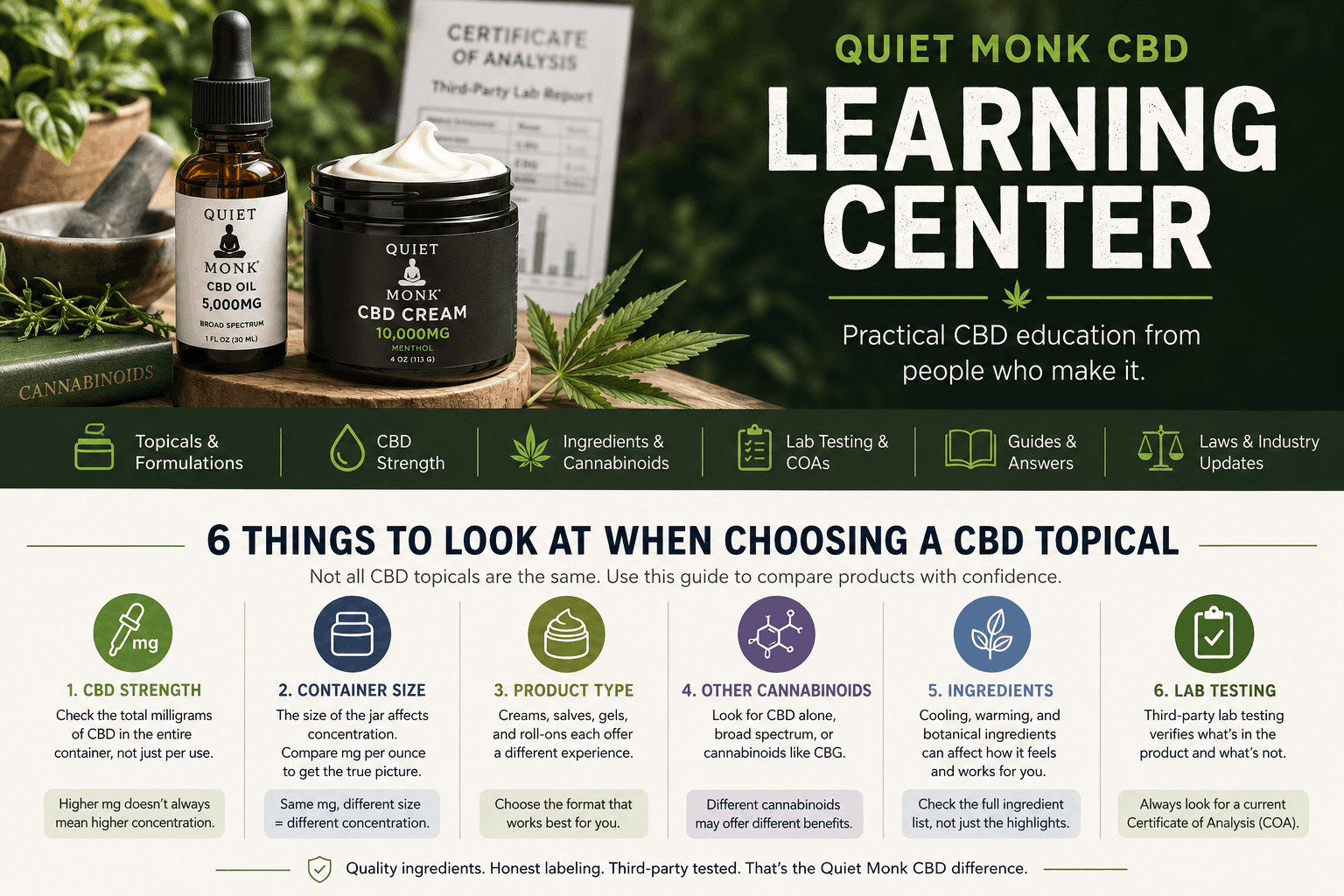
Whether you’re trying to understand the difference between a CBD cream and salve, wondering what 5,000mg or 10,000mg actually means, comparing ingredients, or trying to make sense of a Certificate of Analysis, you’ll find practical information here.
CBD Topicals: Creams, Salves, Gels & Roll-Ons
CBD topicals come in several different forms, and choosing between them isn’t always obvious.
A cream may be easier to spread over a larger area, while a salve has a thicker consistency. Gels and roll-ons provide different application experiences, and cooling ingredients such as menthol can make two products with the same amount of CBD feel very different on the skin.
Our topical guides cover topics including:
- CBD creams and lotions
- CBD salves and balms
- Cooling and warming topicals
- CBD gels
- CBD roll-ons
- How topical formulations differ
- How to apply CBD topicals
- Ingredients commonly found in topical products
Explore our CBD Topical Guides →
Understanding CBD Strength
What does 5,000mg of CBD actually mean?
It’s one of the most common questions we receive.
The milligram number on a CBD product normally represents the total amount of CBD in the entire container—not the amount you’re applying each time you use it.
That makes container size important.
For example, comparing a 5,000mg product in a 4-ounce jar with a 5,000mg product in a much smaller container isn’t necessarily an apples-to-apples comparison.
We believe shoppers should understand what they’re buying instead of simply assuming a larger number automatically makes one product better than another.
Our strength guides explain:
- What CBD milligrams mean
- CBD concentration vs. total CBD
- How container size affects concentration
- How much CBD is in an approximate application
- Differences between lower and higher concentrations
- How to compare CBD products from different manufacturers
Read Our CBD Strength Guides →
How to Choose a CBD Topical
There’s no single CBD topical that’s right for everyone.
Some people prefer a lightweight cream. Others like a thicker salve. Some specifically want a cooling sensation, while others avoid menthol altogether.
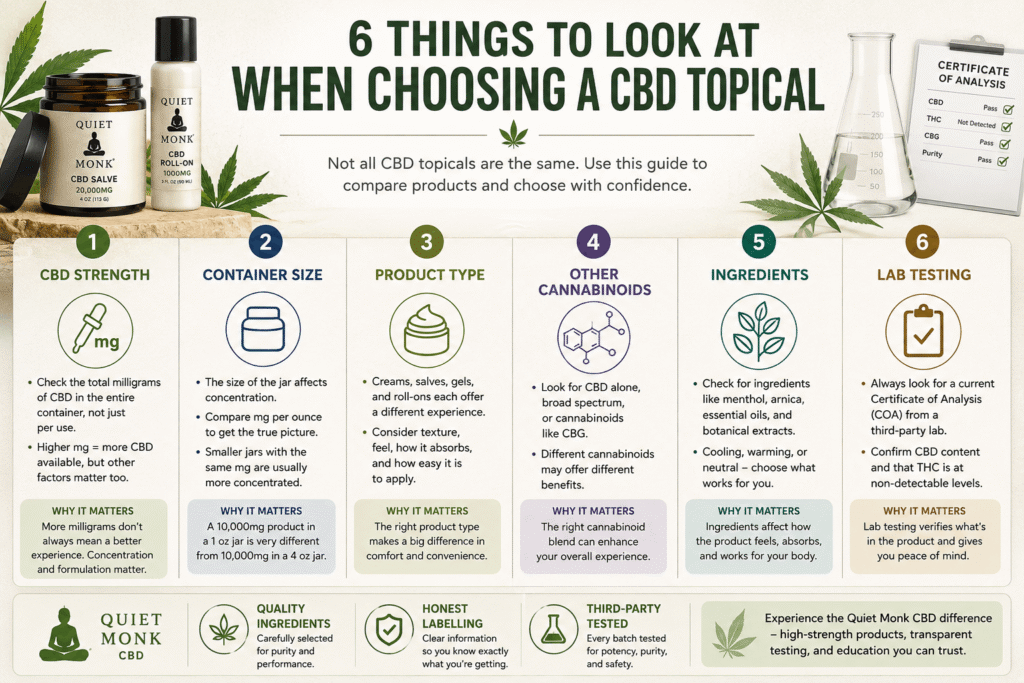
When comparing products, consider more than the number printed on the front of the jar.
Look at:
- Total CBD content
- Container size
- CBD concentration
- Other cannabinoids in the formula
- Cooling or warming ingredients
- Cream, salve, gel or roll-on format
- Complete ingredient list
- Third-party laboratory results
Our guides can help you understand these differences before making a decision.
Browse Our CBD Topical Guides →
CBD Ingredients & Formulations
CBD isn’t the only ingredient that determines how a topical feels.
The base formulation and additional ingredients can dramatically change its texture, cooling sensation, absorption and overall application experience.
Depending on the product, topical formulations may contain ingredients such as menthol, botanical extracts, carrier oils and other cannabinoids such as CBG.
We discuss why these ingredients are used and what to look for when comparing product labels.
We also explain different forms of hemp-derived cannabinoids, including:
- CBD isolate
- Broad-spectrum hemp extract
- CBG
- Other minor cannabinoids
- Carrier oils
- Common topical ingredients
Understanding the formulation makes it much easier to compare two products that may look similar on the front of the label.
Learn About CBD Ingredients →
CBD Lab Testing & Certificates of Analysis
You shouldn’t have to simply trust what a CBD company prints on its label.
Third-party laboratory testing can provide additional information about what’s actually in a CBD product.
A Certificate of Analysis, commonly called a COA, may show cannabinoid potency and whether compounds such as THC were detected in the tested sample.
When reviewing a COA, we recommend checking:
- Product or batch identification
- Date of testing
- Testing laboratory
- CBD concentration
- Other cannabinoids detected
- THC results
- Whether the report corresponds with the product you’re purchasing
Quiet Monk CBD publishes third-party laboratory results so customers can review them directly.
View Quiet Monk CBD Lab Results →
CBD Guides Based on Common Questions
Over the years, customers have asked us thousands of questions about CBD.
Many of our articles started with those conversations.
Our educational guides cover questions about CBD topicals, product strengths, ingredients, application methods and other subjects that come up when people are researching CBD.
Where research is limited or uncertain, we believe it’s important to say so.
CBD products shouldn’t be presented as miracle products or substitutes for appropriate medical care. Our goal is to give you useful information that helps you understand the products you’re considering.
Browse Our CBD Guides →
CBD Laws, Regulations & Industry Changes
Hemp and CBD regulations have changed considerably over the years and continue to evolve.
Our industry section covers significant developments affecting hemp-derived products, including changes to federal and state regulations, THC limits and other issues that may affect CBD consumers and businesses.
Because regulations can change, always check current rules applicable to your location.
Read CBD Industry & Legal Updates →
About Quiet Monk CBD
Quiet Monk CBD isn’t a content website that happens to write about CBD.
We make CBD products.
That hands-on experience gives us a different perspective when discussing CBD strength, ingredients, formulations and product testing.
We’ve worked with different CBD concentrations, cannabinoid formulations, topical bases and product formats while continually refining our products based on testing and customer feedback.
This Learning Center is where we share that experience.
We won’t pretend that every question about CBD has a definitive answer. When scientific evidence is limited, we’ll tell you. When something comes from our own manufacturing experience or customer feedback rather than clinical research, we’ll make that distinction as well.
That’s how we believe CBD education should work.
Explore Quiet Monk CBD
Ready to continue?
CBD Topicals & Creams →
Learn about creams, salves, gels, roll-ons and other topical formats.
CBD Strength Guides →
Understand CBD milligrams, concentrations and how different strengths compare.
CBD Ingredients →
Learn about CBD isolate, broad-spectrum extracts, CBG and topical ingredients.
CBD Lab Testing →
Learn how to read a Certificate of Analysis and view Quiet Monk CBD’s laboratory results.
CBD Guides →
Browse our educational articles and answers to frequently asked CBD questions.
CBD Laws & Industry News →
Follow important developments affecting hemp and CBD products.
A Note About Our Educational Content
Information in the Quiet Monk CBD Learning Center is provided for general educational purposes. It is not intended to diagnose, treat, cure or prevent any disease and should not be considered a substitute for advice from a qualified healthcare professional.
Browse Our Articles To Learn More About CBD
- CBD and Athletics
- Blog Articles
- All About Cannabis
- CBD 101 Basics
- How CBD is Being Used For Eczema
- Mixing CBD & Food
- CBD Gummies
- CBD Use For Dogs
- Using CBD for Pain
- How Seniors Are Using CBD
- Treating Gout with CBD
- Legalization By State
- CBD in The News
- Common Questions About CBD
- General Info About CBD Topicals
- History of CBD
- CBD Extraction Methods
- Comparative Legal Analysis of THC vs. CBD Globally
- Mental Health and CBD
- CBD in Veterinary Medicine
- Check with your employer or any organization you’re part of to ensure there are no rules against using CBD or THC. If its all okay then use coupons for bigger discounts.
Our Most Recent Articles
- Our Best CBD Cream for Restless Leg Syndrome
- Does CBD Cream Work? What the Research Actually Says
- CBD Cream for Lower Back Pain: What to Know About Topicals
- CBD Cream for Arthritis in Seniors: What to Know Before Choosing a Topical
- What Is a CBD Salve Stick? Uses, Strength & How to Choose One
- How to Choose the Best CBD Cream for Neuropathy Pain
- Cost of Chronic Pain Per Person (2026 Statistics): Annual Medical Expenses & Economic Impact
- Chronic Pain Market Size Statistics (2026): Revenue, Growth Rate & Forecast