Posted on

Cost of Chronic Pain Per Person (2026 Statistics): Annual Medical Expenses & Economic Impact

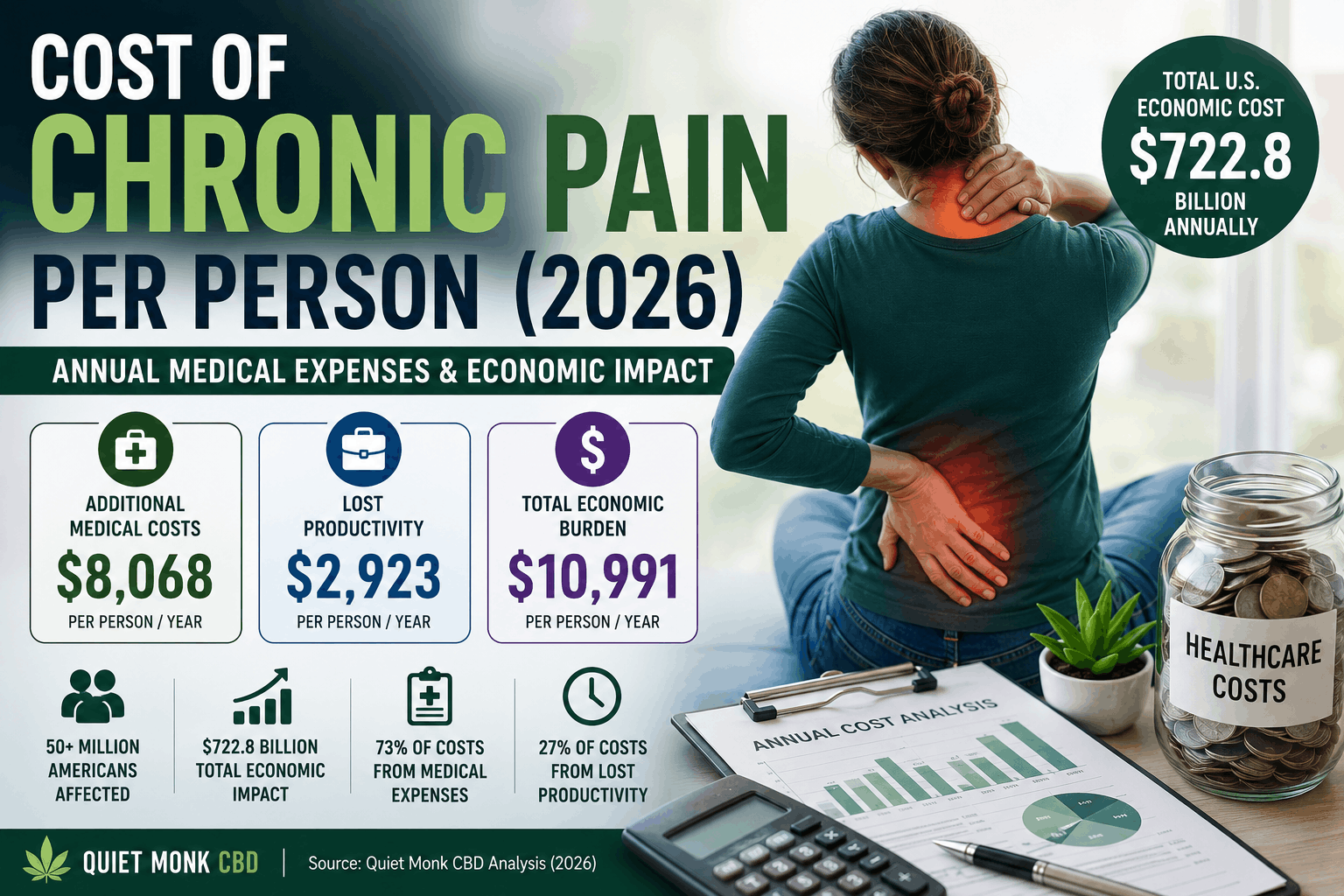
Infographic about the cost of chronic pain per person in 2026 including medical expenses, lost productivity, and national economic impact

Chronic pain affects more than 50 million adults in the United States and remains one of the most expensive health conditions in the country. Beyond the physical and emotional toll, chronic pain creates significant financial burdens through healthcare costs, lost productivity, missed workdays, and reduced quality of life.

In 2026, the average person living with chronic pain incurs thousands of dollars in additional annual expenses compared to individuals without chronic pain. Below is a detailed look at the latest chronic pain cost statistics, including medical expenses, lost income, and the overall economic impact of chronic pain in America.


Key Cost of Chronic Pain Statistics (2026)

  • More than 51 million U.S. adults live with chronic pain.
  • Adults with chronic pain incur approximately $8,068 in additional annual medical expenses.
  • Chronic pain results in approximately $2,923 in lost productivity per person annually.
  • The total annual economic burden of chronic pain is approximately $10,991 per person.
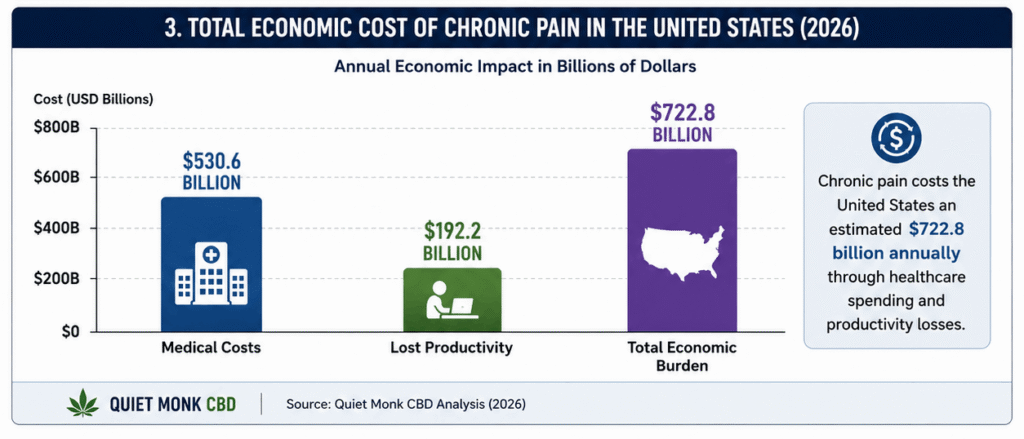
  • Chronic pain costs the United States an estimated $722.8 billion annually.
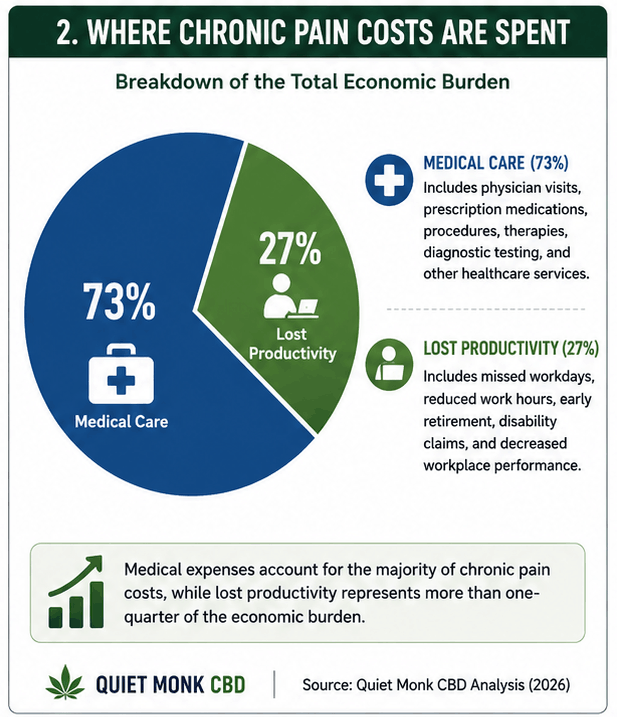
  • Direct medical costs account for approximately 73% of total chronic pain costs.
  • Lost productivity accounts for approximately 27% of total chronic pain costs.

Annual Cost of Chronic Pain Per Person

Chronic pain creates significant expenses beyond routine healthcare costs. Studies show that individuals living with chronic pain spend substantially more on healthcare services, treatments, medications, and specialist visits compared to those without chronic pain.
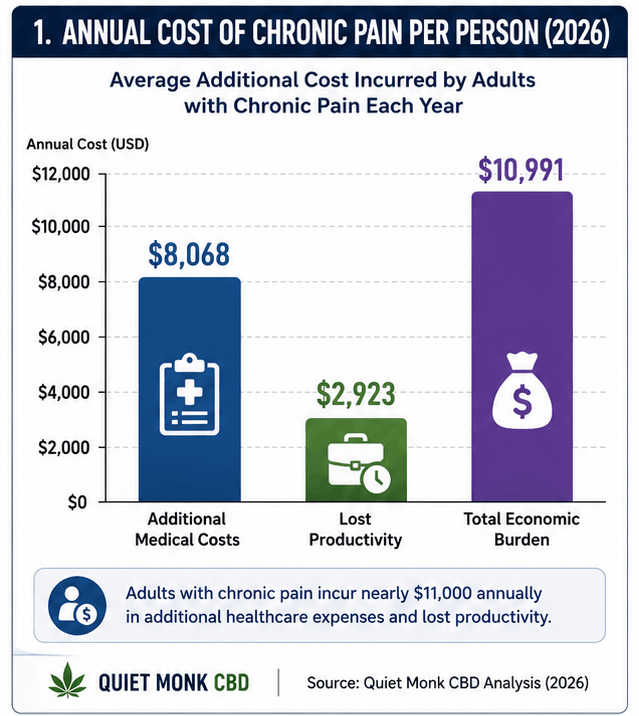
annual cost of chronic pain per person in 2026 showing medical expenses, lost productivity and total economic burden
Adults with chronic pain incur nearly $11,000 annually in additional healthcare expenses and lost productivity.


Direct Medical Costs vs Productivity Costs

The financial burden of chronic pain extends beyond doctor’s visits and prescriptions. Lost productivity, missed workdays, and reduced work performance create a substantial economic impact for both workers and employers.

Breakdown of Chronic Pain Costs

  • Medical Care: 73%
  • Lost Productivity: 27%

Common medical expenses include:

  • Physician visits
  • Prescription medications
  • Physical therapy
  • Pain management procedures
  • Diagnostic testing
  • Specialist consultations

Common productivity losses include:

  • Missed workdays
  • Reduced work hours
  • Early retirement
  • Disability claims
  • Decreased workplace performance
chronic pain cost breakdown showing medical care and lost productivity expenses
Medical expenses account for the majority of chronic pain costs, while lost productivity represents more than one-quarter of the economic burden.


National Economic Impact

When chronic pain costs are multiplied across millions of Americans, the financial impact becomes staggering.

Researchers estimate that chronic pain costs the United States more than $722 billion annually through healthcare spending and productivity losses.

Annual U.S. Economic Burden

CategoryAnnual Cost
Medical Costs$530.6 Billion
Lost Productivity$192.2 Billion
Total Economic Burden$722.8 Billion
Chronic pain generates hundreds of billions of dollars in healthcare costs and lost productivity each year.

Why Chronic Pain Costs Continue to Rise

Several factors are contributing to increasing chronic pain costs in 2026:

Aging Population

As Americans live longer, conditions associated with chronic pain continue to increase, including:

  • Osteoarthritis
  • Degenerative disc disease
  • Neuropathy
  • Joint disorders

Chronic Disease Growth

Conditions frequently associated with chronic pain include:

  • Diabetes
  • Fibromyalgia
  • Autoimmune disorders
  • Cancer-related pain

The prevalence of these diseases continues to increase healthcare spending nationwide.


Increased Healthcare Utilization

People living with chronic pain typically require:

  • More physician visits
  • Additional medications
  • Ongoing treatment plans
  • Long-term management strategies

This creates significantly higher healthcare expenditures compared to the general population.


The Growing Demand for Non-Opioid Pain Relief

As healthcare providers seek alternatives to opioid medications, demand continues to grow for:

Many consumers are increasingly interested in options that can be incorporated into a long-term pain management strategy.


Chronic Pain by Severity

Not all chronic pain patients experience the same financial burden.

Research shows that individuals with severe chronic pain often incur:

  • Higher medical expenses
  • More frequent healthcare visits
  • Greater productivity losses
  • Increased disability-related costs

As pain severity increases, overall annual expenses typically rise as well.


Future Outlook

Healthcare economists expect chronic pain costs to continue increasing through the next decade due to:

  • Population aging
  • Rising healthcare costs
  • Increased chronic disease prevalence
  • Longer life expectancy

Without significant improvements in prevention and treatment, the economic burden of chronic pain is expected to remain one of the largest healthcare challenges facing the United States.


❓ Frequently Asked Questions

How much does chronic pain cost the average person per year?

Research estimates that chronic pain costs the average person approximately $10,991 annually when medical expenses and lost productivity are combined.


What is the largest cost associated with chronic pain?

Direct medical expenses represent the largest portion of chronic pain costs, accounting for approximately 73% of the total economic burden.


How much does chronic pain cost the United States each year?

Chronic pain is estimated to cost the United States approximately $722.8 billion annually through healthcare spending and productivity losses.


Why is chronic pain so expensive?

Chronic pain often requires long-term treatment, specialist care, prescription medications, diagnostic testing, and ongoing management. It also contributes to missed work and reduced productivity.


Will chronic pain costs continue to increase?

Most experts expect chronic pain costs to continue rising due to population aging, increasing chronic disease rates, and higher healthcare expenditures.


What This Means for Consumers

Chronic pain affects not only health and quality of life but also financial well-being. Understanding the true cost of chronic pain highlights the importance of effective pain management strategies, early intervention, and long-term approaches that may help reduce both personal and societal costs.
Sources & References

Posted on

Chronic Pain Market Size Statistics (2026): Revenue, Growth Rate & Forecast

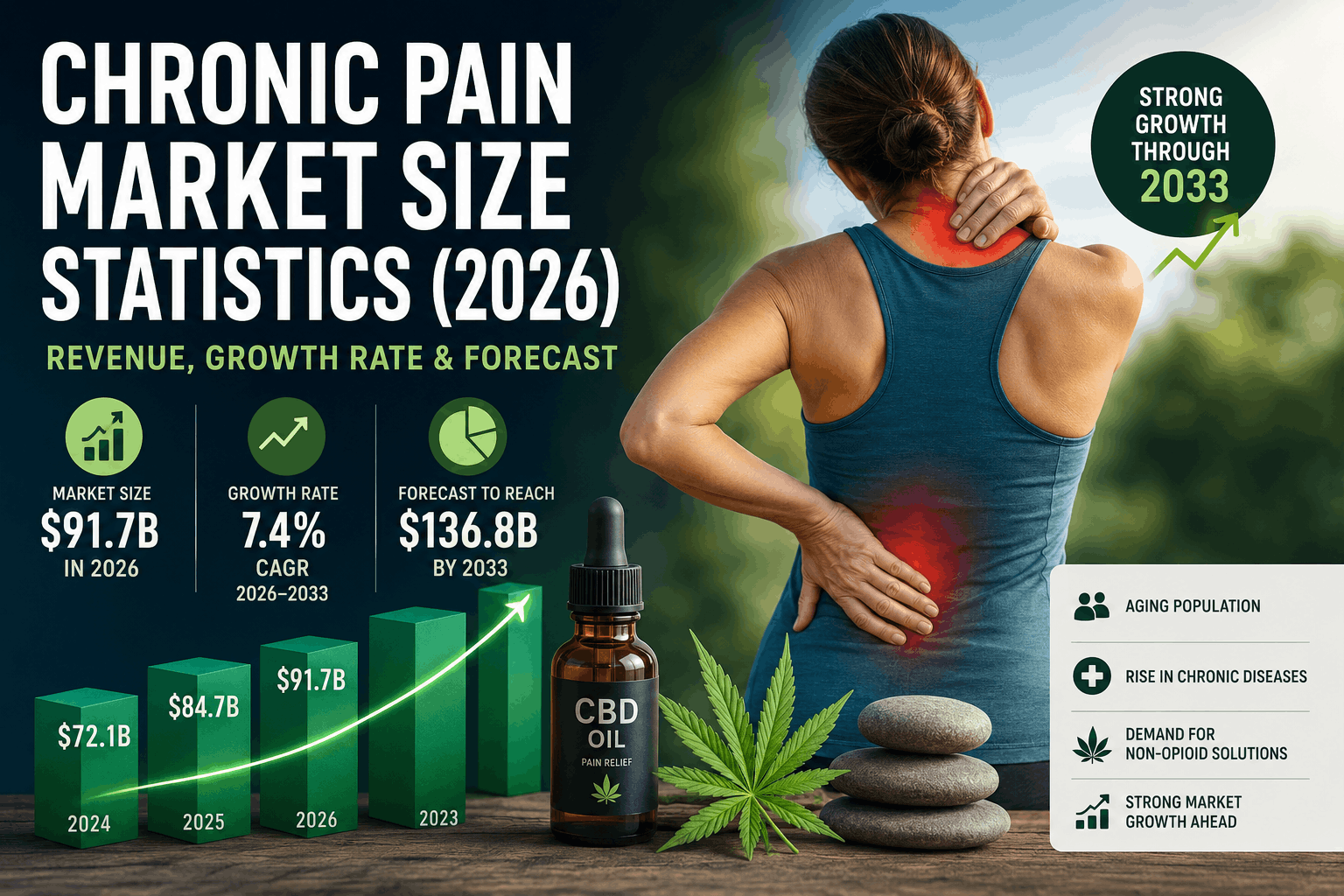
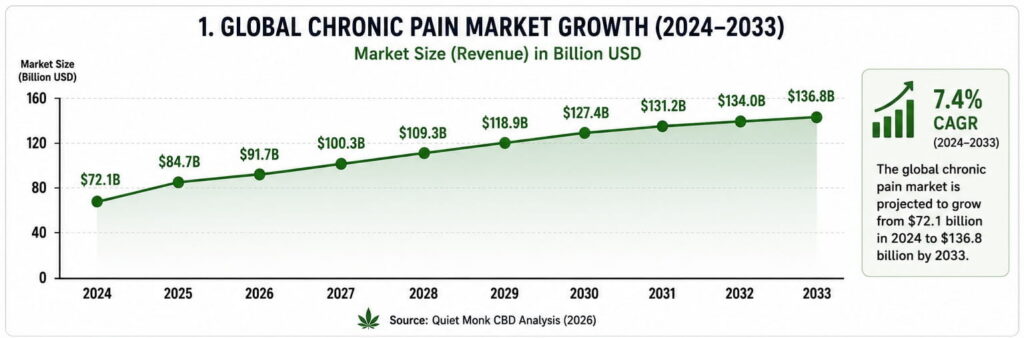
Global chronic pain market forecast through 2033 showing revenue growth from $91.7 billion in 2026 to $136.8 billion

Introduction

Chronic pain affects millions of Americans and represents one of the largest healthcare markets in the world. As the population ages and conditions such as arthritis, neuropathy, back pain, and musculoskeletal disorders become more common, spending on pain management continues to grow. Below is a data-driven look at chronic pain market size, revenue trends, growth rates, and forecasts through 2035.


🔢 Key Chronic Pain Market Statistics (2026)

  • Global chronic pain market estimated at $83.0 billion in 2026.
  • Chronic pain market expected to reach $136.8 billion by 2033.
  • Forecast growth rate of approximately 7.4% CAGR from 2026-2033.
  • Chronic pain market projected to grow from $91.7 billion in 2026 to $127.4 billion by 2030.
  • Chronic pain treatment market expected to exceed $152 billion by 2032.

📊 Chronic Pain Market Revenue Growth

chronic pain market size growth chart 2024 to 2033 showing revenue forecast and market expansion
Global chronic pain market revenue is projected to grow from approximately $72 billion in 2024 to nearly $137 billion by 2033.

Sources indicate strong annual growth driven by aging populations, increased chronic disease prevalence, and demand for non-opioid pain treatments.

📈 Chronic Pain Market Growth Rate

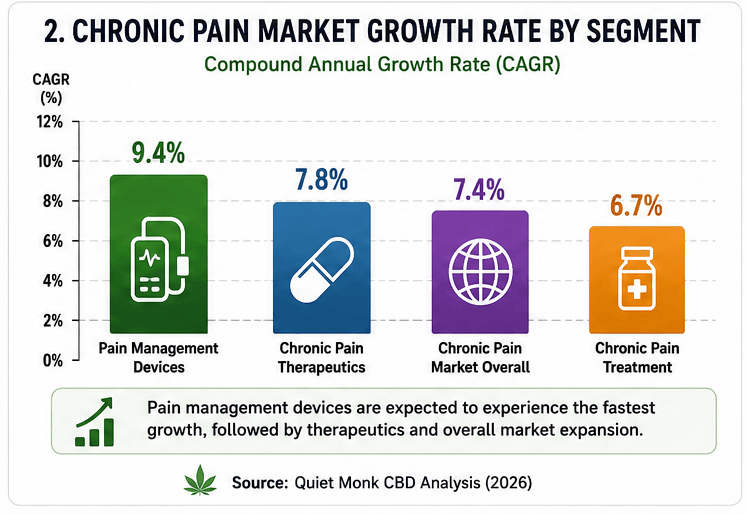
The chronic pain industry is currently growing between 6.7% and 7.8% annually, depending on the market segment being measured.

Growth Rate by Segment

chronic pain treatment growth rate by segment chart showing pain management devices and therapeutics CAGR
Pain management devices are expected to experience the fastest growth among chronic pain treatment segments.
Pain management devices are currently among the fastest-growing categories in the industry.

🏥 What’s Driving Chronic Pain Market Growth?

Aging Population

Americans are living longer than ever before. Age-related conditions such as:

  • Arthritis
  • Degenerative disc disease
  • Neuropathy
  • Joint disorders

continue to increase demand for pain relief solutions.


Rise in Chronic Disease

Conditions associated with long-term pain include:

  • Diabetes
  • Cancer
  • Fibromyalgia
  • Autoimmune disorders

These diseases continue to expand globally, creating greater demand for treatment options.


Demand for Non-Opioid Alternatives

One of the fastest-growing trends is the move toward:

  • Topical pain relief products
  • CBD products
  • Neuromodulation devices
  • Non-opioid pharmaceuticals

Healthcare providers are increasingly seeking alternatives to traditional opioid therapies.


📊 Largest Chronic Pain Categories

Musculoskeletal Pain

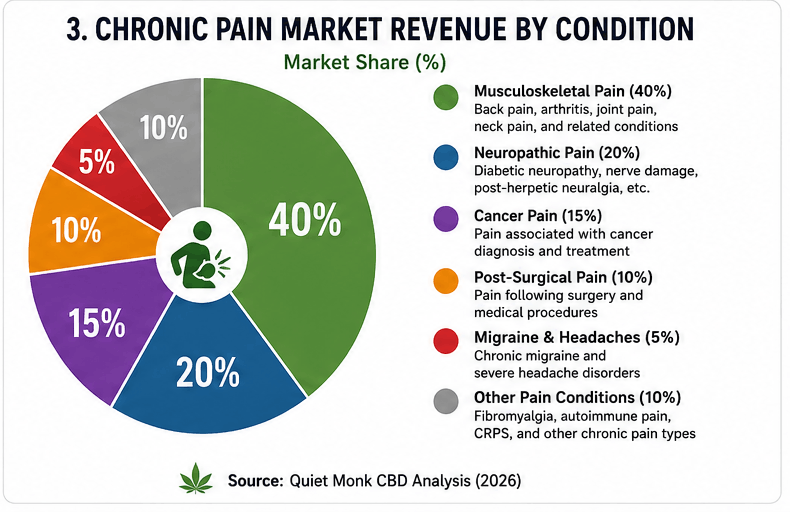
chronic pain market share by condition pie chart showing musculoskeletal, neuropathic, cancer and post surgical pain
Musculoskeletal conditions account for the largest share of chronic pain treatment revenue worldwide.

Approximately 40% of pain management revenue comes from musculoskeletal conditions.

Examples include:

  • Back pain
  • Joint pain
  • Osteoarthritis
  • Neck pain

Neuropathic Pain

Neuropathic pain is among the fastest-growing segments in the chronic pain market.

Examples include:

  • Diabetic neuropathy
  • Nerve damage
  • Post-surgical nerve pain

🌎 Regional Market Share

North America

  • Largest global market
  • Approximately 30% of worldwide revenue share

Drivers include:

  • High healthcare spending
  • Aging population
  • Large number of chronic pain patients

Asia-Pacific

  • Fastest-growing region
  • Driven by expanding healthcare access and aging populations.

📈 Future Forecast (2026–2035)

Industry analysts expect:

  • Continued growth in chronic pain treatment spending
  • Expansion of non-opioid therapies
  • Increased adoption of pain management devices
  • Greater demand for topical pain products

Several forecasts project the market will exceed $150 billion globally by the early 2030s.


❓ FAQ

How large is the chronic pain market in 2026?

The global chronic pain market is estimated at approximately $83 billion to $92 billion, depending on the segment analyzed.

What is the growth rate of the chronic pain market?

Most forecasts place growth between 6.7% and 7.8% CAGR through the next decade.

What is the largest chronic pain segment?

Musculoskeletal pain remains the largest segment, accounting for roughly 40% of market revenue.

What is driving growth in the chronic pain market?

Key drivers include aging populations, chronic disease prevalence, demand for non-opioid treatments, and technological advancements in pain management.


Posted on

Hemp Industry Growth Rate (2026): Market Size, Trends & Future Outlook

Hemp Industry Growth Rate (2026) Market Size, CAGR & Trends

The hemp industry is entering a major growth phase in 2026, driven by increasing legalization, consumer demand for natural products, and expanding industrial applications. From CBD wellness products to textiles and construction materials, hemp is becoming one of the fastest-growing plant-based industries globally. Below is a data-driven breakdown of hemp industry growth rates, market size, and key trends shaping 2026 and beyond.


🔢 Key Hemp Industry Growth Statistics (2026)

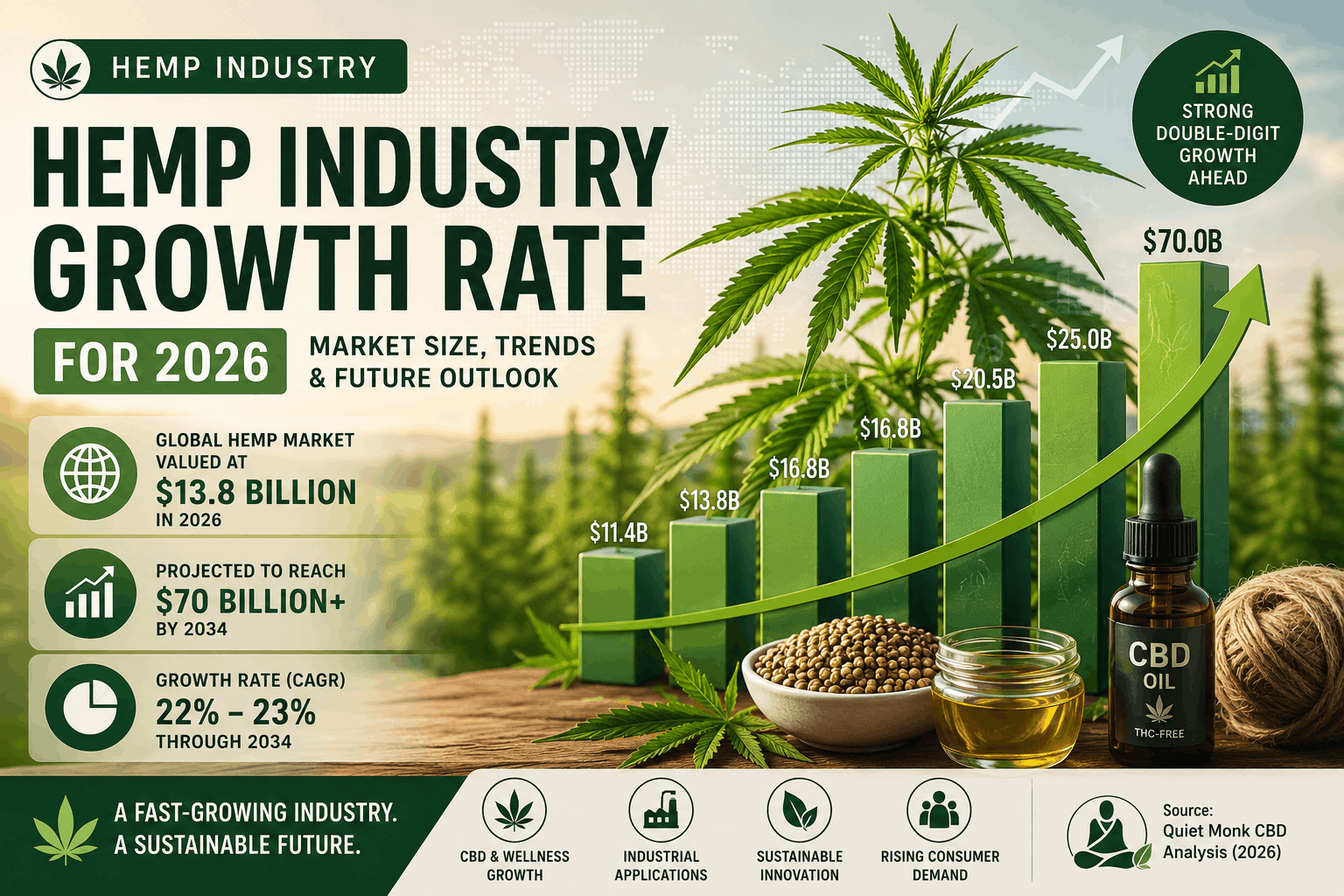
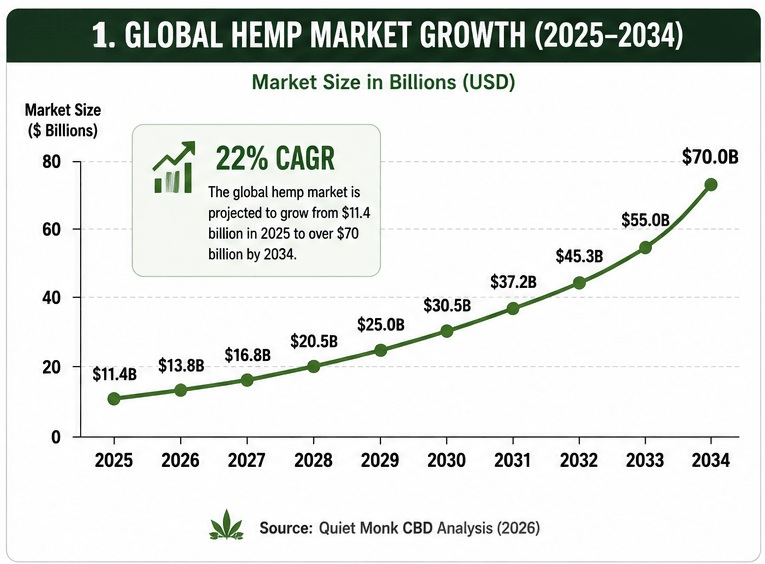
Global hemp market growth from 2025 to 2034, showing strong double-digit expansion across the industry.
  • The global hemp market is valued at approximately $13.8 billion in 2026
  • The industry is projected to grow to over $70 billion by 2034
  • Estimated compound annual growth rate (CAGR): ~22%–23%
  • Some forecasts show 17%–18% CAGR depending on sector
  • U.S. hemp market expected growth: ~20% CAGR through 2033

👉 Bottom line:
The hemp industry is growing at double-digit rates globally, making it one of the fastest-expanding plant-based markets.


📊 Market Size Growth (2025 → 2026)

  • 2025 market size: ~$11.4 billion
  • 2026 market size: ~$13.8 billion

👉 That’s roughly:

  • 20%+ year-over-year growth

This kind of growth is rare and signals strong momentum across multiple sectors.


📈 Growth Rate Breakdown by Segment

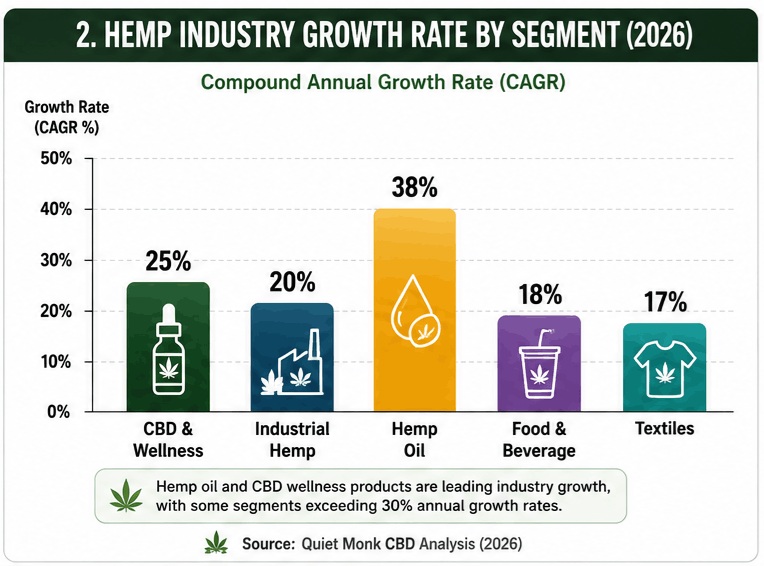
Growth rates vary across hemp industry segments, with hemp oil and CBD wellness products leading expansion.

🌿 CBD & Wellness Products

  • U.S. CBD market projected CAGR: ~25%+
  • Driven by:
    • Pain relief demand
    • Anxiety and sleep products
    • Aging population

🧵 Industrial Hemp (Textiles, Materials)

  • Growth rate: ~17%–23% CAGR
  • Major drivers:
    • Sustainable fabrics
    • Hempcrete construction
    • Eco-friendly packaging

🛢️ Hemp Oil Market

  • One of the fastest-growing segments
  • Growth rate: up to 38% CAGR

👉 This is fueled by:

  • Skincare
  • Supplements
  • Natural product trends

🗺️ Regional Growth Trends

  • North America = fastest-growing region
  • U.S. growth rate: ~20% CAGR
  • Europe = largest market share in some reports
  • Asia-Pacific = rapidly expanding production

👉 Key takeaway:
Growth is global, not just U.S.-driven


📉 Challenges Slowing Growth

Despite strong expansion, the industry faces:

  • Regulatory uncertainty (especially THC laws)
  • State-by-state restrictions
  • Oversupply in some markets
  • Pricing compression

👉 Example:
U.S. cannabis market growth slowed to ~4.9% in 2026 after previous higher growth years

📊 Market Shift Toward Compliance (2026)

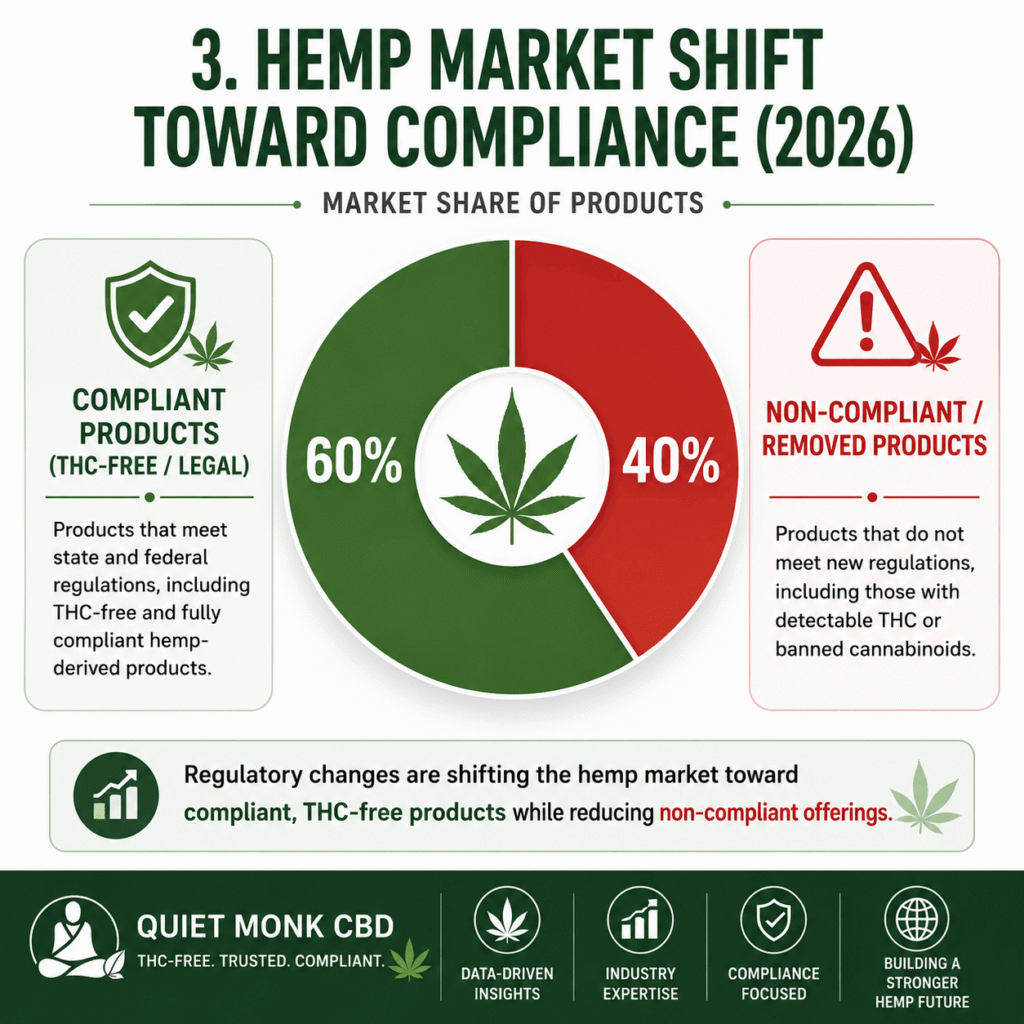
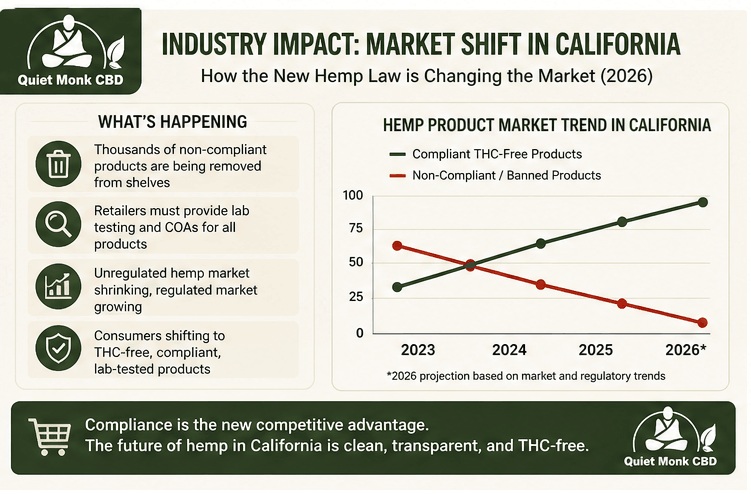
Regulatory changes are shifting the hemp market toward compliant, THC-free products while reducing non-compliant offerings.

As the hemp industry grows, regulatory changes—especially in states like California—are reshaping the market. One of the biggest trends in 2026 is the shift toward compliant, THC-free products and away from unregulated or non-compliant offerings.

Key changes driving this shift include:

  • Stricter THC limits in retail hemp products
  • Bans on synthetic cannabinoids like Delta-8
  • Increased enforcement and product testing requirements
  • Retailers removing non-compliant inventory

As a result, the hemp market is evolving into two clear categories:

  • Compliant products → THC-free, lab-tested, legally sold
  • Non-compliant products → removed from shelves or restricted

This shift is pushing both consumers and manufacturers toward safer, fully compliant CBD products.


📊 What’s Driving Hemp Growth in 2026?

1. Legalization Expansion

  • More countries and states allowing hemp production
  • Clearer federal frameworks emerging

2. Consumer Demand for Natural Products

  • Shift toward:
    • Plant-based wellness
    • Non-pharmaceutical solutions

3. Sustainability Trends

Hemp is:

  • Fast-growing
  • Low water use
  • Environmentally friendly

👉 Makes it attractive for:

  • Construction
  • Packaging
  • Textiles

4. Product Diversification

Hemp is now used in:

  • CBD topicals
  • Food & beverages
  • Clothing
  • Bioplastics
  • Building materials

📈 Future Outlook (2026–2030)

  • Continued double-digit growth expected
  • CBD and wellness sectors leading expansion
  • Industrial hemp gaining traction in construction and textiles
  • Regulatory clarity will determine long-term acceleration

👉 Conservative estimate:

  • 15%–25% annual growth across the industry

❓ FAQ: Hemp Industry Growth

How fast is the hemp industry growing?

The hemp industry is growing at 15%–25% annually, depending on the segment.


What is the hemp market size in 2026?

Approximately $13–14 billion globally.


Which hemp segment is growing fastest?

Hemp oil and CBD wellness products, with growth rates exceeding 25% CAGR.


Is hemp still a growing industry?

Yes—despite regulatory challenges, hemp remains one of the fastest-growing plant-based industries.


🔗 What This Means for Consumers

The rapid growth of the hemp industry means:

  • More product options
  • Better quality and testing
  • Increased availability of THC-free CBD products
  • More innovation in natural health
Posted on

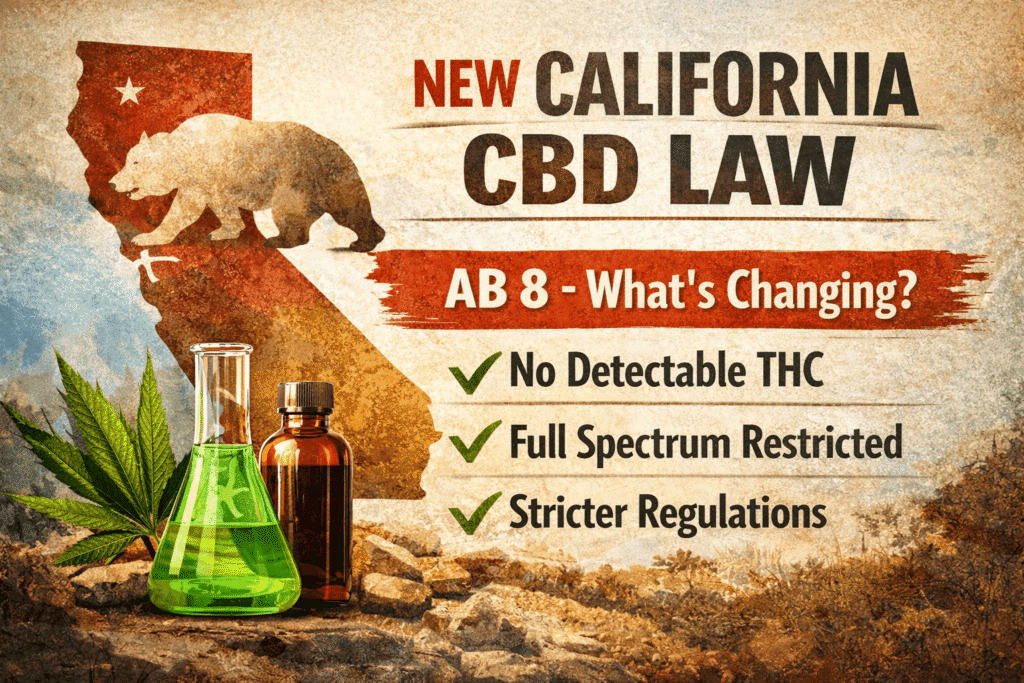
What Products Are Now Illegal in California? (2026 Hemp & CBD Law Statistics)

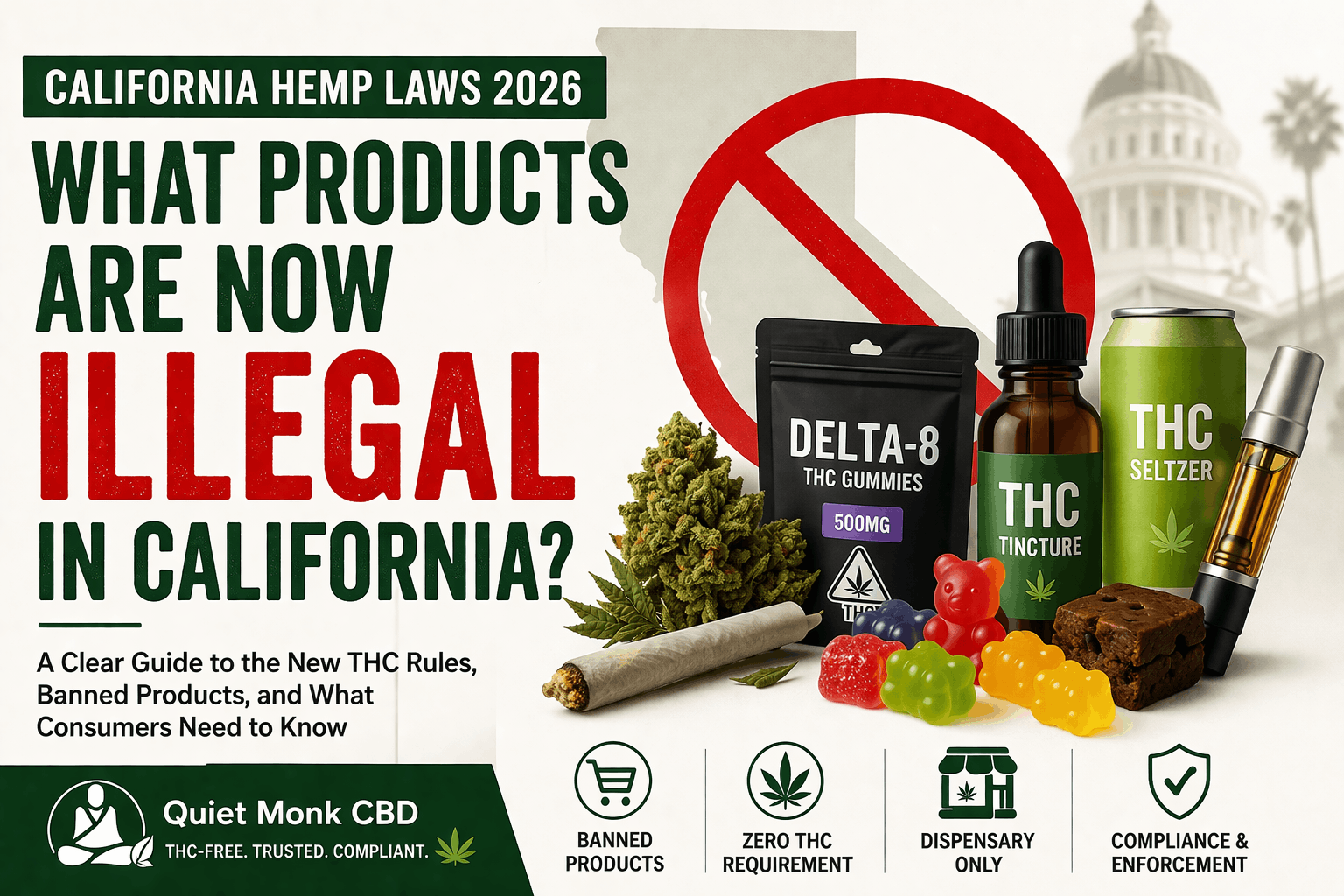
hemp products illegal California

California’s 2026 hemp law (AB 8) has significantly changed what CBD and hemp products can legally be sold in the state. Many items that were widely available just a year ago are now restricted, banned, or moved into the licensed cannabis system. Below is a clear, data-driven breakdown of what products are now illegal in California, along with statistics and compliance trends shaping the market.


Continue reading What Products Are Now Illegal in California? (2026 Hemp & CBD Law Statistics)
Posted on

California THC Law Statistics: What Changed in 2026

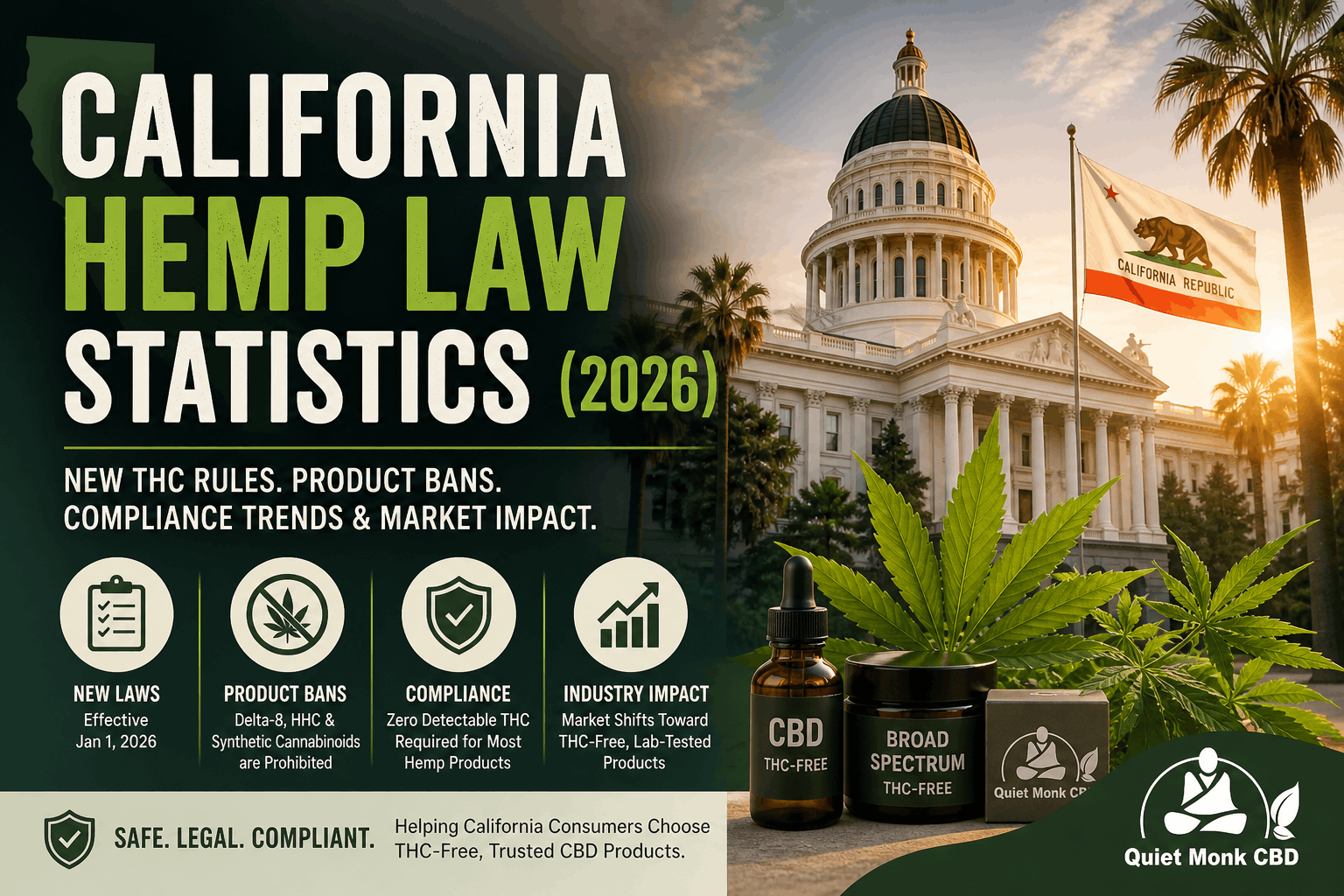
California 2026 hemp law stats

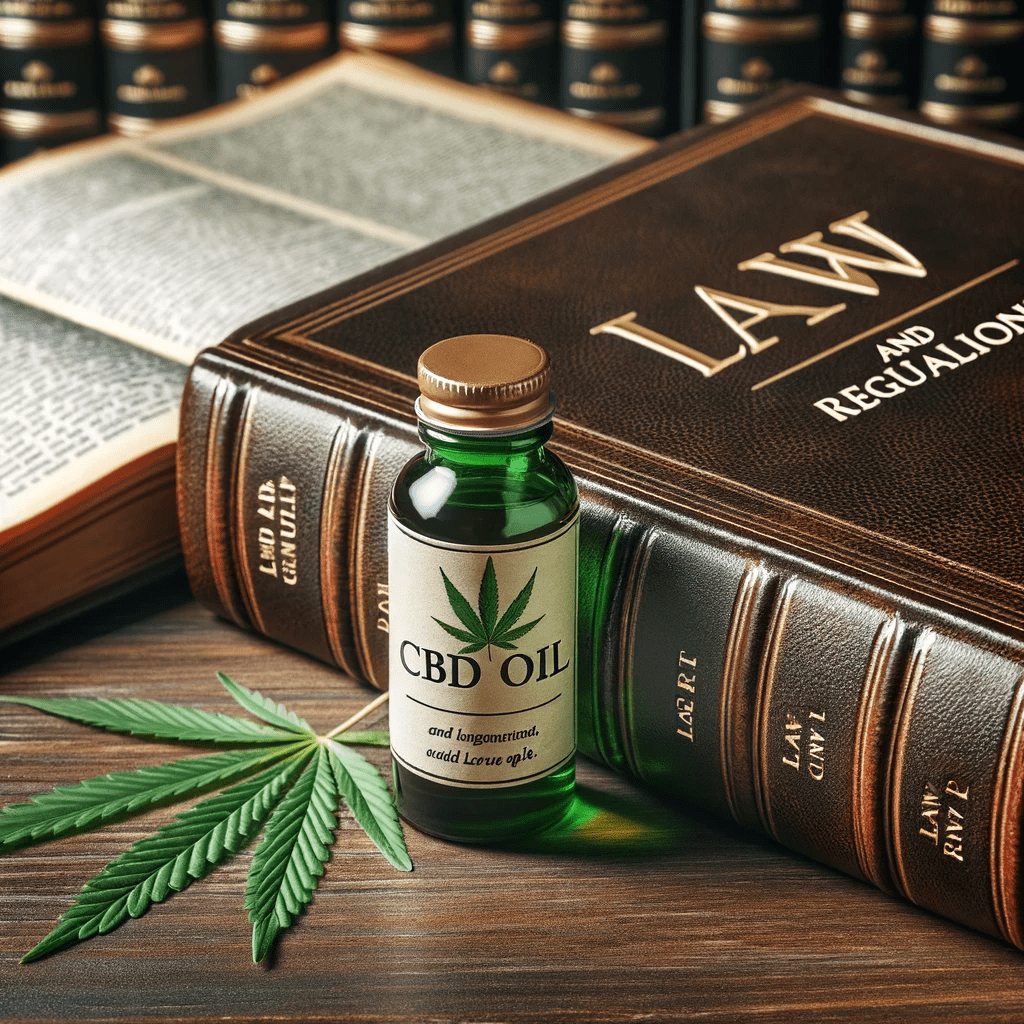
California’s new hemp law (AB 8) represents one of the most aggressive regulatory shifts in the country. Beginning January 1, 2026, the state tightened rules on THC content, banned certain hemp-derived products, and moved many cannabinoid products into the regulated cannabis system. Below is a data-driven breakdown of the most important California hemp law statistics, including product bans, enforcement trends, and compliance requirements. Many consumers are now choosing safer, non-intoxicating options like THC-free CBD products.


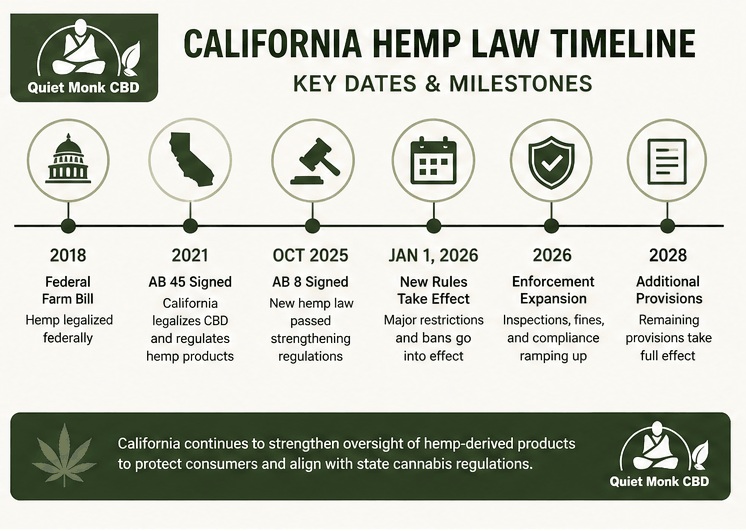
California hemp law timeline showing key dates from 2018 Farm Bill through 2026 AB 8 regulations and enforcement changes
Timeline of major hemp and CBD law changes leading to California’s 2026 regulations.

🔢 Key California Hemp Law Statistics (2026)

  • California’s AB 8 took effect January 1, 2026
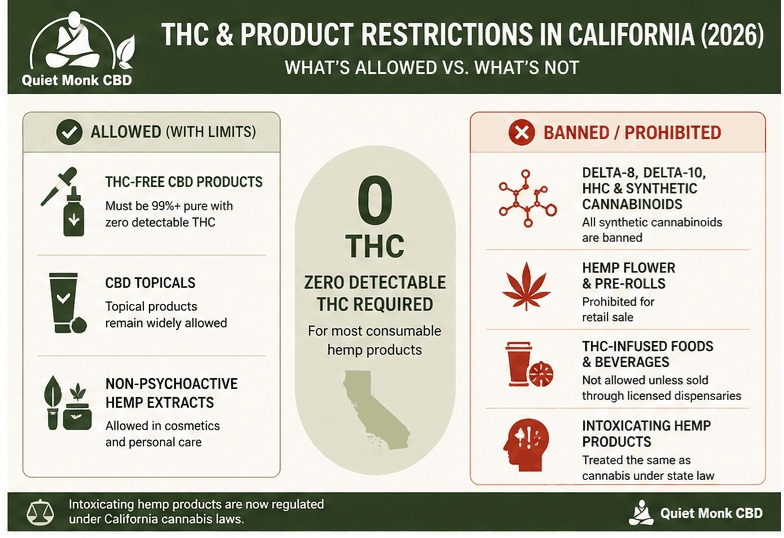
  • Synthetic cannabinoids (Delta-8, Delta-10, HHC) are banned statewide
  • Hemp extracts in food or supplements must be 99%+ pure with zero detectable THC
  • Hemp flower and pre-rolls are prohibited for retail sale
  • Intoxicating hemp products are now treated the same as cannabis under state law
  • Products with THC must be sold through licensed dispensaries only

📊 THC & Product Restrictions

  • California moved toward a zero-detectable THC standard for retail hemp products
  • Hemp extracts used in:
    • Food
    • Beverages
    • Supplements

👉 Must contain:

  • No THC
  • No synthetic cannabinoids

This effectively eliminates:

  • Delta-8 products
  • THC-infused hemp drinks
  • Many gray-market hemp items

This has increased demand for compliant alternatives such as broad spectrum CBD creams with non-detectable THC.

California hemp THC law 2026 chart showing allowed CBD products and banned items like delta-8, THCA flower, and THC-infused products
Breakdown of hemp products allowed and prohibited under California’s 2026 law.

📉 Industry Impact Statistics

  • Thousands of hemp-derived products are being removed or reformulated
  • Retailers must:
    • Verify lab testing (COAs)
    • Remove non-compliant inventory
  • The law is expected to:
    • Shrink the unregulated hemp market
    • Push consumers toward compliant CBD products

👉 Many existing products no longer meet California requirements. Many consumers are turning to high-potency CBD lotions for pain relief that meets California’s updated standards

California hemp market shift chart showing growth of compliant THC-free CBD products and decline of non-compliant hemp products after 2026 law
Market shift toward compliant, THC-free products as regulations tighten in California.

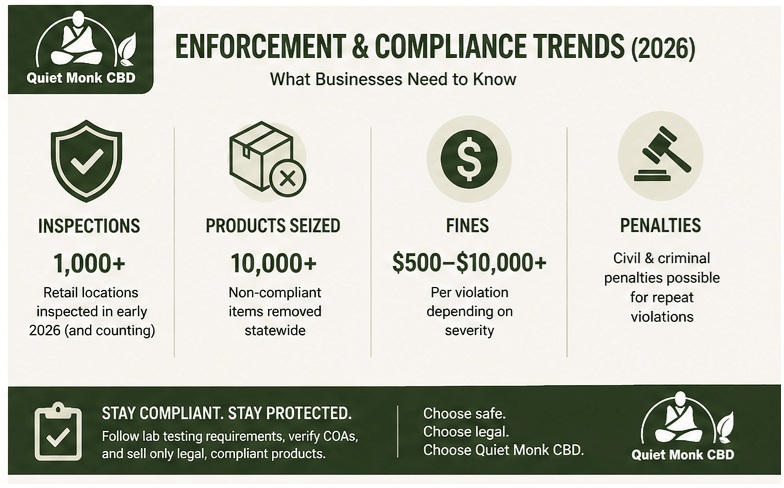
🗺️ Enforcement & Compliance Trends

  • State agencies now have authority to:
    • Inspect businesses
    • Seize non-compliant products
    • Issue fines and penalties
  • Enforcement includes:
    • Retail inspections
    • Product embargoes
    • License suspensions

👉 Non-compliance can result in civil and criminal penalties. Choosing lab-tested CBD products with verified COAs is now more important than ever.


📈 Market Shift Trends

  • Strong shift toward:
    • THC-free CBD products
    • Broad spectrum formulations
    • Lab-tested products with verified COAs
  • Decline in:
    • Gas station hemp products
    • Unregulated THC items
    • Synthetic cannabinoid sales

👉 Compliance is becoming a major competitive advantage


🧾 Legal Timeline (California)

  • 2018 – Federal Farm Bill legalizes hemp
  • 2021 – California legalizes CBD (AB 45)
  • Oct 2025 – AB 8 signed into law
  • Jan 1, 2026 – New hemp rules take effect
  • 2026 (ongoing) – Enforcement and compliance expansion
  • 2028 – Additional provisions take full effect

California hemp law enforcement statistics 2026 showing inspections, product seizures, fines, and compliance trends

❓ FAQ: California Hemp Law (2026)

What changed in California hemp law in 2026?

California banned intoxicating hemp products, required zero detectable THC in many products, and moved THC products into the licensed cannabis system.


Are CBD products still legal?

Yes—especially products like CBD creams for joint pain that contain non-detectable THC and meet California compliance standards.


Are Delta-8 and similar products legal?

No. Synthetic cannabinoids like Delta-8 are banned statewide.


Can hemp products contain THC?

In most retail settings, no detectable THC is allowed in consumable products.


Where can THC products be sold?

Only through licensed cannabis dispensaries


🔗 What This Means for Consumers

California’s new law is pushing the market toward:

  • Safer, lab-tested products
  • Clear labeling and compliance
  • THC-free CBD options

For consumers, this means choosing products that meet strict testing standards and contain non-detectable THC levels to stay within California law. For a full explanation in plain English, see our guide to the new California CBD and THC law.

Posted on

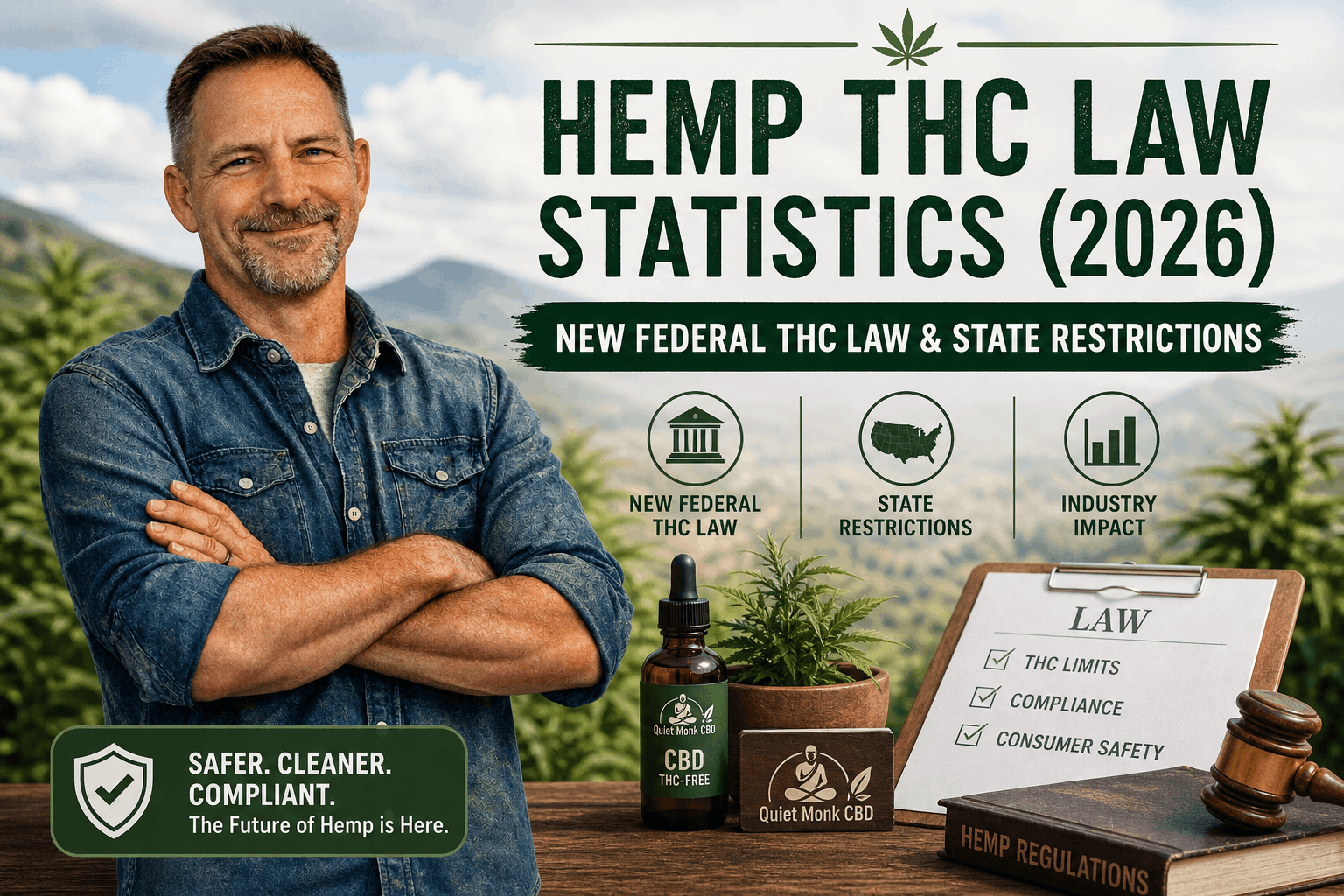
Hemp THC Limit Statistics (2026): New Federal THC Law & State Restrictions

hemp THC law statistics 2026

Hemp laws in the United States are undergoing one of the biggest changes since the 2018 Farm Bill. A new federal rule set to take effect in November 2026 will redefine how THC is measured in hemp products. Instead of using a percentage-based limit, regulators are moving toward a strict per-product THC cap. Below are the most important statistics explaining the new hemp THC limits, state-level bans, and what this means for consumers and businesses. As regulations evolve, many consumers are shifting toward safer, non-intoxicating options like THC-free CBD products


Continue reading Hemp THC Limit Statistics (2026): New Federal THC Law & State Restrictions
Posted on

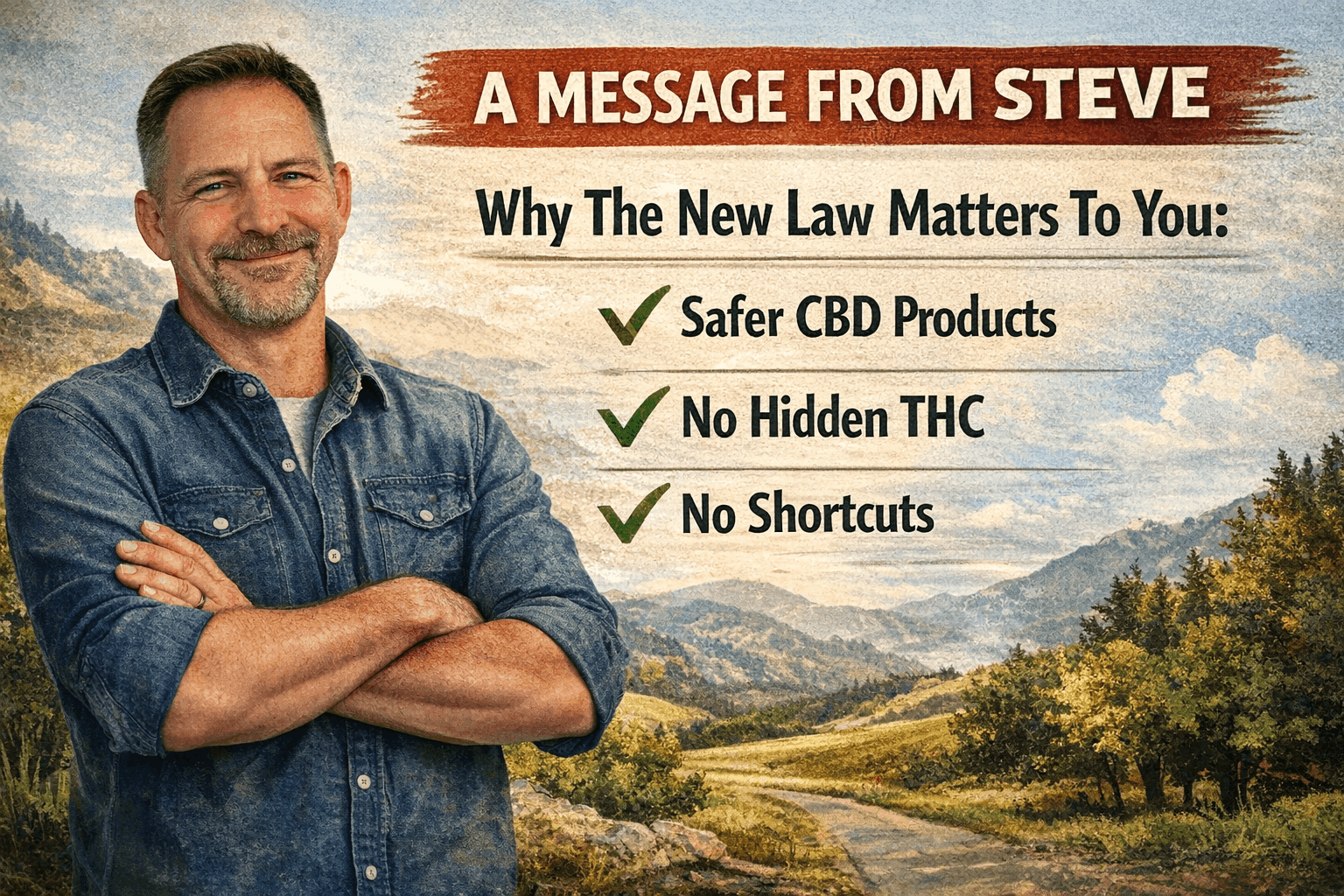
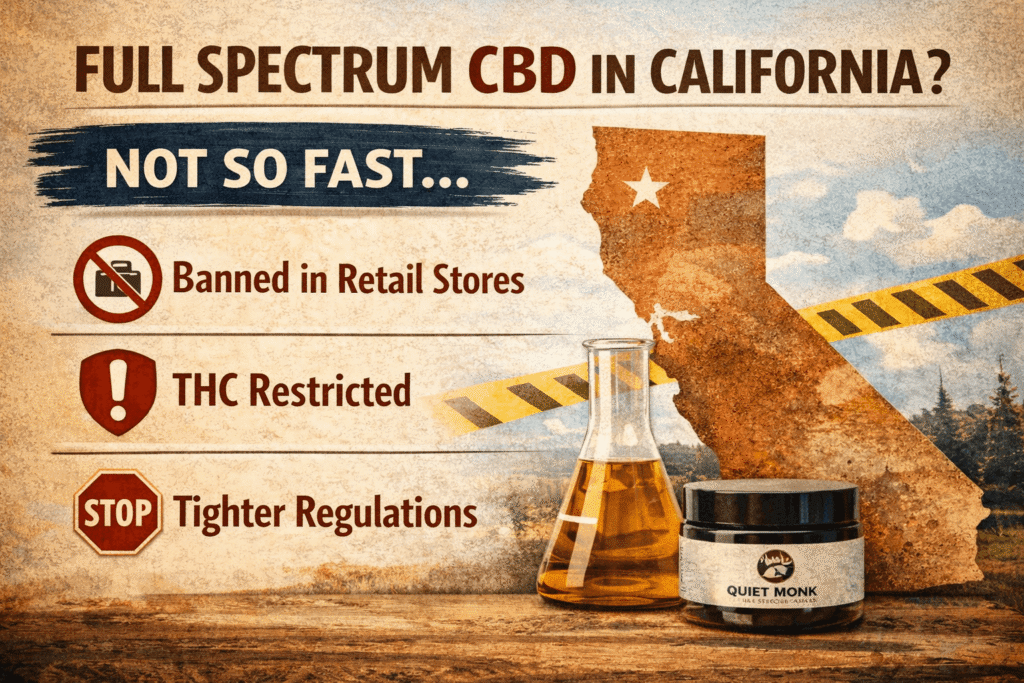
What the New California CBD & THC Law Means in 2026

Steve Quiet Monk CBD message

If you’ve been hearing about new CBD laws in California and wondering what’s going on, I want to take a minute and explain it to you in plain English.

A lot of companies are sending out emails, some people are worried, and honestly—there’s a lot of confusion out there.

So here’s the real story, and how it affects you as a Quiet Monk CBD customer.


First—What Changed?

California passed a new law called Assembly Bill 8 (AB 8), and it’s starting to really take effect this summer.

The goal of the law is simple:

👉 Clean up the CBD market and protect customers

Over the past few years, a lot of products started showing up that weren’t what they claimed to be—especially with things like Delta-8 and other forms of THC.

Some had more THC than labeled. Some had synthetic ingredients. Some weren’t tested properly.

California basically said:
“Enough—we’re tightening this up.”


The Big Shift (And This Is the Important Part)

Here’s what really matters for you:

👉 Hemp products sold outside of dispensaries now need to have non-detectable THC

Not “a little bit.”
Not “under 0.3%.”

None that shows up on a lab test.

That’s a big change.


What Happens to Full Spectrum CBD?

This is where most people get confused.

A lot of CBD products out there are labeled “full spectrum,” which means they contain small amounts of THC.

Under the new California rules, many of those products:

  • Won’t be allowed in regular retail
  • Or will need to move into the licensed cannabis system

So you’re going to start seeing fewer of them.


Why California Did This

From what I’ve seen in this industry, this move actually makes sense.

There’s been:

  • A lot of low-quality products
  • A lot of misleading labels
  • And honestly… a lot of shortcuts

This law is California stepping in and saying:

👉 “If it’s going into someone’s body, it better be clean, tested, and honest.”

I can respect that.


Where Quiet Monk CBD Stands

This is the part I want you to feel confident about.

From day one, I made a very intentional decision:

👉 We do not chase THC. We focus on clean, effective CBD.

All of our products are:

✔ Broad Spectrum

That means:

  • You still get beneficial cannabinoids
  • But THC is removed

✔ THC-Free (Non-Detectable)

We test every batch to make sure:

  • THC does not show up on lab results

✔ Third-Party Lab Tested

No guessing. No cutting corners.


So… Are We Affected?

Short answer:

👉 We’re already aligned with where California is going

While some companies are scrambling to adjust, we don’t have to change how we formulate our products.

That’s because we built Quiet Monk CBD around:

  • Consistency
  • Safety
  • And long-term trust

Not trends.


What This Means for You

If you’re using our products, nothing changes.

If you’re shopping around elsewhere, here’s what I’d watch for:

Be careful with:

  • “Full spectrum” labels
  • Products that don’t show lab tests
  • Anything that feels vague about THC content

Look for:

  • Clear “THC-free” or “non-detectable THC”
  • Transparent lab results
  • Brands that explain what’s actually inside

My Take (Straight Up)

I think this law is going to shake out a lot of the junk in the market.

And honestly, that’s a good thing.

Because at the end of the day, this isn’t just about CBD…

👉 It’s about what you’re putting in your body.


If You Ever Have Questions

If you’re unsure about anything—dosage, products, or these new laws—you can always reach out.

I’d rather answer your question directly than have you guessing.


Final Thought

We’ve always believed in keeping things simple:

👉 Clean CBD. No THC. No shortcuts.

This new law just reinforces that approach.

And I’m glad we’re already there.

— Steve
Quiet Monk CBD

FAQ: California CBD Law (AB 8)

Is CBD still legal in California in 2026?

Yes. CBD is still legal in California, but it must meet stricter requirements—especially around THC content and testing.


Does CBD need to be THC-free now?

For most hemp-derived products sold outside of dispensaries, yes.
They must have non-detectable THC, meaning none shows up in lab testing.


What does “non-detectable THC” mean?

It means that even with sensitive lab equipment, THC cannot be detected in the product.
This is stricter than the old “less than 0.3% THC” rule.


Are full spectrum CBD products still allowed?

Many full spectrum products will no longer be allowed in standard retail in California because they contain trace THC.


What is the difference between full spectrum and broad spectrum CBD?

  • Full Spectrum: Contains CBD + other cannabinoids + small amounts of THC
  • Broad Spectrum: Contains CBD + other cannabinoids but THC is removed

Will this affect how CBD works?

For most people, no. Many customers prefer THC-free products because they:

  • Avoid psychoactive effects
  • Reduce risk of drug test issues
  • Provide consistent dosing

Are Quiet Monk CBD products compliant with California law?

Our products are formulated with current regulations in mind and are:

  • Broad spectrum
  • THC-free (non-detectable based on third-party lab testing)
  • Third-party lab tested for quality and consistency

We continuously monitor evolving California hemp regulations to ensure our products remain aligned with current requirements.


Why are some CBD products disappearing from stores?

Products that contain THC or don’t meet testing standards are being removed or restricted under the new law.


Is Delta-8 THC still legal in California?

No. California has restricted intoxicating hemp-derived cannabinoids like Delta-8 outside of the licensed cannabis system.


Do I need to worry about ordering CBD online?

You just need to be selective. Make sure the brand:

  • Provides lab results
  • Clearly states THC content
  • Follows California guidelines

Sources & References

  • California Assembly Bill 8 (AB 8) – Legislative Text
  • California Department of Public Health (CDPH) Hemp Regulations
  • Cannabis Business Times – Coverage on AB 8 and hemp restrictions
  • California Matters – Bill tracking and regulatory summaries
  • Manzuri Law – Legal analysis of AB 8 and hemp policy changes
  • California Cannabis Operators Association (CACOA) – Industry guidance

Posted on

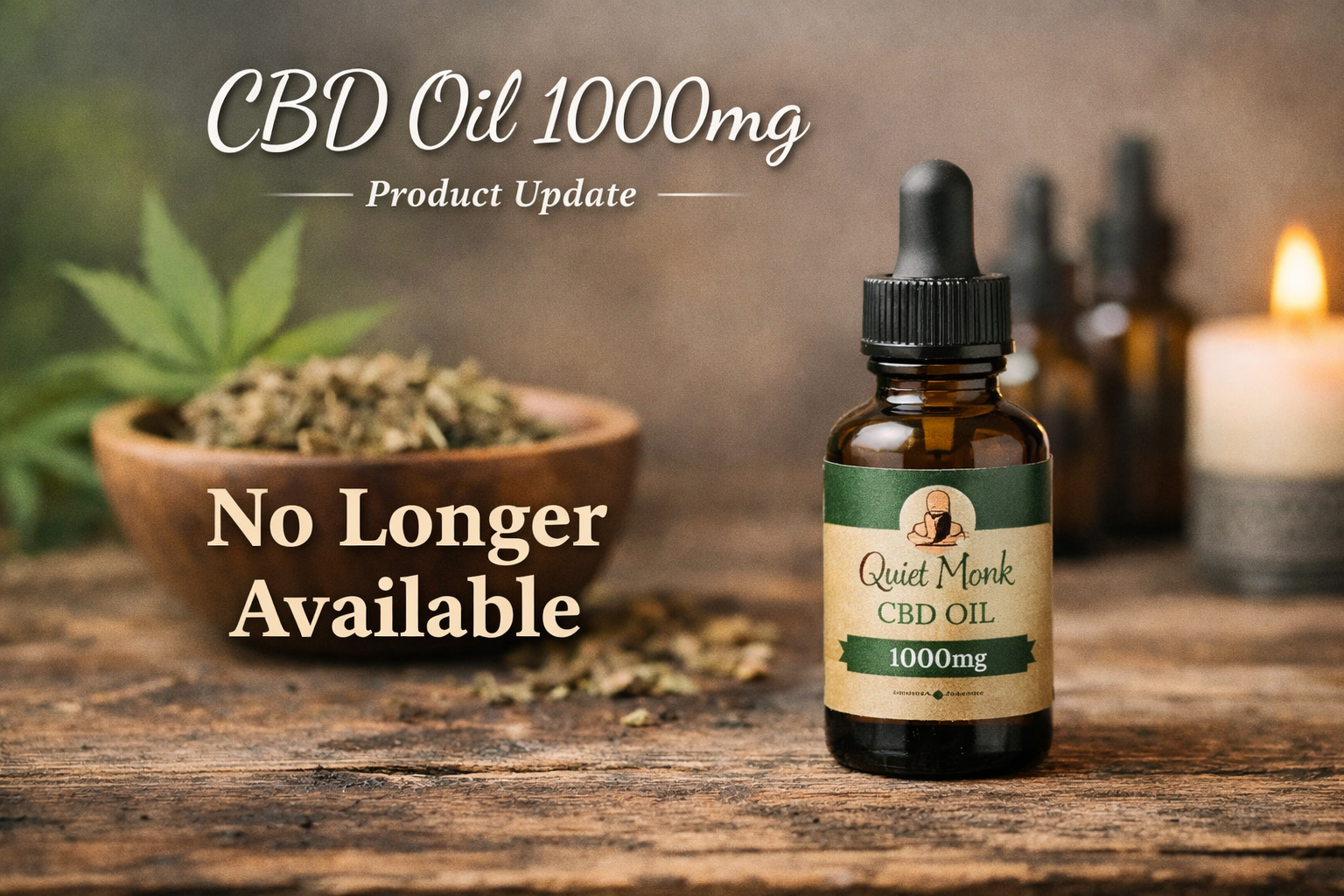
CBD Oil 1000mg Product Update

1000 CBD Discontinued

A Note About Our CBD Oil 1,000mg

The Quiet Monk CBD Oil 1000mg is no longer part of our product line. As we continue to refine and improve what we offer, we’ve chosen to focus on CBD oil strengths that better support consistent, long-term use.

This change allows us to simplify our lineup while continuing to deliver the same quality, clean formulations you expect from Quiet Monk CBD.


What to Use Instead

If you’ve been using the 1000mg oil, the transition is straightforward. We still offer the same broad-spectrum CBD oil, just in higher concentrations:

    Each oil is:

    • Broad-spectrum and THC-free
    • Third-party lab tested
    • Made in the USA
    • Designed for clean, consistent dosing

    Why We Made This Change

    Over time, we found that many customers needed more than the 1000mg oil could provide, often increasing serving size sooner than expected. By focusing on higher-strength oils, we’re able to offer better consistency and value without changing what matters most—quality and transparency.


    We’re Here If You Need Help

    If you’re unsure which strength is right for you, feel free to reach out. We’re always happy to help you choose what fits your routine best.

    Frequently Asked Questions

    Why was the CBD Oil 1000mg discontinued?

    As we reviewed how customers were using our oils, we found that many people quickly needed a higher strength for consistent results. By focusing on stronger options, we can offer better long-term value while keeping our product line simple and effective.


    Is the formula different in the higher-strength oils?

    No. The formulation remains the same. Our 2000mg, 5000mg, and 10,000mg CBD oils use the same broad-spectrum hemp extract and carrier oils—only the concentration has changed.


    Will switching to a higher strength feel too strong?

    Not necessarily. Higher-strength oils allow you to take a smaller serving while achieving the same—or better—results. Many customers find this provides more consistent support without increasing overall intake.


    Which strength should I choose if I used the 1000mg oil?

    Most customers move comfortably to the 2000mg CBD oil. If you’ve been using larger servings or want more noticeable support, the 5000mg may be a better fit. The 10,000mg option is best for experienced users.


    Is this a temporary removal?

    At this time, the 1000mg CBD oil has been permanently discontinued. If this changes in the future, we’ll always share updates clearly and directly.


    Can I still view lab results for Quiet Monk CBD oils?

    Yes. All of our CBD oils continue to be third-party lab tested, and current Certificates of Analysis are available for each product.

    Posted on

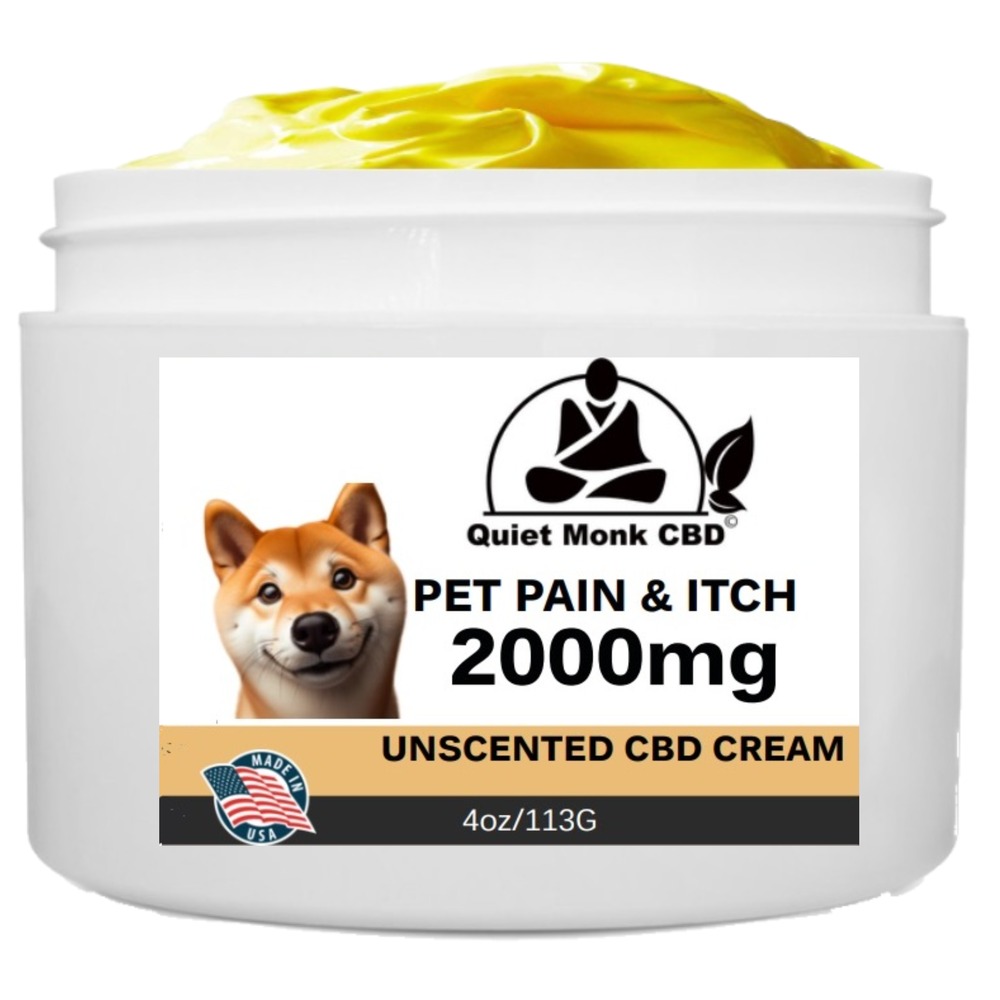
    Quiet Monk CBD Dog & Pet Cream – Product Update

    dog cbd cream

    Important Notice

    Quiet Monk CBD has discontinued our Dog & Pet CBD Cream as part of a product line update. This page explains what has changed and what it means for customers who previously used this product.


    Why Our Dog & Pet CBD Cream Was Discontinued

    As part of routine product reviews, we periodically evaluate demand, sourcing, and long-term product focus. After careful consideration, we made the decision to retire our dog and pet-specific topical product.

    This change allows us to:

    • Simplify product offerings
    • Maintain clarity in labeling and intended use
    • Focus on our core product lines

    At this time, Quiet Monk CBD no longer offers pet-labeled or animal-specific topical creams.


    Are There Replacement Products Available?

    No. Quiet Monk CBD does not currently offer a replacement or alternative product labeled for use on dogs or pets.

    We do not recommend or endorse off-label use of human CBD products for animals. Products intended for human use are formulated, labeled, and regulated differently than those designed for pets.


    Important Use

    Quiet Monk CBD pet products are formulated and labeled specifically for animal use while available. Quiet Monk CBD does not recommend or endorse off-label use of other CBD products for pets or animals. Customers should always follow labeled directions for use.


    For Past Customers

    We appreciate the customers who trusted Quiet Monk CBD Dog & Pet Cream while it was available. If you have questions regarding a previous purchase or need assistance related to past orders, our support team is available to help.

    Please contact us through our website for additional support.


    What This Means Going Forward

    • The Dog & Pet CBD Cream product page has been retired
    • No pet-specific CBD products are currently planned

    If pet products are reintroduced in the future, they will be launched as clearly labeled, animal-specific offerings.


    Thank You

    Quiet Monk CBD is committed to transparency, responsible labeling, and clear communication as our product lineup evolves. We appreciate your understanding and continued trust.

    Posted on

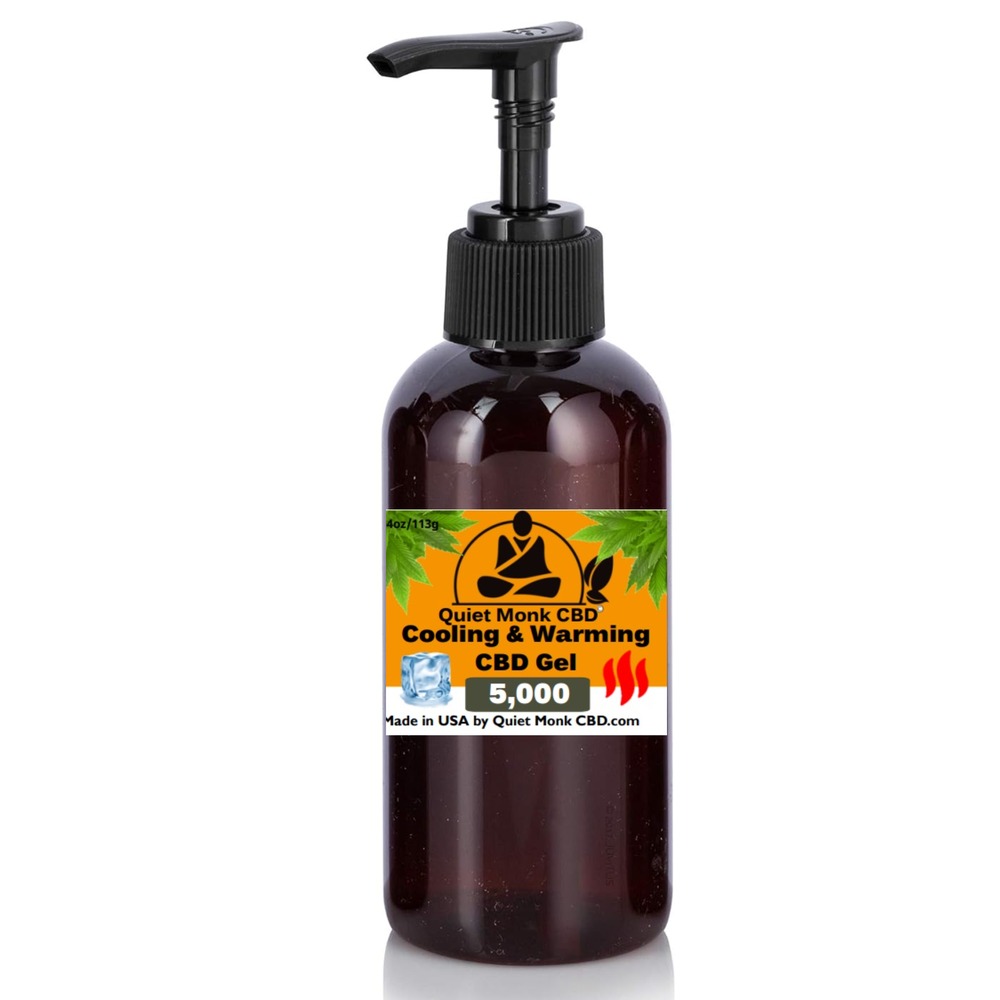
    Quiet Monk CBD Gel Products – Product Update

    5000mg cbd muscle gel pump

    Important Notice

    Quiet Monk CBD has discontinued select CBD gel products as part of a product line update. This page explains what has changed and what it means for customers who previously used our gel-based topical products.

    The following products are no longer available:

    • Unscented 5000mg Aloe Gel
    • Cooling 5000mg Gel
    • Warming 5000mg Gel

    Why Certain Gel Products Were Discontinued

    As part of ongoing product reviews, we periodically evaluate demand, manufacturing complexity, and long-term product focus. After careful consideration, we made the decision to retire several general-use gel formulations.

    This change allows us to:

    • Simplify production and inventory
    • Maintain fresher batches across active products
    • Focus on topical formats and use cases we can support consistently

    Are All CBD Gels Discontinued?

    No. Quiet Monk CBD continues to offer specialized topical gel products, including formulations designed for specific use cases.

    However, the general-use aloe, cooling, and warming gel formats listed above are no longer part of our active lineup.


    About Specialized Gel Formulations

    While we no longer offer general-purpose CBD gels, Quiet Monk CBD continues to offer specialized topical gel products intended for specific needs.

    These products:

    • Are formulated for targeted use cases
    • Use different ingredient profiles than general gels
    • Are clearly labeled for their intended purpose

    Specialized gels are not positioned as replacements for discontinued general-use gels and differ in formulation and application style.


    Important Use & Format Disclaimer

    Topical gels can differ significantly in formulation, ingredients, and intended use. Quiet Monk CBD does not claim equivalency between discontinued gel products and any remaining topical offerings. Customers should select products based on labeled use and personal preference.


    For Past Customers

    We appreciate the customers who trusted Quiet Monk CBD gel products while they were available. If you have questions regarding a previous purchase or need assistance related to past orders, our support team is available to help.

    Please contact us through our website for additional support.


    What This Means Going Forward

    • Select gel product pages have been retired
    • General-use aloe, cooling, and warming gels are no longer available
    • Specialized gel formulations remain available as clearly labeled products

    If additional gel formats are introduced in the future, they will be launched as separate, clearly defined products.


    Thank You

    Quiet Monk CBD remains committed to transparency, responsible labeling, and clear communication as our product lineup evolves. We appreciate your understanding and continued trust.

    Explore Other Topical Formats

    While the general-use gel products listed above are no longer available, Quiet Monk CBD continues to offer a range of topical products in different formats. Customers who wish to explore our current topical lineup may do so below based on personal preference and application style.

    These products use different formulations and application methods and are not positioned as replacements for discontinued gel products.

    Posted on

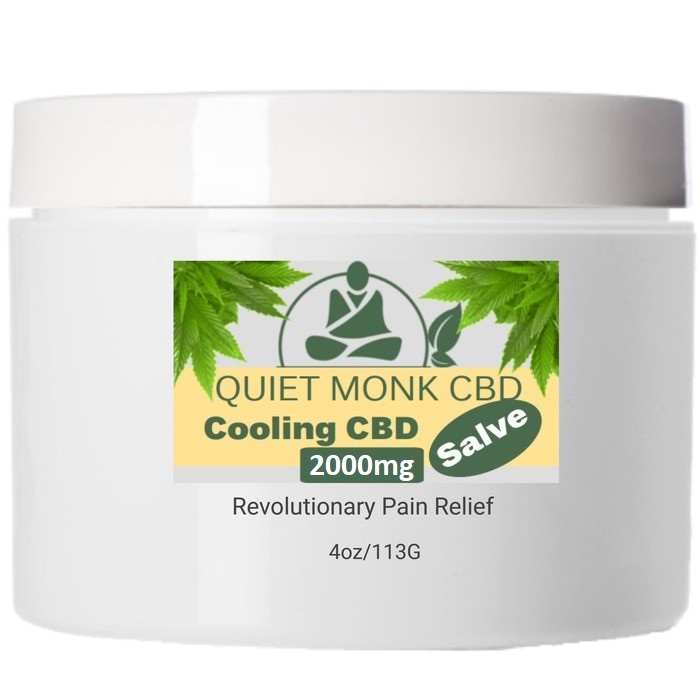
    CBD Salve Strength Guide – Alternative to 1000 & 2000mg Strength

    2000 CBD oil hemp balm

    Choosing the Right Formula for Your Needs

    Quiet Monk CBD has discontinued our 1,000mg and 2,000mg CBD salves as part of a product lineup update. This page explains how CBD salve strength works and helps you choose the most appropriate current option based on application style—not just the number on the jar.

    The following products are no longer available:

    • 1,000mg CBD Salve
    • 2,000mg CBD Salve

    Understanding CBD Salve Strength

    CBD salve strength refers to the total amount of CBD in the container, not how much you use at one time.

    What matters most:

    • How much salve you apply
    • How often you apply it
    • The area being treated

    Higher-concentration salves allow for smaller applications while maintaining consistency. Strength does not equal harshness or intensity.


    Why the 1,000mg and 2,000mg Salves Were Discontinued

    Customers using lower-strength salves often needed:

    • Larger amounts per application
    • More frequent reapplication
    • Faster depletion of product

    By simplifying our salve lineup, we can:

    • Offer more consistent results using less product
    • Maintain fresher production batches
    • Focus on formats that perform reliably across use cases

    Comparing Discontinued and Current CBD Salves

    Discontinued SalveClosest Current OptionHow to Apply
    1,000mg CBD Salve5,000mg CBD SalveApply a small amount; start light
    2,000mg CBD Salve5,000mg CBD SalveUse less product per application

    Most customers transitioning from 1,000mg or 2,000mg salves find the 5,000mg CBD Salve provides similar support when used in smaller amounts.


    Current CBD Salve & Topical Options

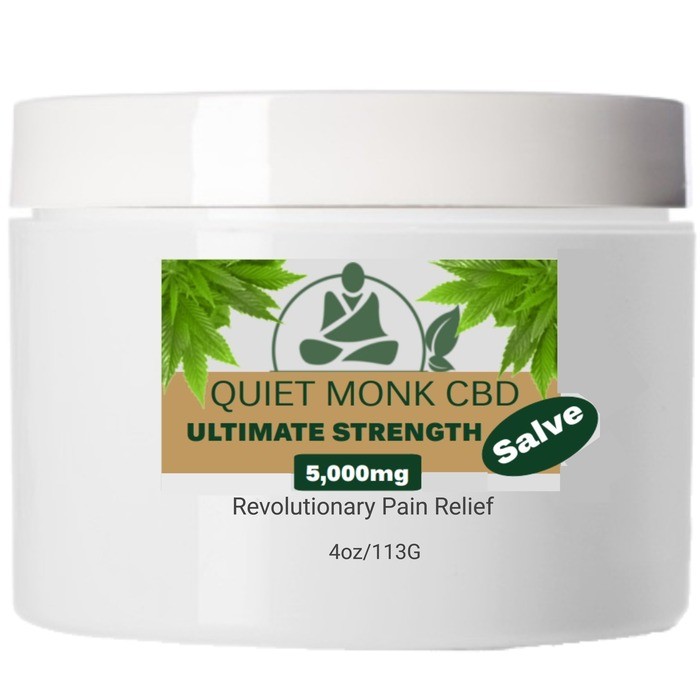
    5,000mg CBD Salve

    • Closest match to discontinued salves
    • Designed for everyday topical use
    • Allows for controlled, light application

    50,000mg CBD Salve

    • Highly concentrated formula
    • Intended for targeted, sparing use
    • Apply only a small amount to specific areas

    5,000mg Pain Stick (Alternative Format)

    • Solid-stick topical format
    • Offers mess-free, targeted application
    • Different format than salves; not a replacement

    Find Your Salve (Quick Selector)

    I previously used the 1,000mg or 2,000mg salve
    → Start with 5,000mg CBD Salve using less product

    I want highly targeted, minimal application
    50,000mg CBD Salve (apply sparingly)

    I prefer a no-mess, roll-on style
    5,000mg Pain Stick (alternative format)

    Simple rule: Higher concentration means you can use less, not that it is stronger on the skin.


    Is a Higher-Strength Salve Too Much?

    Not when used properly.

    CBD salves allow precise control:

    • Apply less product
    • Target smaller areas
    • Adjust frequency as needed

    Always start with a small amount and increase gradually.


    Why We Simplified Our Salve Line

    • Fewer SKUs ensure fresher inventory
    • More consistent customer experience
    • Easier selection without guesswork

    Our goal is clarity, not upselling.


    Still Unsure Where to Start?

    Begin with the smallest practical amount and adjust gradually based on comfort and response. Everyone’s experience with topical CBD is different.

    Frequently Asked Questions About CBD Salve Strength

    What does CBD salve strength mean?
    CBD salve strength refers to the total amount of CBD in the container, not how much you apply at one time. Your actual experience depends on how much salve you use and how often you apply it.

    Why were the 1,000mg and 2,000mg CBD salves discontinued?
    These lower-strength salves were discontinued to simplify the product lineup and provide more consistent use with smaller application amounts. Many customers found they needed larger quantities per use.

    Is the 5,000mg CBD salve stronger on the skin?
    No. A higher-concentration salve allows you to use less product per application. It does not mean the salve is harsher or more intense when applied lightly.

    What is the closest replacement for the 1,000mg and 2,000mg salves?
    For most customers, the closest option is the 5,000mg CBD salve, applied in a smaller amount.

    When should someone consider the 50,000mg CBD salve?
    The 50,000mg CBD salve is designed for highly targeted, sparing use. Only a small amount is needed, and it should be applied to specific areas rather than broadly.

    Is the pain stick the same as a salve?
    No. The pain stick is a different topical format designed for mess-free, targeted application. It is not a replacement for salve but may be preferred by some users based on application style.

    How should I start if I’m unsure which salve to use?
    Start with the smallest amount possible, apply to a limited area, and adjust gradually based on comfort and preference.

    Posted on

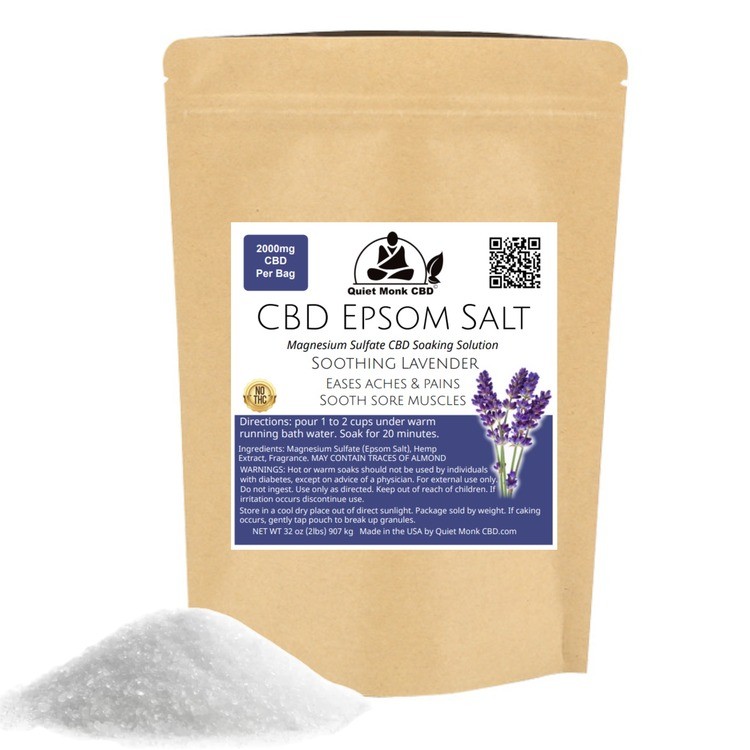
    Quiet Monk CBD Epsom Salt – Product Update

    Important Notice

    Quiet Monk CBD has discontinued our CBD Epsom Salt as part of a product lineup update. This page explains what has changed and what it means for customers who previously purchased this product.


    Why Our CBD Epsom Salt Was Discontinued

    As part of routine product reviews, we periodically evaluate demand, sourcing, and production efficiency. After careful consideration, we made the decision to retire our CBD Epsom Salt.

    This change allows us to:

    • Focus on core product formats
    • Simplify inventory and production
    • Maintain consistent quality across active products

    At this time, Quiet Monk CBD no longer offers a CBD-infused bath soak or Epsom salt product.


    Is CBD Epsom Salt Still Available?

    No. Quiet Monk CBD does not currently carry a CBD Epsom Salt product.


    Alternative Product Formats

    While CBD Epsom Salt is no longer available, Quiet Monk CBD continues to offer topical CBD products, including creams designed for localized application.

    These products:

    • Use a different application format than bath soaks
    • Are applied directly to targeted areas
    • May be preferred by customers who want topical use outside of bathing routines

    Topical products are not positioned as direct replacements for CBD Epsom Salt and differ in how they are used.


    Important Use Disclaimer

    Bath soaks and topical creams differ in how they are applied and experienced. Customers should choose products based on personal preference and follow labeled directions for use.


    For Past Customers

    We appreciate the customers who trusted Quiet Monk CBD Epsom Salt while it was available. If you have questions regarding a previous purchase or need assistance related to past orders, our support team is available to help.

    Please contact us through our website for additional support.


    What This Means Going Forward

    • The CBD Epsom Salt product page has been retired
    • No bath soak products are currently planned
    • Quiet Monk CBD remains focused on topical formulations

    If bath or soak products are reintroduced in the future, they will be launched as clearly labeled, standalone products.


    Thank You

    Quiet Monk CBD is committed to transparency and responsible product communication. We appreciate your understanding as our product lineup continues to evolve.

    Posted on

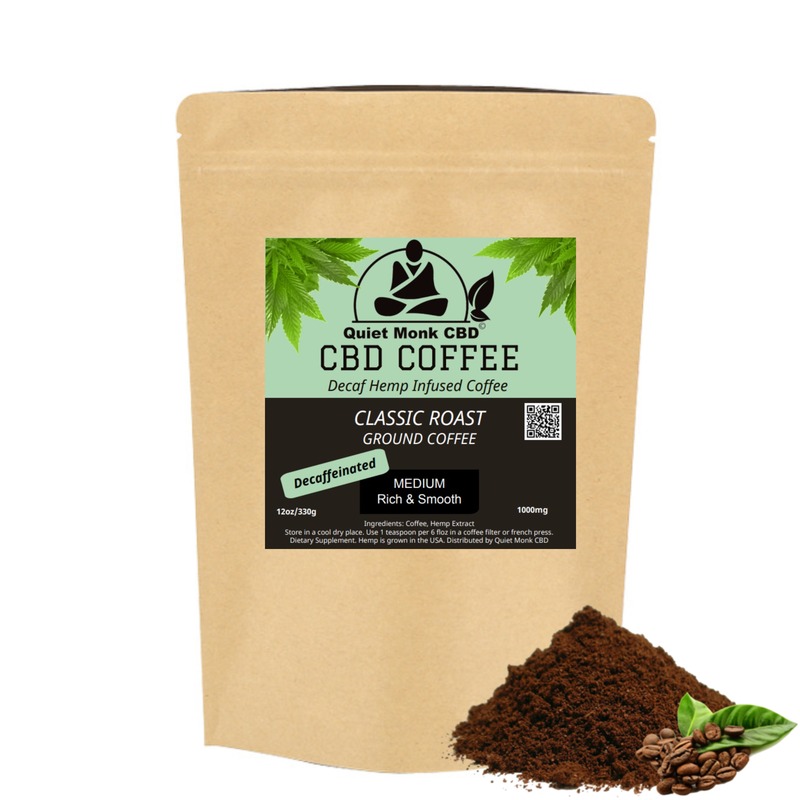
    Quiet Monk Decaf Coffee– Product Update

    cbd ground decaf coffee

    Important Notice

    Quiet Monk Coffee has discontinued our decaffeinated coffee as part of a product lineup update. This page explains what has changed and what it means for customers who previously purchased our decaf option.


    Why Our Decaf Coffee Was Discontinued

    As part of routine product reviews, we periodically evaluate demand, sourcing, and production efficiency. After careful consideration, we made the decision to retire our decaffeinated coffee.

    This change allows us to:

    • Focus on our core coffee offerings
    • Streamline roasting and inventory
    • Maintain consistent freshness and quality standards

    At this time, Quiet Monk Coffee no longer offers a decaffeinated option.


    Is Decaf Coffee Still Available?

    No. Quiet Monk Coffee does not currently carry a decaffeinated coffee product.


    Regular Coffee Option

    While we no longer offer a decaf option, Quiet Monk Coffee continues to offer our regular coffee, roasted and packaged with the same quality standards customers expect from us.

    Regular coffee may be preferred by customers who:

    • Enjoy caffeinated coffee
    • Drink coffee earlier in the day
    • Are comfortable with caffeine intake

    This option is provided for informational purposes only and is not positioned as a replacement for decaf.


    For Past Customers

    We appreciate the customers who supported our decaf coffee while it was available. If you have questions regarding a previous purchase or need assistance related to past orders, our support team is available to help.

    Please contact us through our website for additional support.


    What This Means Going Forward

    • The decaf coffee product page has been retired
    • No decaffeinated coffee products are currently planned
    • Our regular coffee offerings remain available

    If decaffeinated coffee is reintroduced in the future, it will be launched as a clearly labeled, standalone product.


    Thank You

    Quiet Monk Coffee values transparency and clear communication as our product lineup evolves. We appreciate your understanding and continued support.

    Posted on

    Quiet Monk CBD Pain Patches – Product Update

    Important Notice

    Quiet Monk CBD has discontinued all pain patch products as part of a product line update. This page explains what has changed and what it means for customers who previously used our pain patch formulations.

    The following products are no longer available:

    • Small Pain Patches
    • Large Pain Patches
    • Lidocaine Pain Patches

    Why Our Pain Patch Products Were Discontinued

    As part of ongoing product line reviews, we periodically assess manufacturing complexity, supply consistency, and long-term product focus. After careful consideration, we made the decision to retire all pain patch products.

    This change allows us to:

    • Streamline production and inventory
    • Maintain consistency across active product formats
    • Focus on topical formulations we can support long term

    At this time, Quiet Monk CBD is no longer producing patch-style pain products.


    Important Use & Format Disclaimer

    Pain patches and topical creams differ in how they are applied and how they deliver ingredients to the skin. Quiet Monk CBD does not claim equivalency between patches and creams, and customers should follow labeled directions for use when selecting any topical format.


    Are There Replacement Pain Patch Products?

    Quiet Monk CBD does not currently offer any pain patch or transdermal patch products.


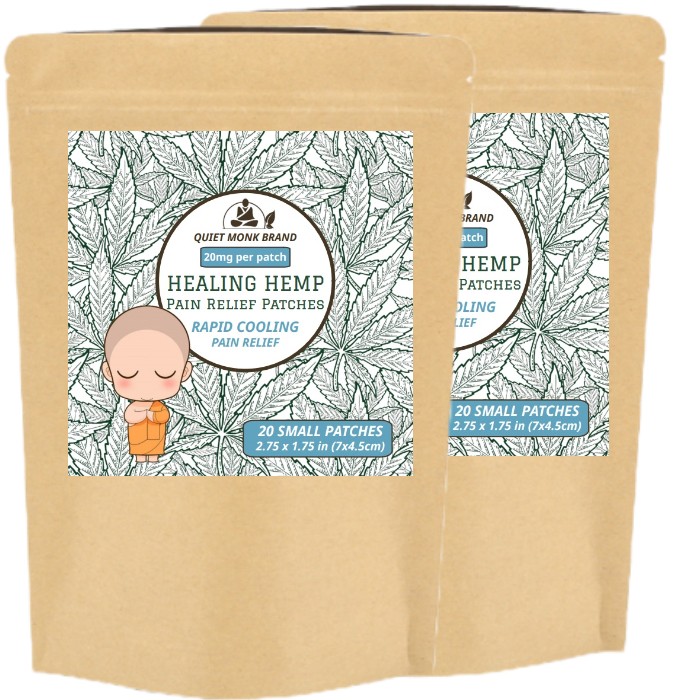
    cbd pain patches

    Alternative Topical Formats Available

    While pain patches are no longer available, Quiet Monk CBD continues to offer topical pain creams designed for localized application.

    These products:

    • Use a different delivery format than patches
    • Allow for flexible, targeted application
    • Are applied directly to the desired area as needed

    Customers who prefer a topical format may find pain creams to be a suitable option based on personal preference and application style.

    (Pain creams are not positioned as direct replacements for patches.)


    For Past Customers

    We appreciate the customers who trusted Quiet Monk CBD pain patches while they were available. If you have questions regarding a previous purchase or need information related to past orders, our support team is available to assist.

    Please contact us through our website for additional support.


    What This Means Going Forward

    • Pain patch product pages have been retired
    • The pain patches category is no longer active
    • No new patch-style formulations are currently planned

    If pain patches are reintroduced in the future, they will be launched as a separate, clearly labeled product line.


    Thank You

    Quiet Monk CBD remains committed to transparency, responsible labeling, and clear communication as our product offerings evolve. We appreciate your understanding and continued trust.

    Posted on

    Quiet Monk CBD Tattoo Products – Product Update

    what cbd can do for tattoos

    Important Notice

    Quiet Monk CBD has discontinued all tattoo-specific products as part of a product line update. This page explains what has changed and what it means for customers who previously used our tattoo care formulations.

    The following products are no longer available:

    • CBD Tattoo Balm
    • CBD Tattoo Cream

    Why Our Tattoo Products Were Discontinued

    As part of an ongoing review of our product lineup, we periodically evaluate demand, production requirements, and long-term focus. After careful consideration, we made the decision to retire our tattoo-specific products.

    This change allows us to:

    • Focus on our core product lines
    • Simplify manufacturing and inventory
    • Maintain consistency across active formulations

    At this time, we are no longer producing tattoo-labeled products.


    Important Use & Labeling Disclaimer

    Quiet Monk CBD tattoo products were formulated and labeled specifically for tattoo aftercare while available. Quiet Monk CBD does not recommend or endorse off-label use of other CBD products for tattoo care. Products intended for general topical use are formulated, labeled, and regulated differently than those designed for tattoo-specific application.


    Are There Replacement Tattoo Products?

    Currently, Quiet Monk CBD does not offer tattoo-specific or tattoo-labeled products.

    We do not suggest or promote alternative products for tattoo aftercare, and no direct substitutes are available at this time.


    For Past Customers

    We sincerely appreciate the customers who trusted Quiet Monk CBD tattoo products while they were available. If you have questions regarding a previous purchase, product information, or usage instructions related to past orders, our support team is available to assist.

    Please contact us through our website for additional support.


    What This Means Going Forward

    • Tattoo product pages have been retired
    • The tattoo products category is no longer active
    • No new tattoo-specific formulations are currently planned

    If tattoo products are reintroduced in the future, they will be launched as a separate, clearly labeled product line.


    Thank You

    We value the support of our customers and appreciate your understanding as our product offerings evolve. Quiet Monk CBD remains committed to transparency, clarity, and responsible product labeling.

    Posted on

    Quiet Monk CBD Equine Products – Product Update

    Important Notice

    Quiet Monk CBD has discontinued all equine-specific products as part of a product line update. This page explains what has changed and what it means for customers who previously purchased equine formulations.

    The following products are no longer available:

    • Horse CBD Topical Balm
    • Horse CBD Liniment Spray
    • Equine Gel for Recovery

    Why Our Equine Products Were Discontinued

    From time to time, we review our product lineup to ensure we can maintain consistency, quality, and focus across our core offerings. After evaluating demand, production logistics, and long-term product direction, we made the decision to retire our equine category.

    This change allows us to:

    • Streamline manufacturing and inventory
    • Maintain fresher production batches
    • Focus on our primary product lines

    Are There Replacement Equine Products?

    At this time, Quiet Monk CBD does not offer equine-labeled or animal-specific products.

    We do not recommend or promote off-label use of human products for animals. Products intended for human use are formulated, labeled, and regulated differently than those designed specifically for animals.


    For Past Customers

    We appreciate the trust placed in our equine products while they were available. If you have questions regarding a previous purchase, usage instructions, or product information, our support team is happy to help.

    Please contact us through our website for assistance.


    What This Means Going Forward

    • All equine product pages have been retired
    • The equine category is no longer active
    • No new equine formulations are currently planned

    If equine products return in the future, they will be introduced as a separate, clearly labeled product line.


    Thank You

    We value the customers who supported our equine offerings and appreciate your understanding as our product lineup evolves.

    Posted on

    CBD Gummy Strength Guide: Is 300mg Strong Enough

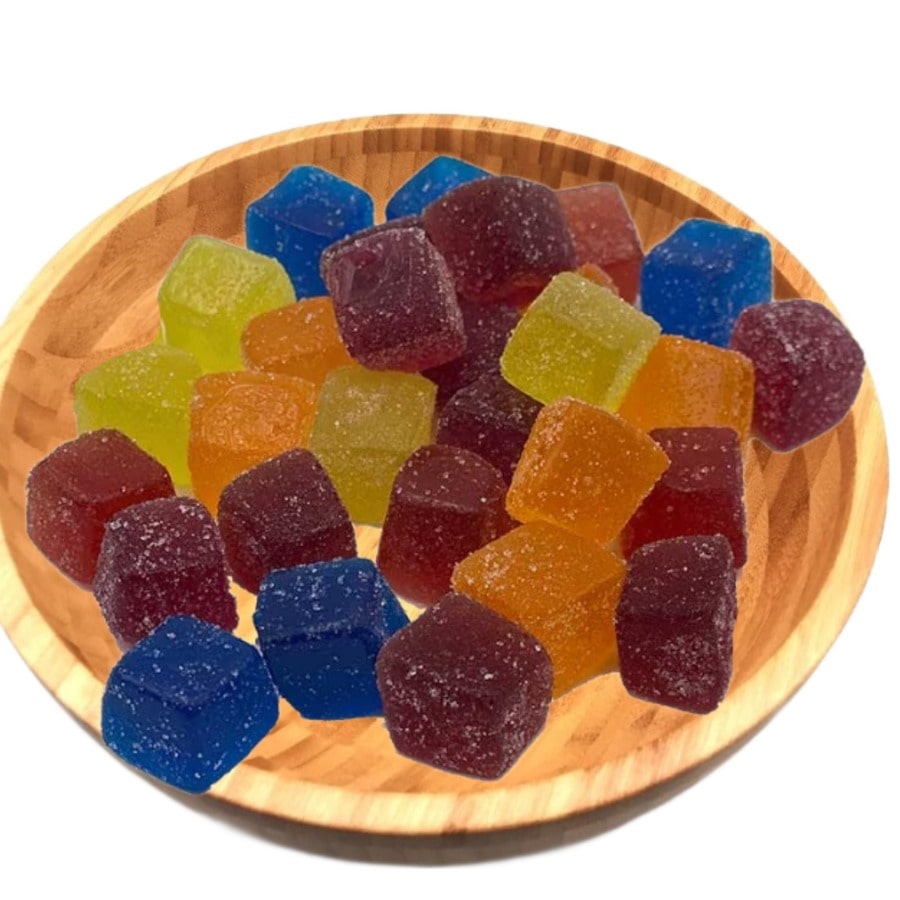
    Close up cbd gummies by Quiet Monk

    Understanding Dosage & Choosing the Right Gummies

    As part of a product update, Quiet Monk CBD has discontinued our 300mg CBD Gummies. This change allows us to focus on formulations that provide more consistent dosing, fewer daily gummies, and fresher production batches.

    This page explains how CBD gummy strength works and how to choose the right option based on your comfort level—not just the milligrams listed on the bottle.


    How CBD Gummy Strength Really Works

    With CBD gummies, the number on the bottle represents total CBD per container, not how much you consume at once.

    What matters most:

    • CBD per gummy
    • How many gummies you take
    • How often you take them

    Higher-strength bottles don’t force higher intake. They simply give you more flexibility to control your dose.


    Why the 300mg Gummies Were Discontinued

    Customers using lower-strength gummies often needed:

    • Multiple gummies per serving
    • More frequent re-ordering
    • Less consistent daily intake

    By simplifying our lineup, we can offer:

    • More predictable dosing
    • Fewer gummies per day
    • Better consistency across batches

    Comparing Past and Current CBD Gummies

    Discontinued ProductCurrent OptionsHow to Start
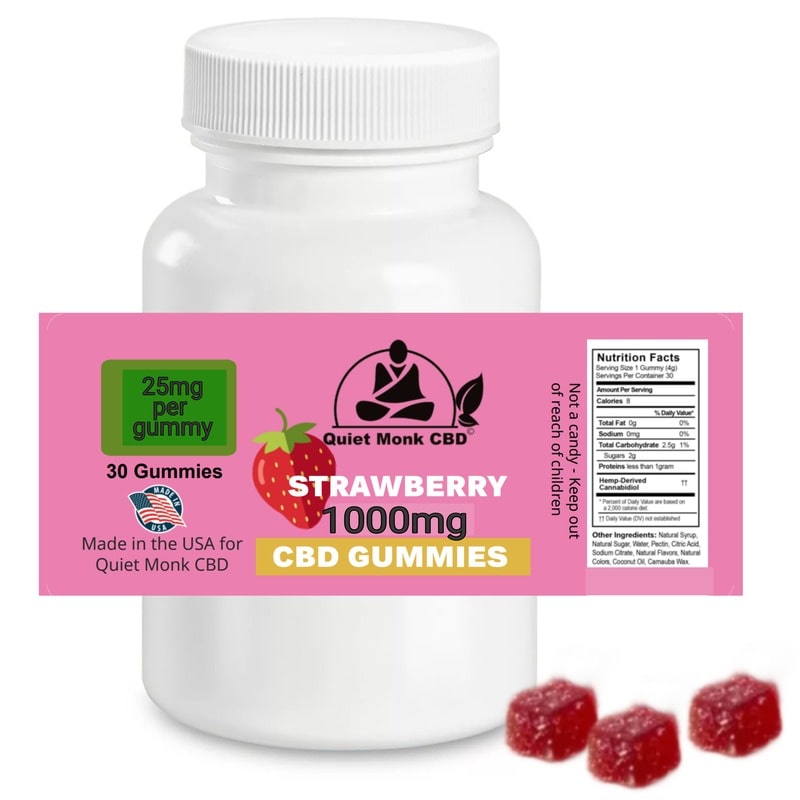
    300mg CBD Gummies1000mg CBD GummiesStart with ½–1 gummy
    1500mg CBD GummiesStart low; increase gradually
    1000mg CBD Gummies Strawberry

    Most customers transitioning from 300mg gummies find the 1000mg gummies provide the closest experience when taken in smaller amounts.


    Find Your Gummies (Quick Selector)

    Use this guide to choose what fits your needs—no pressure.

    I’m New to CBD or Prefer a Lower Dose

    • 1000mg CBD Gummies
    • Start with ½ gummy
    • Increase slowly as needed

    I’ve Used CBD Before or Need More Consistency

    • 1500mg CBD Gummies
    • Begin with 1 gummy
    • Adjust timing or quantity gradually

    I Used the 300mg Gummies Before

    • Most customers start with 1000mg gummies
    • Take fewer gummies per day for similar support

    Simple rule: With gummies, you control your intake by how many you take—not by the bottle size.


    Is a Higher-Strength Gummy Too Much?

    Not when used properly.

    CBD gummies allow precise control:

    • You can take less
    • You can space doses out
    • You can increase gradually over time

    Always start low and adjust based on how your body responds.


    Why We Simplified Our Gummy Line

    • More consistent dosing
    • Fewer gummies needed per day
    • Fresher inventory
    • Easier product selection

    Our goal is clarity—not confusion.


    Still Unsure Where to Start?

    Begin with the lowest practical amount, give your body time to respond, and adjust gradually. Everyone’s endocannabinoid system is different, and gummies make it easy to fine-tune intake.

    Frequently Asked Questions About CBD Gummy Strength

    What does CBD gummy strength mean?
    CBD gummy strength refers to the total amount of CBD in the container, not the amount you consume at one time. Your actual intake depends on how many gummies you take and how often you take them.

    Why were the 300mg CBD gummies discontinued?
    The 300mg gummies were discontinued to simplify dosing and improve consistency. Many customers needed multiple gummies per serving, which made dosing less predictable over time.

    Are higher-strength CBD gummies stronger or harsher?
    No. Higher-strength gummies simply allow you to take fewer gummies to reach your preferred intake. You control the experience by starting with a small amount and adjusting gradually.

    What is the closest replacement for 300mg CBD gummies?
    For most people, the closest option is the 1000mg CBD gummies when taken in smaller amounts, such as half a gummy.

    Should beginners choose 1000mg or 1500mg CBD gummies?
    Beginners typically start with 1000mg CBD gummies and take a smaller portion. The 1500mg option is better suited for those already familiar with CBD.

    Are Quiet Monk CBD gummies broad spectrum?
    Yes. Quiet Monk CBD gummies are made with broad spectrum hemp extract and contain no THC.

    Can I control my CBD intake with gummies?
    Yes. Gummies offer precise control because you can adjust your intake by changing the number of gummies you take or spacing doses throughout the day.

    Posted on

    CBD Cream Strength Comparison

    5000mg CBD cream for pain relief

    What the Numbers Really Mean

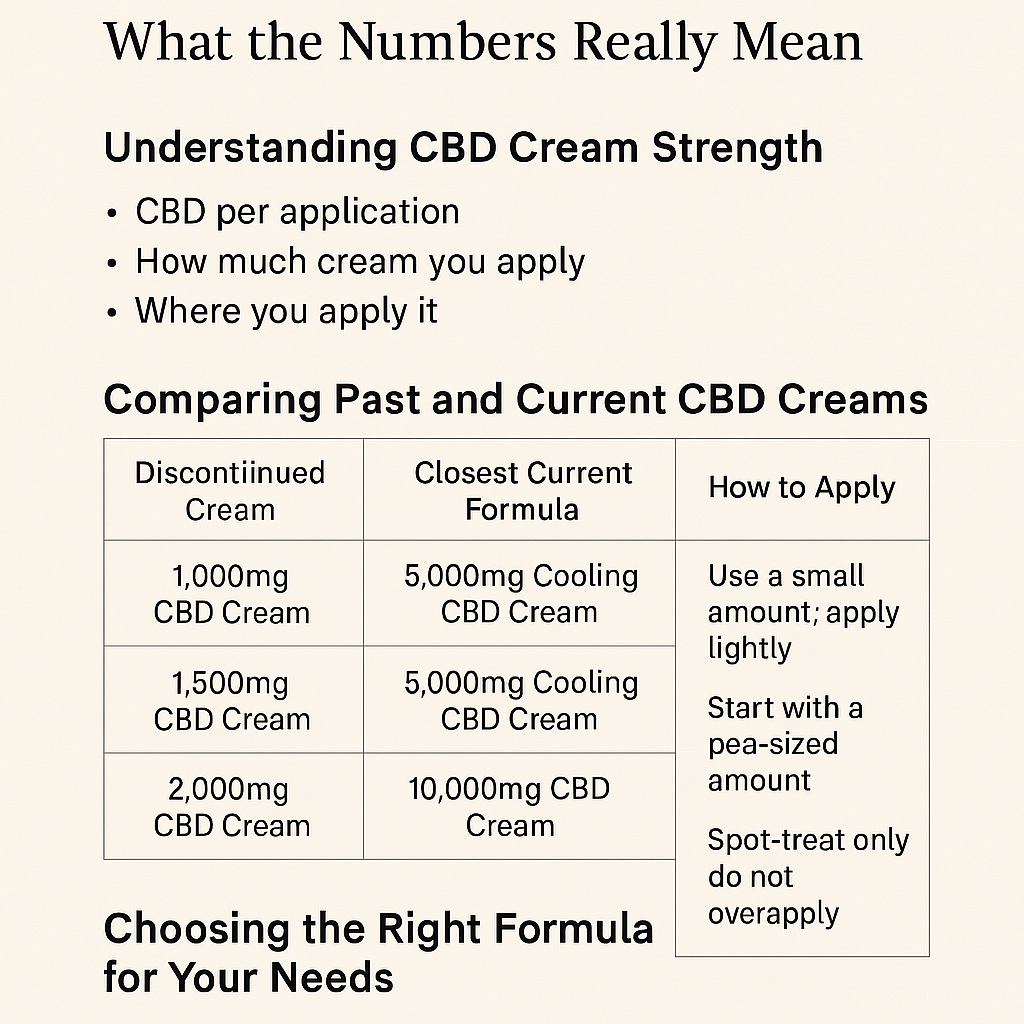
    We’ve simplified our CBD cream lineup to focus on formulas that deliver consistent results using less product per application. As part of this update, our 1,000mg, 1,500mg, and 2,000mg CBD creams have been discontinued.

    This page explains how CBD cream strength works and how to choose the right current formula based on your needs—not just the number on the jar.


    Understanding CBD Cream Strength

    CBD strength is often misunderstood. A higher milligram number does not mean the product is harsher or “too strong.”

    What matters most is:

    • CBD per application
    • How much cream you apply
    • Where you apply it

    Higher-concentration creams allow you to use less product while achieving the same—or better—results.

    Find Your Cream (Quick Selector)

    Not sure where to start? Use this quick guide based on what you’re trying to support.

    Pick what fits you best:

    • I want daily support for mild aches or occasional soreness
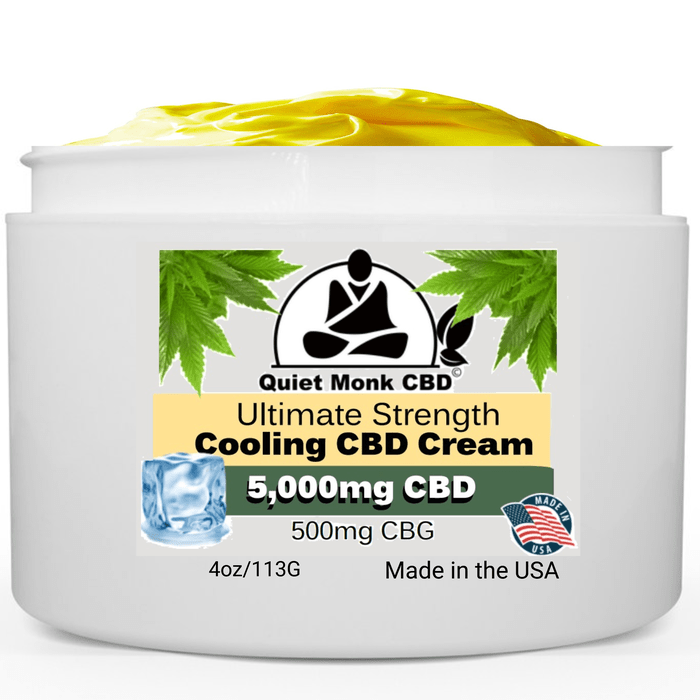
      Start with 5,000mg Cooling CBD Cream using a small amount.
    • I want targeted support for deeper discomfort or joint-focused pain
      Use 10,000mg CBD Cream as a spot treatment (start small).
    • I’m sensitive to strong sensations (like menthol/cooling)
      Choose the formula you tolerate best and apply lightly. Start with the smallest amount and increase gradually.
    • I used the 1,000mg–2,000mg creams and just want the closest match
      Most customers do well starting with 5,000mg Cooling using less product per application.

    Simple rule: Higher mg doesn’t mean “harsher.” It usually means you can use less.


    Comparing Past and Current CBD Creams

    1000 1500 2000 CBD Cream Comparison

    The table below shows how discontinued creams compare to current Quiet Monk CBD formulas when used correctly.

    Discontinued CreamClosest Current FormulaHow to Apply
    1,000mg CBD Cream5,000mg Cooling CBD CreamUse a small amount; apply lightly
    1,500mg CBD Cream5,000mg Cooling CBD CreamStart with a pea-sized amount
    2,000mg CBD Cream10,000mg CBD CreamSpot-treat only; do not overapply

    In most cases, customers find they use less cream overall, making higher-concentration formulas last longer.


    Choosing the Right Formula for Your Needs

    For Mild or Occasional Discomfort

    If you previously used a lower-strength cream for:

    • Everyday aches
    • Light soreness
    • General wellness support

    A light application of the 5,000mg Cooling CBD Cream typically provides equivalent support when used sparingly.

    For Chronic, Deep, or Joint-Focused Pain

    If you were already applying lower-strength creams multiple times per day, the 10,000mg CBD Cream allows for targeted use with fewer applications.


    Is a Higher-Strength Cream Safe for Me?

    Yes—when used as directed.

    CBD topical intensity is controlled by:

    • Amount applied
    • Frequency of use
    • Area treated

    You can always start with a small amount and adjust as needed.


    Why We Made This Change

    • Fewer SKUs ensure fresher batches
    • Higher-concentration formulas provide better consistency
    • Customers reported using less product with improved results

    This update allows us to focus on formulas that perform reliably across a wide range of needs.


    Still Not Sure Which Cream Is Right?

    We recommend starting with the smallest application possible and adjusting gradually. Everyone’s body responds differently, and topical CBD allows for precise, localized use.

    Explore Other Topical Formats

    While the cream strengths discussed above are no longer part of our active lineup, Quiet Monk CBD continues to offer topical products in different formats. Customers who wish to explore our current topical options may do so below, based on personal preference and application style.

    These products use different application formats and are not positioned as replacements for discontinued items.

    Posted on

    Quiet Monk CBD Without THC: Natural Pain Relief Without the High

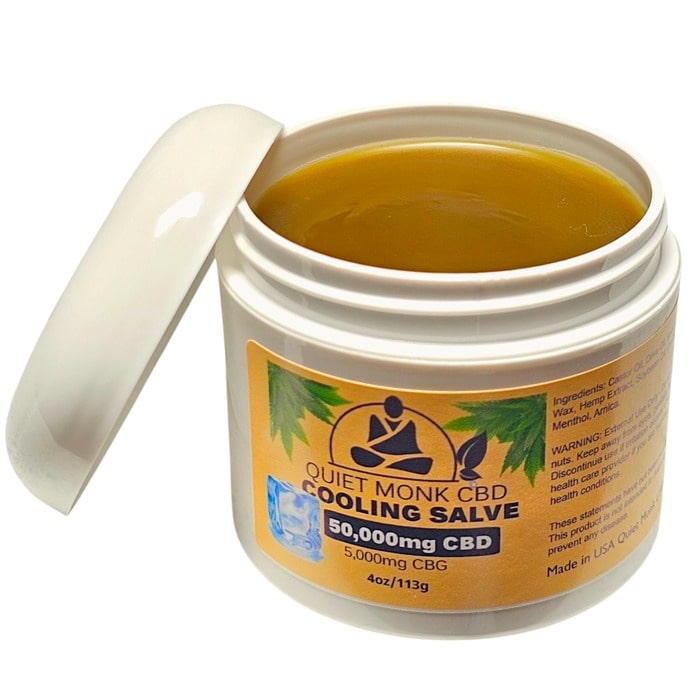
    CBD topical salve open jar

    TL;DR (Quick Summary)

    • CBD without THC for pain gives natural relief without the high.
    • Our CBD is made without delta 9 THC, so it’s safe, non-intoxicating, and compliant.
    • Expect subtle benefits: reduced inflammation, better recovery, and more comfort.
    • CBD without the high is ideal for athletes, seniors, and anyone who wants relief while staying clear-headed.
    • Quiet Monk CBD makes pure, tested CBD products that deliver results—backed by a 30-day money-back guarantee.

    Continue reading Quiet Monk CBD Without THC: Natural Pain Relief Without the High
    Posted on

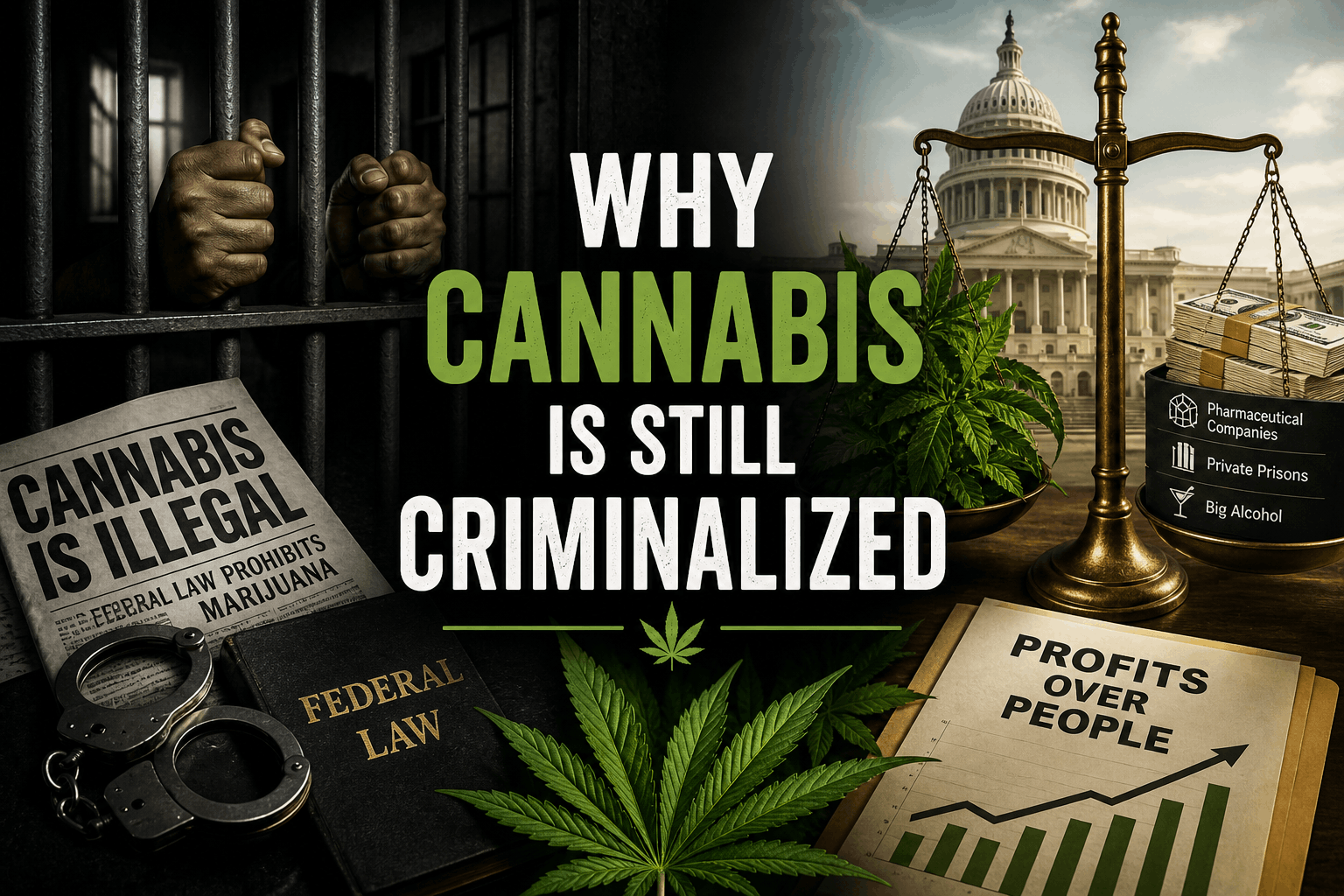
    Why Cannabis Is Still Criminalized: A Legacy of Propaganda and the Promise of Regulation 2025

    why cannabis

    Despite the sweeping tide of legalization efforts in many parts of the world, cannabis remains criminalized in numerous regions. The roots of this ongoing prohibition are deeply entwined with early 20th-century propaganda, political agendas, and racial prejudice—factors that still echo today. To understand why cannabis remains illegal in many places, we must look back at key figures like Harry Anslinger and the lasting impact of misinformation campaigns, as well as consider why regulation offers a far better path forward.

    Continue reading Why Cannabis Is Still Criminalized: A Legacy of Propaganda and the Promise of Regulation 2025
    Posted on

    How Does CBD Cream Ease Inflammation?

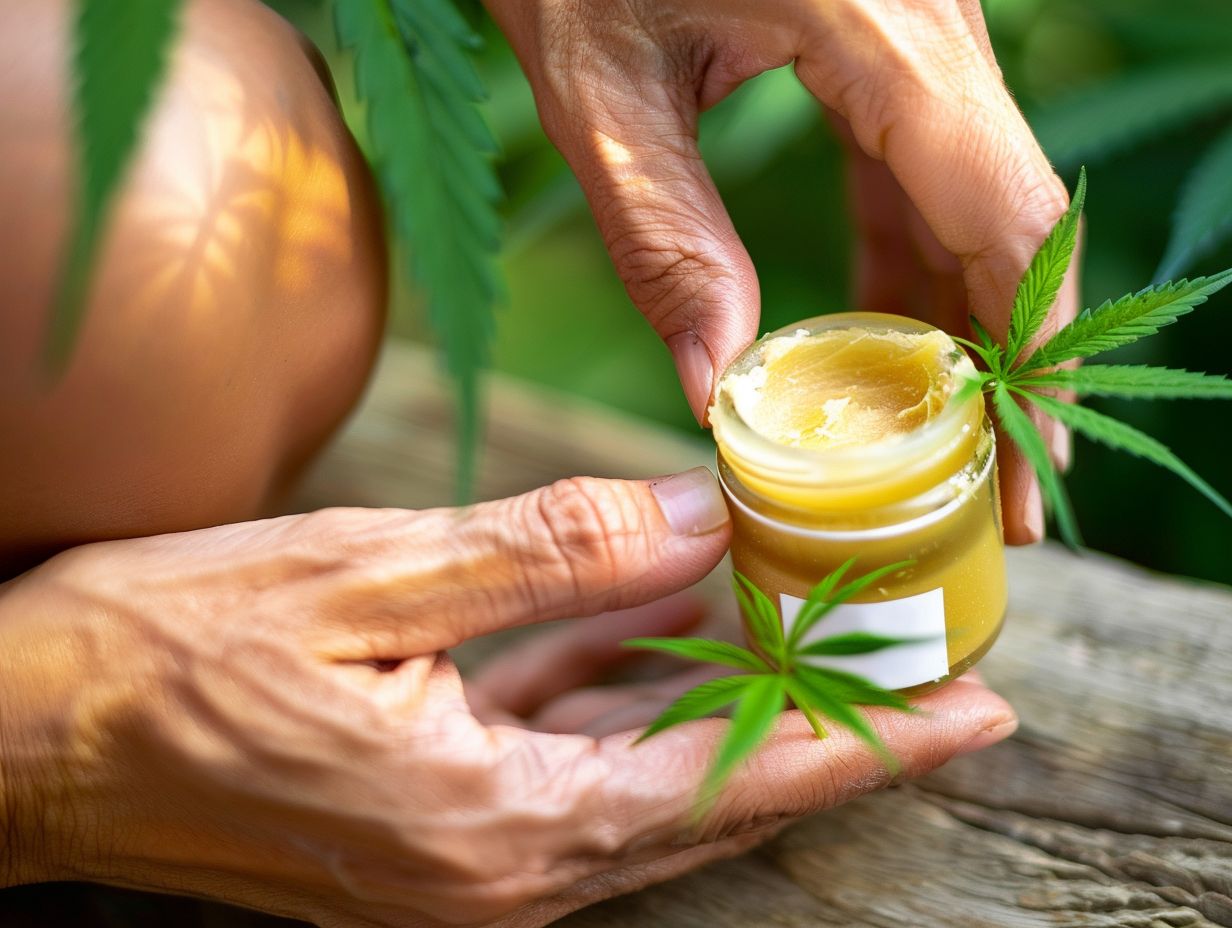
    After a knee injury, Zach Carney used a CBD cream to ease his pain. He found that applying the cream to a small area twice daily helped.

    The topical application of CBD interacts with the endocannabinoid system to lower inflammation, ease stress and support sleep and balance. Rubbing CBD cream directly on the skin helps alleviate muscle and joint pain.

    Continue reading How Does CBD Cream Ease Inflammation?
    Posted on

    Hemp industry of Tennessee makes last-minute bid to preserve their industry

    In December 2024, Tennessee’s hemp industry faced a significant challenge due to new state regulations. The Tennessee Department of Agriculture introduced rules set to take effect on December 26, 2024, aiming to ban the sale of certain hemp products that had been legally available since 2019.

    Continue reading Hemp industry of Tennessee makes last-minute bid to preserve their industry
    Posted on

    Oregon’s Recriminalization of Drugs: A Step Back or Necessary Adjustment?

    We here at Quiet Monk wanted to take a look at what’s going on in Oregon. After three years of decriminalization, Oregon reinstated laws earlier this year that criminalize personal possession of all drugs. Lawmakers describe it as a necessary response to rising overdoses, homelessness, and crime, particularly in urban areas like Portland.

    With recriminalization in effect, possessing even small amounts of drugs can now result in jail time. However, critics view this move as regressive, arguing that instead of reversing decriminalization, Oregon should focus on practical measures to address overdoses and crime.

    Continue reading Oregon’s Recriminalization of Drugs: A Step Back or Necessary Adjustment?
    Posted on

    Exploring the Science of CBD: Benefits for Pain, Anxiety, Insomnia, and More

    Cannabis and hemp plants are rich in cannabinoids—nearly 100 of them, to be precise. Among these, THC and CBD take center stage. As research into these compounds expands, CBD, in particular, is proving to be effective in addressing numerous health conditions.

    Continue reading Exploring the Science of CBD: Benefits for Pain, Anxiety, Insomnia, and More
    Posted on

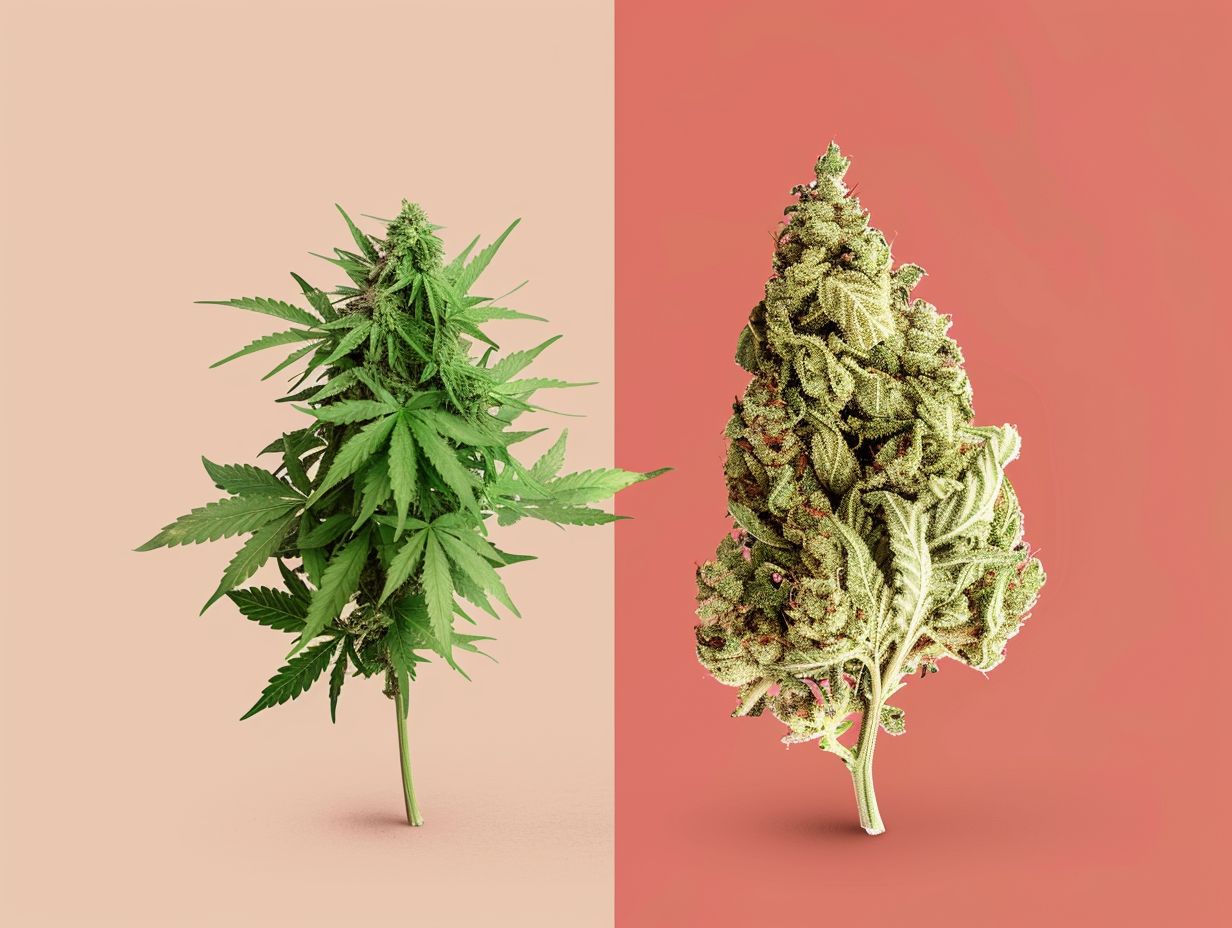
    CBG vs CBD What’s the Difference

                                    As the field of cannabinoids continues to evolve, cannabigerol (CBG) and cannabidiol (CBD) are increasingly recognized for their potential therapeutic benefits. 

    While both compounds originate from the cannabis plant, they exhibit significant differences in their chemical structures, effects on the human body, and medical applications.

    This article examines these distinctions, explores their respective medical uses, and addresses potential side effects, legal considerations, and guidance for selecting the most appropriate option based on individual needs.

    Continue reading CBG vs CBD What’s the Difference
    Posted on

    How Long Do Edible Gummies Take To Expire

    edible CBD gummies

    Expiration dates can often be a source of confusion, particularly when it pertains to edible gummies. For enthusiasts of these confections, it is crucial to understand their shelf life in order to enjoy them safely and at their optimal quality. This article aims to clarify the meaning of expiration dates, examine the factors that affect the longevity of gummies, and identify the signs that indicate they may have deteriorated. Additionally, this article will provide recommendations on proper storage and handling techniques to help maximize freshness. Continue reading to ensure that your gummies remain a pleasurable treat.

    Continue reading How Long Do Edible Gummies Take To Expire
    Posted on

    Understanding Terpenes: What They Do and Why They Matter

    Terpenes are natural compounds found in plants, responsible for their unique aromas and flavors. While terpenes are best known for giving plants like cannabis, lavender, and citrus fruits their distinctive scents, they also have various therapeutic effects. In this article, we’ll explore what terpenes do, how they work, and why they are gaining popularity in wellness and health products.

    Continue reading Understanding Terpenes: What They Do and Why They Matter
    Posted on

    NCAA Votes to Remove Cannabis from Banned Substances List

    The NCAA’s Landmark Decision: Removing Cannabis from its List of Prohibited Substances for Division I Players The National Collegiate Athletic Association (NCAA) has long been the governing body of college sports in the United States, overseeing the athletic programs of many colleges and universities. Over the years, the NCAA has implemented various policies aimed at maintaining the integrity of sports and ensuring the well-being of student-athletes. One such policy has been the prohibition of certain substances, including cannabis. However, a recent and historic decision by the NCAA to remove cannabis from its list of prohibited substances for Division I players, effective immediately, marks a significant shift in the landscape of collegiate athletics and substance regulation. This blog delves into the details of this decision, exploring its implications for athletes, the rationale behind the change, and the broader societal context that has influenced this move. A Historic Decision: The NCAA’s Cannabis Policy Change The NCAA’s decision to remove cannabis from its list of prohibited substances for Division I athletes is monumental, not just for the organization but for the broader sports community. For decades, cannabis has been classified as a banned substance under NCAA regulations, with student-athletes facing suspensions and other penalties if they tested positive. This policy was in line with federal laws and societal views that classified cannabis alongside more harmful and addictive substances. However, recent years have seen a significant shift in public opinion and legal frameworks regarding cannabis. The NCAA’s decision reflects this change, acknowledging that cannabis is no longer viewed in the same light as it was decades ago. This decision does not only impact the athletes directly but also sends a message about the evolving understanding of cannabis and its role in society. The Rationale Behind the Decision The decision to remove cannabis from the NCAA’s list of prohibited substances did not come overnight. It was the result of extensive research, debate, and reflection within the organization. Several key factors contributed to this historic change: Evolving Public Opinion and Legalization Trends: Over the past decade, there has been a significant shift in public opinion regarding cannabis. What was once seen as a dangerous drug is now legal for medicinal use in most states and for recreational use in an increasing number of states. This shift in public perception has been driven by a growing body of research highlighting the potential medicinal benefits of cannabis, as well as its relatively low risk compared to other substances like alcohol and tobacco. The NCAA recognized that continuing to ban a substance that is legal in many states where its member schools are located would be increasingly difficult to justify. This discrepancy between state laws and NCAA regulations created confusion and inconsistency in enforcement, leading to calls for reform. Medical Research and Understanding of Cannabis: Scientific research has shown that cannabis can have a range of therapeutic benefits, particularly in managing pain, anxiety, and other conditions that are common among athletes. Unlike opioids and other pain management drugs, cannabis has a lower risk of addiction and overdose. The NCAA’s decision reflects a growing recognition of the importance of evidence-based policy. By aligning their regulations with the latest scientific understanding, the NCAA is prioritizing the health and well-being of its athletes. Advocacy from Athletes and Stakeholders: Many athletes and advocates have long argued that the NCAA’s cannabis ban was outdated and overly punitive. They pointed out that cannabis is less harmful than other substances that were not banned by the NCAA, such as alcohol and prescription painkillers. Over the years, several high-profile athletes have been penalized for cannabis use, leading to widespread criticism of the policy. Advocacy from these athletes, along with support from medical professionals and other stakeholders, played a crucial role in pushing the NCAA to reconsider its stance. Implications for Division I Athletes The removal of cannabis from the NCAA’s list of prohibited substances has far-reaching implications for Division I athletes. This decision will affect various aspects of their lives, from their athletic careers to their personal health and well-being. Mental and Physical Health: One of the most significant benefits of this policy change is the potential positive impact on athletes' mental and physical health. Many athletes use cannabis for pain management, recovery, and anxiety reduction. With the removal of the ban, athletes can now use cannabis without fear of penalty, allowing them to explore alternative methods of managing their health. This change is particularly important for athletes who suffer from chronic pain or injuries. Instead of relying on prescription painkillers, which can be addictive and have harmful side effects, athletes can now use cannabis as a safer alternative. Career and Reputation: The NCAA’s previous cannabis ban often led to harsh penalties for athletes who tested positive, including suspensions and damage to their reputations. These penalties could have long-lasting effects, potentially jeopardizing professional careers and future opportunities. With the removal of the ban, athletes no longer face the risk of career-altering penalties for cannabis use. This change allows athletes to focus on their performance and development without the added stress of potential sanctions. Leveling the Playing Field: The NCAA’s decision also helps level the playing field for athletes from states where cannabis is legal. Previously, athletes from these states faced a dilemma: adhere to state laws and use cannabis legally, or comply with NCAA rules and risk penalties. This inconsistency created an unfair advantage for athletes from states where cannabis was illegal. By removing the cannabis ban, the NCAA ensures that all athletes are subject to the same rules, regardless of their state of residence. The Broader Societal Context The NCAA’s decision to remove cannabis from its list of prohibited substances cannot be viewed in isolation. It is part of a broader societal shift in the perception and legalization of cannabis. Understanding this context is crucial to fully grasp the significance of this decision. Cannabis Legalization Across the U.S.: As of 2024, cannabis is legal for recreational use in 23 states and for medicinal use in 38 states. This widespread legalization has fundamentally changed how cannabis is viewed and used in society. The NCAA’s decision reflects the reality that cannabis is no longer a fringe issue but a mainstream topic with significant public support. By aligning its policies with state laws, the NCAA is recognizing the new legal and cultural landscape surrounding cannabis. Shift in Drug Policy and Criminal Justice Reform: The removal of cannabis from the NCAA’s prohibited substances list is also in line with broader trends in drug policy reform. Across the country, there is a growing movement to decriminalize or legalize cannabis and to address the disproportionate impact of drug laws on marginalized communities. The NCAA’s decision can be seen as part of this larger effort to rethink outdated drug policies and to adopt a more compassionate and evidence-based approach to substance regulation. Impact on Other Sports Organizations: The NCAA’s decision is likely to have ripple effects across the sports world. Other sports organizations, including professional leagues, may feel pressure to reevaluate their own cannabis policies in light of this change. This decision sets a precedent that could influence how cannabis is regulated in sports at all levels, from youth leagues to professional organizations. The Path Forward: What’s Next for the NCAA and Collegiate Athletics? The decision to remove cannabis from the NCAA’s list of prohibited substances is just the beginning of what is likely to be an ongoing conversation about substance use and athlete well-being. As the NCAA moves forward, several key areas will need to be addressed: Education and Awareness: With the removal of the cannabis ban, it will be crucial for the NCAA to provide education and resources to athletes about responsible cannabis use. This includes information on the potential risks and benefits of cannabis, as well as guidance on how to use it safely and legally. The NCAA can partner with medical professionals, mental health experts, and substance use specialists to develop comprehensive educational programs for athletes, coaches, and administrators. Monitoring and Evaluation: The NCAA will need to monitor the impact of this policy change on athletes and the broader sports community. This includes tracking health outcomes, performance, and any potential issues related to cannabis use. By regularly evaluating the effects of this decision, the NCAA can make informed adjustments to its policies and ensure that the well-being of athletes remains a top priority. Policy Alignment Across Divisions: Currently, the removal of cannabis from the prohibited substances list applies only to Division I athletes. The NCAA will need to consider whether this policy should be extended to Division II and III athletes as well. Aligning policies across divisions could help create a more consistent and fair regulatory framework for all NCAA athletes. Addressing Stigma: Despite the growing acceptance of cannabis, there is still stigma associated with its use, particularly in the sports community. The NCAA will need to work to reduce this stigma and create an environment where athletes feel comfortable discussing and using cannabis without fear of judgment or discrimination. This can be achieved through public statements, educational campaigns, and by fostering open dialogue within the collegiate sports community. Conclusion: A New Era for Collegiate Athletics The NCAA’s decision to remove cannabis from its list of prohibited substances marks the beginning of a new era in collegiate athletics. This historic move reflects the changing legal and cultural landscape surrounding cannabis and demonstrates the NCAA’s commitment to evolving with the times. For Division I athletes, this decision offers new opportunities for managing their health and well-being while leveling the playing field and reducing the risk of career-altering penalties. For the broader sports community, the NCAA’s decision sets a precedent that could lead to further changes in how cannabis is regulated and perceived in sports. As the NCAA and its member institutions move forward, the focus will be on ensuring that this policy change is implemented in a way that prioritizes the health and safety of athletes. By providing education, monitoring outcomes, and addressing stigma, the NCAA can help create a more supportive

    The NCAA’s Landmark Decision: Removing Cannabis from its List of Prohibited Substances for Division I Players

    The National Collegiate Athletic Association (NCAA) has long been the governing body of college sports in the United States, overseeing the athletic programs of many colleges and universities. Over the years, the NCAA has implemented various policies aimed at maintaining the integrity of sports and ensuring the well-being of student-athletes. One such policy has been the prohibition of certain substances, including cannabis. However, a recent and historic decision by the NCAA to remove cannabis from its list of prohibited substances for Division I players, effective immediately, marks a significant shift in the landscape of collegiate athletics and substance regulation.

    Continue reading NCAA Votes to Remove Cannabis from Banned Substances List
    Posted on

    Best Way To Use CBD Oil

    Curious about CBD oil? Interested in how it’s made and the different ways it can be utilized? From sublingual and topical applications to inhalation, edibles, and capsules, there are various options worth exploring.

    Wondering what the best method is for using CBD oil? It’s essential to consider factors such as convenience, effectiveness, and personal preferences. Dive into the benefits of CBD oil, potential risks or side effects, and gain insights on how to select the right product for your needs.

    Explore recommended dosages and the timeframe required for CBD oil to take effect.

    Continue reading Best Way To Use CBD Oil
    Posted on

    Can You Take Cbd And Melatonin Together

    Are you interested in learning about the potential advantages of combining CBD and melatonin? These two supplements are known to offer various health benefits, such as reducing anxiety, alleviating stress, and enhancing sleep quality.

    Today, we will delve into the possible interactions between CBD and melatonin, offer dosage recommendations, and provide insights on the optimal methods of taking them together. Additionally, we will discuss precautions to consider when combining these two supplements.

    Let’s explore the synergistic effects of CBD and melatonin further.

    Continue reading Can You Take Cbd And Melatonin Together